TSMC steadies at 21x earnings with 73% share of foundry spending
Sub-7-nanometer processes generated 79% of the foundry's $46.72 billion in third-quarter revenue, cushioning equity declines across broader hardware benchmarks.
Taiwan Semiconductor Manufacturing Co. settled at 21 times forward earnings on Nov. 8, 2026, establishing valuation support after a 30% decline in the broader Philadelphia Semiconductor Index.
The company commands approximately 73% of global spending on contract chip manufacturing. It remains the only producer delivering commercial volumes of sub-3-nanometer logic for high-performance computing hardware.
Consolidated third-quarter revenue reached $46.72 billion, rising 41.2% from the same period last year. Advanced manufacturing nodes below 7 nanometers generated 79% of total wafer revenue during the quarter.
The 3-nanometer process accounted for 33% of wafer sales, while the newly deployed 2-nanometer node contributed 8%. The 5-nanometer family generated 28% of quarterly wafer billings, according to financial statements.
Net income for the quarter rose 68.7% from a year earlier to NT$763.06 billion ($23.59 billion). Diluted earnings per share reached NT$29.43, exceeding initial company targets, executives said.
Nvidia dropped 21% during the market decline while purchasing its entire supply of commercial AI processors from TSMC. Micron Technology lost 34% over the same stretch, settling near 4 times forward earnings.
The valuation divergence between TSMC and memory makers highlighted structural differences across semiconductor supply chains. Commodity memory suppliers face inventory adjustments when device assembly schedules shift, market analysts said.
Contract logic fabricators operate under multi-year reservation agreements that insulate revenue from short-term assembly fluctuations. Chip designers pay non-refundable reservation fees to guarantee manufacturing capacity on leading-edge production lines.
TSMC reaffirmed its full-year capital expenditure forecast of $60 billion to $64 billion for 2026. Management allocated roughly 75% of that spending plan to advanced process technologies and packaging facilities.
Gross margin fell 130 basis points from the second quarter to 66.4% in the third quarter. Initial tooling costs for the 2-nanometer production ramp and overseas expansion expenses drove the sequential margin decline.
Management guided fourth-quarter consolidated revenue to between $52.3 billion and $54.3 billion. Operating margin guidance was set at a midpoint of 57.5%, down from 58.7% recorded in the third quarter.
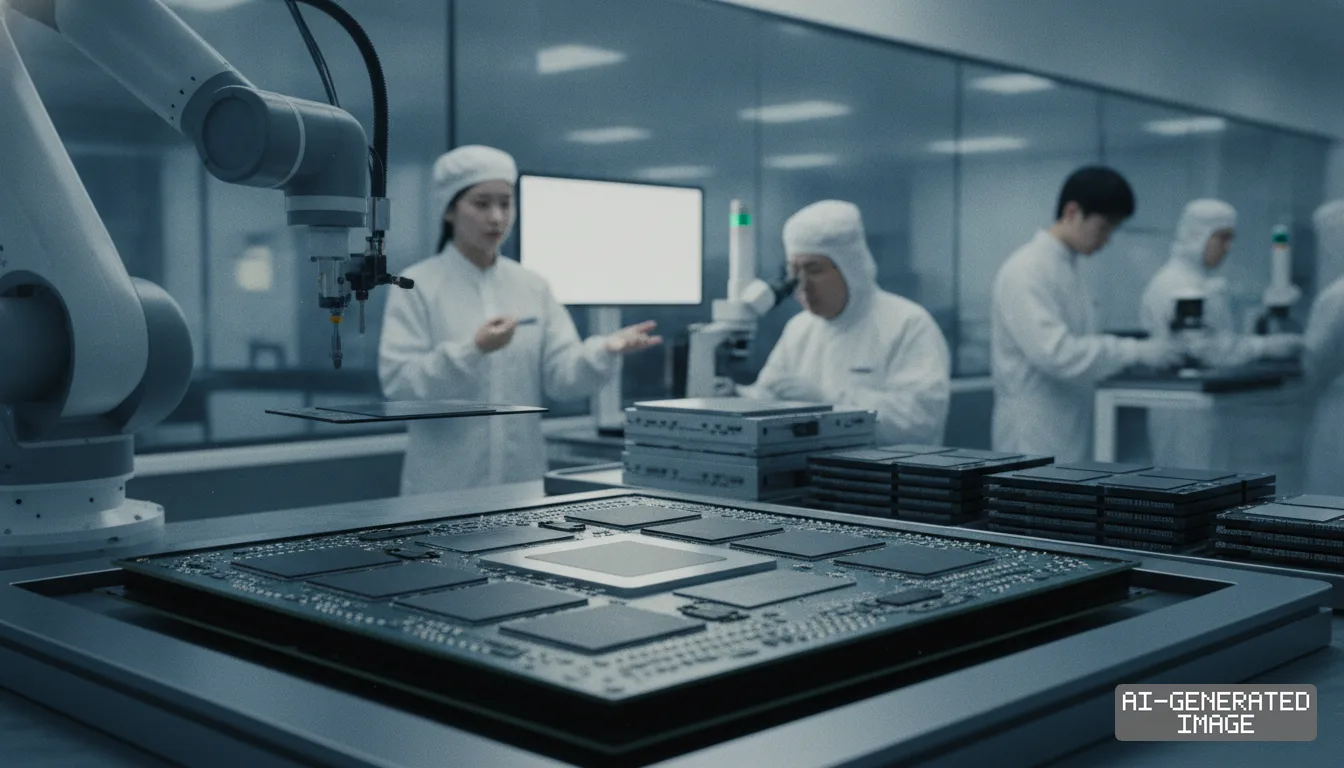
Chip on Wafer on Substrate packaging—a method attaching compute logic directly beside high-bandwidth memory stacks—remained sold out through late 2026. Cloud infrastructure providers booked all available packaging lines through next year.
The foundry evaluated price adjustments of 10% to 20% on advanced packaging services for production runs scheduled in 2027. Cloud infrastructure providers accepted higher assembly rates to maintain their allocated delivery schedules.
Contract prices for 2-nanometer processed silicon wafers commanded unit estimates exceeding $30,000 each. The premium pricing supported operating cash generation despite increased depreciation charges on advanced extreme ultraviolet scanners.
Intel Foundry and Samsung Electronics continued to register lower operational yields on their competing sub-3-nanometer processes. Production yield setbacks at rival foundries left artificial intelligence chip designers without secondary manufacturing sources.
Apple absorbed roughly 20% of TSMC's total production capacity, securing primary allocations for next-generation mobile silicon. The consumer hardware designer absorbed fabrication rate increases across its premium mobile processor families.
Advanced Micro Devices and Broadcom accounted for a combined 15% of advanced manufacturing orders at the Taiwanese foundry. Both chip designers confirmed steady wafer allocations for data center accelerators through the final quarter.
High-performance computing chips generated 68% of TSMC's net quarterly revenue, up from 52% two years earlier. The rising share of data center silicon counterbalanced seasonal softness in personal computers and mainstream smartphones.
Commercial output at TSMC's first semiconductor fabrication facility in Phoenix, Arizona, progressed toward scheduled production runs. Tooling expenses at the second Arizona facility remained within corporate capital projections, management said.
TSMC has not published final contract price schedules for its 2-nanometer wafers or confirmed the specific percentage increase planned for 2027 packaging contracts.
The foundry reports audited full-year 2026 financial results and announces its initial 2027 capital expenditure guidance on Jan. 14, 2027.
The Philadelphia Semiconductor Index closed at 10,600 on the final trading session of the week, following eight consecutive sessions of net equity selling.
Impact map
How this development propagates across the region and out to global buyers.
| Event | Korea | China | Japan | Global impact |
|---|---|---|---|---|
| Foundry valuation settlement | Samsung Foundry trails in 2nm yield, absorbing margin pressure | SMIC remains restricted to trailing nodes, no access to EUV tools | Tokyo Electron and packaging suppliers maintain steady tool backlogs | AI chip designers face 10-20% higher advanced packaging costs into 2027 |
In this story
- Companies
- Taiwan Semiconductor Manufacturing Co.
- Tickers
- 2330.TWTSM
- Exposed
- NvidiaMicron TechnologyAppleAdvanced Micro DevicesBroadcom
- Impact
- PricingCapexValuation
Related briefings
- SK hynix Evaluates Solidigm US IPO Amid Governance Scrutiny Also on Valuation
- Silicon interposer scaling drives foundry and OSAT shifts in 3.5D chiplets Also on Broadcom, Advanced Micro Devices, Taiwan Semiconductor Manufacturing Co
- TSMC sees 3nm revenue overtake 5nm node on surge in AI accelerators Also on Broadcom, Apple, Nvidia
- TSMC Arizona Fab Delivers 100 Million Chips for Apple Devices Also on Broadcom, Apple
Sources
Primary documents
Reporting
Confidence: high — how we grade this
The documents behind this briefing are linked above. East Asia Brief produces its English text with AI assistance under human editorial review, and does not translate or republish other outlets' articles. See our methodology and AI policy. Spotted an error? Tell us.
The Morning Brief
What changed in Korean, Chinese and Japanese industry overnight — and what it means for your supply chain. One email, weekday mornings, US time. Free.
The Morning Brief is in preparation. Leave your address and we will write to you once — when the first issue is ready. Nothing before that.