SK hynix markets liquid cooling chips to U.S. AI data centers
The supplier offered custom thermal packaging as American operators face grid pushback, with global data center power consumption forecast at 945 TWh by 2030.
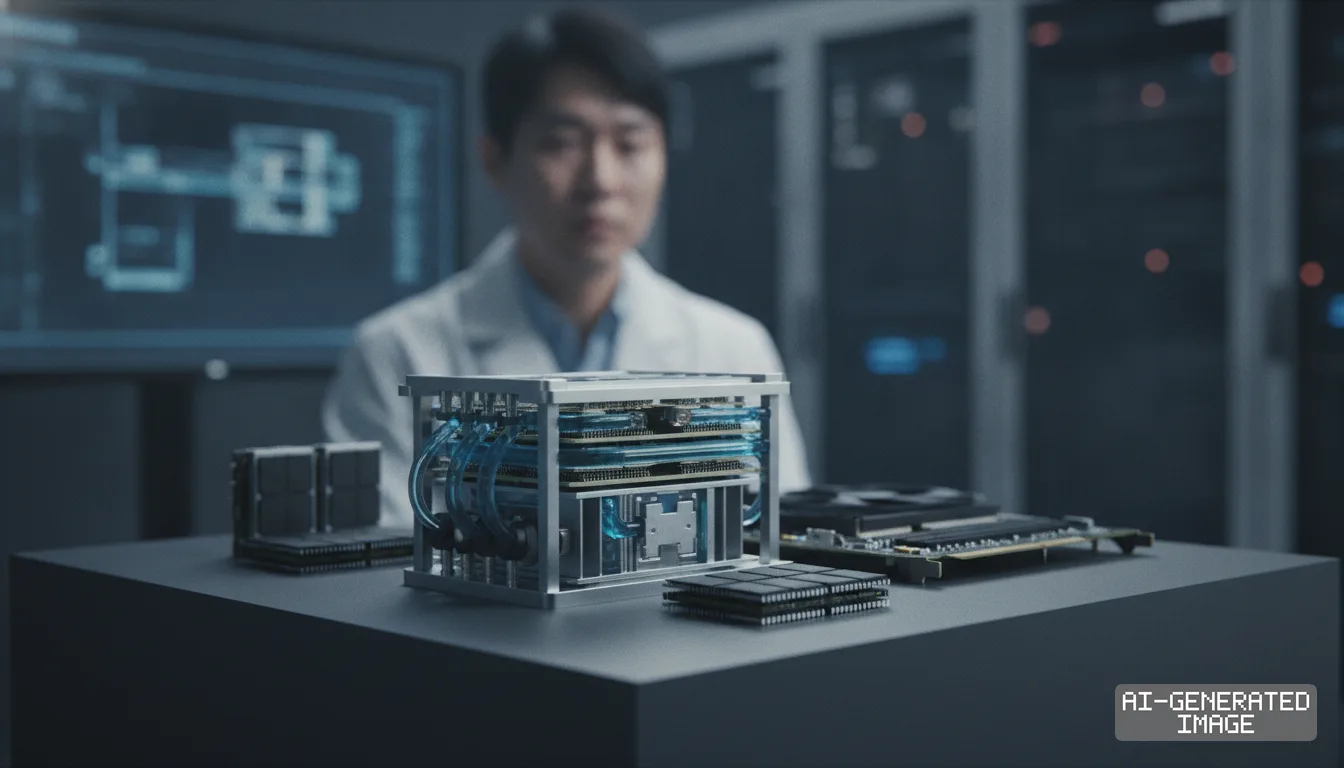
SK hynix pitched custom cooling packaging on Nov. 8 to American data center operators confronting regulatory pushback against high-density artificial intelligence server installations across regional electrical networks.
The South Korean supplier commands over 50% of the global high-bandwidth memory market, fabricating dynamic random-access memory stacks that sit directly alongside advanced graphics processors inside accelerated computing systems.
Data centers will consume 945 terawatt-hours of electricity globally by 2030, accounting for roughly 3% of global electricity demand and 75% of new American power demand additions, company disclosures show.
Nvidia draws more than 60% of its high-bandwidth memory volume from SK hynix, linking server hardware rollouts directly to the memory maker's thermal packaging yields and mechanical tolerances.
Rising compute power has pushed single AI server racks past 100 kilowatts, generating thermal loads that conventional air systems cannot dissipate without straining local grid capacity.
Municipal planners and state utility commissions across Virginia, Ohio and Georgia have slowed substation interconnections, questioning whether residential electricity customers will absorb grid reinforcement costs.
Voters approved 46 of 47 local ballot measures restricting utility capital expenditure transfers and imposing conditional moratoria on large-scale computing permits earlier this month.
The regulatory bottleneck forces cloud operators to cap total campus power draw, elevating silicon-level thermal efficiency into a commercial prerequisite for next-generation facility builds.
SK hynix unveiled its integrated high-bandwidth memory packaging architecture, designated iHBM, on May 26 to manage heat within the silicon stack.
The packaging structure embeds integrated cooling elements directly into the die-to-die physical layer, the interface connecting the base logic die to the memory stack.
Integrated cooling elements use silicon-based non-conductive materials engineered with high thermal conductivity to extract heat away from concentrated signal paths.
The structural redesign creates a direct heat dissipation path that reduces package thermal resistance by more than 30%, the company said.
Standard memory stacks route heat outward through successive core dies, creating internal hot spots that accelerate chip degradation under continuous artificial intelligence inference workloads.
SK hynix manufactures the architecture using its mass reflow molded underfill wafer-level packaging process, preserving compatibility with existing substrate assembly lines.
The company also demonstrated direct liquid cooling enterprise solid-state drives on Oct. 16 during an industry hardware summit in San Jose.
That lineup includes the PEB210 E1.S drive, designed with a 9.5-millimeter profile that routes liquid coolant directly across the drive chassis.
Liquid cooling transfers heat up to 1,000 times more efficiently than air, lowering auxiliary fan power consumption inside dense multi-node computing enclosures.
Hyperscale operators spend roughly 40% of overall data center electricity on air chillers and motorized rack ventilation units.
Lowering server-level thermal resistance allows operators to pack more compute density under fixed regional substation allocations without breaching local utility power limits.
Domestic competitors have accelerated parallel development of packaging heat spreaders and hybrid bonding techniques to prevent SK hynix from locking down next-generation memory sockets.
Samsung Electronics supplies high-bandwidth memory to hyperscale buyers and maintains an alternative thermal packaging lineup using integrated heat spreaders.
Taiwan Semiconductor Manufacturing Company provides the underlying CoWoS advanced packaging lines where SK hynix memory stacks combine with host processors.
A single 30-gigawatt shortfall in projected annual American grid expansions could delay dozens of multi-billion-dollar campus developments over the next four years.
Cloud providers face rising electricity tariffs and interconnection queues extending up to seven years in primary data center hubs.
Thermal chip redesigns shift the capital burden of energy conservation from exterior plant equipment to component-level silicon packaging.
The company plans to apply the integrated cooling architecture to commercial HBM5 production lines scheduled to begin sampling in 2027.
State utility commissions in Virginia and Ohio will hold public hearings on revised data center interconnection rate structures on Dec. 15.
The notice does not state whether commercial hyperscalers have signed binding supply agreements for the liquid-cooled solid-state drive modules.
SK hynix closed down 1.8% at 182,500 won in Seoul trading on Friday.
Impact map
How this development propagates across the region and out to global buyers.
| Event | Korea | China | Japan | Global impact |
|---|---|---|---|---|
| AI data center power scrutiny | SK hynix leverages 30% thermal packaging reduction to defend 50% HBM market share | Domestic cloud providers operate under stricter air-cooling power usage constraints | Advanced packaging substrate vendors see order shifts toward liquid-cooled form factors | Cloud operators redesign hyperscale server racks to avoid regional grid connection delays |
In this story
- Companies
- SK hynix
- Tickers
- 000660.KS
- Exposed
- NvidiaSamsung Electronics
- Policy
- Standards
- Impact
- Supply ChainCapexCost Structure
Track every Standards development →
Related briefings
- HANMI Semiconductor posts 50% operating margin on HBM bonder demand Also on Standards, Nvidia, SK hynix
- Intel pits EMIB-T packaging against TSMC to win AI chip orders Also on Nvidia, SK hynix, Samsung Electronics
- GlobalFoundries signs $2 billion TSMC chip interposer deal Also on Nvidia, SK hynix, Samsung Electronics
- GlobalFoundries signs $2B TSMC packaging deal for AI chips Also on Nvidia, SK hynix, Samsung Electronics
Sources
Primary documents
Reporting
Confidence: high — how we grade this
The documents behind this briefing are linked above. East Asia Brief produces its English text with AI assistance under human editorial review, and does not translate or republish other outlets' articles. See our methodology and AI policy. Spotted an error? Tell us.
The Morning Brief
What changed in Korean, Chinese and Japanese industry overnight — and what it means for your supply chain. One email, weekday mornings, US time. Free.
The Morning Brief is in preparation. Leave your address and we will write to you once — when the first issue is ready. Nothing before that.