Samsung cash reserves top $157 billion on semiconductor profits
Liquid balances reached a record 214.8 trillion won through September, leaving the company with 197.6 trillion won in net cash to fund advanced fab construction.
Samsung Electronics reached 214.8 trillion won ($157.5 billion) in cash and liquid assets on Nov. 8, 2026, marking the first time a South Korean company has crossed the 200-trillion-won threshold.
The liquid balance rose 24.8 trillion won from 190 trillion won at the end of June. The total nearly doubled from 108.5 trillion won recorded a year earlier, regulatory filings showed.
Net cash after subtracting 17.2 trillion won in outstanding debt reached 197.6 trillion won. Total assets expanded to 791.84 trillion won, which reduced the company's debt-to-equity ratio to 29% from 31%.
Cash expansion accelerated as quarterly operating profit climbed to 107.4 trillion won on consolidated revenue of 195.3 trillion won. Cash flow generated from operating activities during the third quarter alone reached 98.6 trillion won.
The Device Solutions division accounted for 106.5 trillion won of consolidated operating profit on revenue of 147.1 trillion won. Strong enterprise demand for server dynamic random-access memory drove sharp pricing gains across memory categories, the company said.
Memory shipments expanded around high-density server solid-state drives and sixth-generation high-bandwidth memory, known as HBM4. Tight production capacity across the wider memory market supported wider operating margins throughout the summer quarter.
Samsung Electronics increased its planned capital expenditures for 2026 to 84.4 trillion won. That level represents a 60% expansion over the 52.7 trillion won in capital spending executed during 2025.
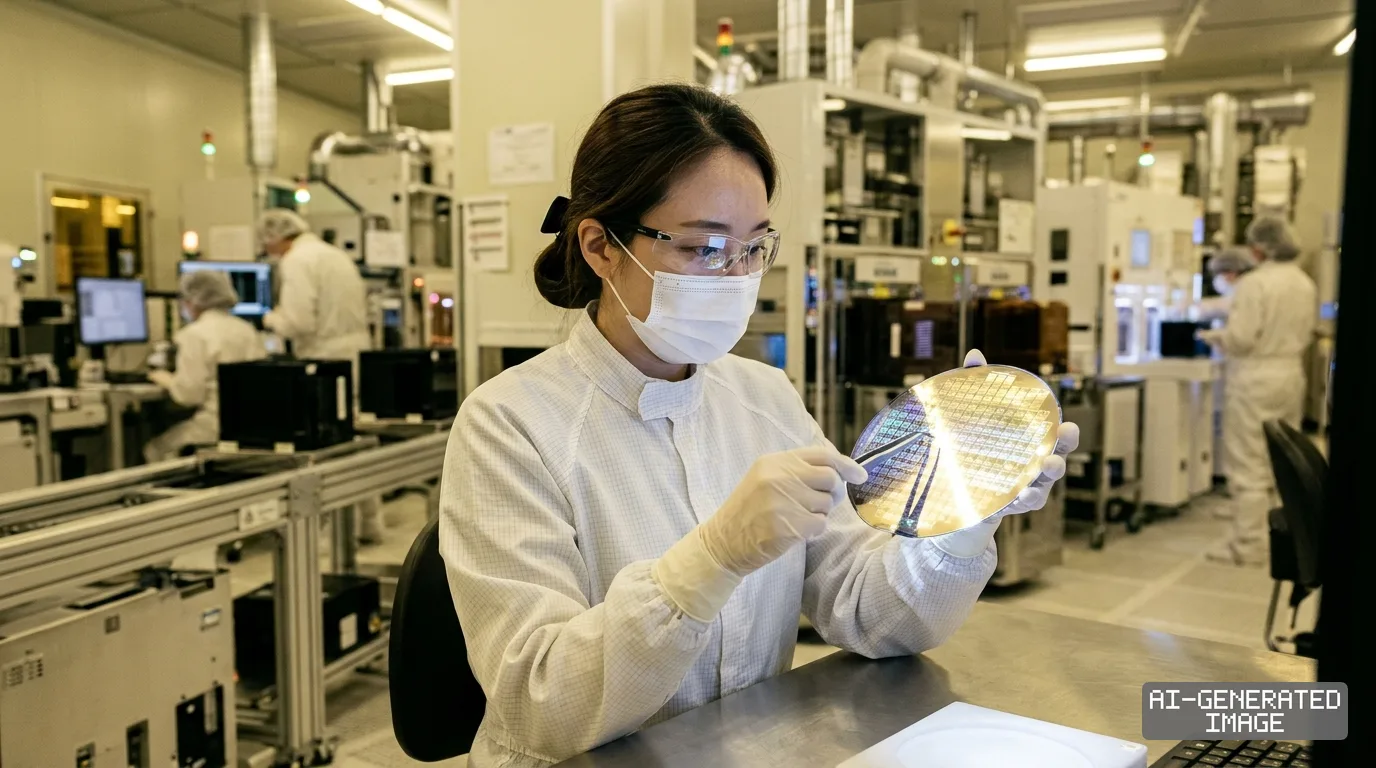
The chipmaker allocated 76.8 trillion won, or 91% of its total investment budget, directly to the semiconductor division. The capital program finances fab shell preparation, cleanroom expansion and advanced packaging lines.
Domestic capital outlays focus on wafer fabrication facilities in Pyeongtaek and site work at the Yongin semiconductor cluster. Samsung Electronics designated both locations to handle volume ramp-ups for advanced memory architectures.
Overseas investments center on the company's fabrication facility in Taylor, Texas. The funds support installation of extreme ultraviolet lithography systems and initial cleanroom outfitting for sub-two-nanometer foundry processing.
The company also expanded outlays for advanced packaging infrastructure. Packaging lines use through-silicon vias—vertical electrical connections through silicon dies—to stack multiple memory chips directly atop host graphics processors.
Research and development spending reached 41.7 trillion won through the first nine months of 2026. Full-year research allocations are projected to surpass 50 trillion won, lifting combined annual development and equipment spending above 130 trillion won.
The expanded treasury reserve provides capital for potential corporate acquisitions in semiconductor supply chains. Analysts expect future targets could include specialized materials refiners, precision motion control vendors or advanced testing toolmakers.
Samsung Electronics committed to return between 90 trillion won and 110 trillion won to shareholders during 2026. The company distributed 35 trillion won through the third quarter, leaving between 55 trillion won and 75 trillion won for year-end execution.
Shareholder distributions combine regular cash dividends with open-market share repurchases and cancellations. The corporate framework allocates approximately 50% of free cash flow toward shareholder payouts.
Equipment suppliers face larger booking schedules under the expanded investment framework. Domestic sub-tier toolmakers and Japanese etching specialists prepare delivery pipelines to match cleanroom construction deadlines across South Korea and the United States.
The regulatory filings do not state whether Samsung Electronics has reserved specific cash allocations for corporate buyouts, and the company has not published target lists for semiconductor materials or packaging assets.
The company board meets in late January 2027 to finalize the scale of remaining shareholder distributions. That meeting will also determine initial capital expenditure allocations for fiscal year 2027.
Impact map
How this development propagates across the region and out to global buyers.
| Event | Korea | China | Japan | Global impact |
|---|---|---|---|---|
| Cash reserve surge | Samsung Electronics directs 76.8 trillion won capex to memory and foundry lines | Domestic memory fabs face widening capex gap with Korean leaders | Japanese etching and packaging equipment suppliers see expanded tool orders | AI server supply chains secure higher HBM4 volume commitments for 2027 |
In this story
- Companies
- Samsung Electronics
- Tickers
- 005930.KS
- Impact
- CapexSupply Chain
Related briefings
- SK hynix markets liquid cooling chips to U.S. AI data centers Also on Samsung Electronics
- Samsung and LG recruit foreign specialists for robot automation Also on Samsung Electronics
- Beijing targets Samsung $59 billion outlay to secure tech supply Also on Samsung Electronics
- Foreign investors cut Samsung stake to 17-year low of 45.95% Also on Samsung Electronics
Sources
Reporting
Confidence: medium — how we grade this
The documents behind this briefing are linked above. East Asia Brief produces its English text with AI assistance under human editorial review, and does not translate or republish other outlets' articles. See our methodology and AI policy. Spotted an error? Tell us.
The Morning Brief
What changed in Korean, Chinese and Japanese industry overnight — and what it means for your supply chain. One email, weekday mornings, US time. Free.
The Morning Brief is in preparation. Leave your address and we will write to you once — when the first issue is ready. Nothing before that.