Korean power gear makers book grid orders on US fab growth
Surging battery storage deployments and grid bottlenecks across North America lift combined order backlogs at South Korea's three major electrical equipment suppliers past 36 trillion won.
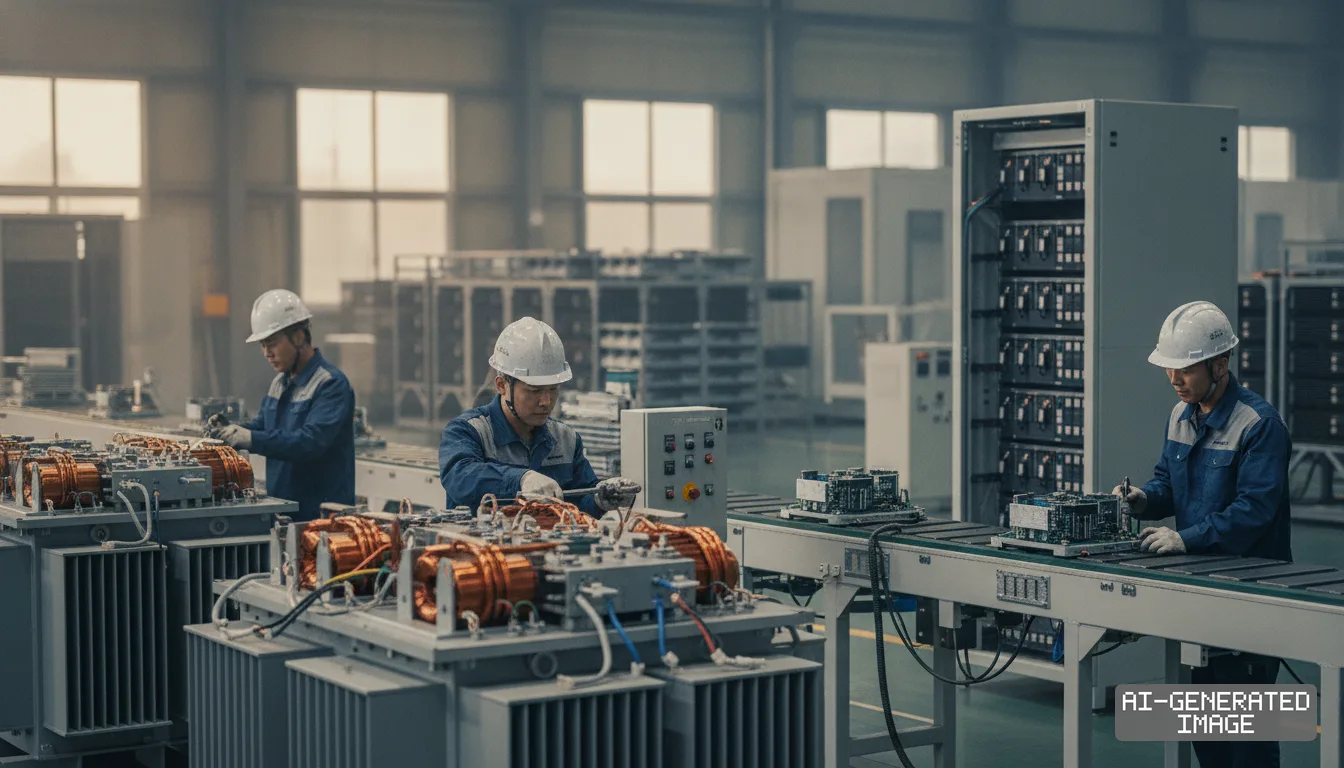
The Korea Trade-Investment Promotion Agency reported Sept. 27 that surging North American battery storage installations are driving secondary equipment orders across South Korean transformer and distribution gear manufacturers.
United States data center electricity demand will jump from 52 gigawatts in 2025 to 115 gigawatts by 2030, the agency stated. That expansion represents a 121% surge in regional power requirements over five years.
Grid congestion forces utility operators to install battery energy storage systems alongside new substations. The resulting secondary hardware procurements are extending factory backlogs for high-voltage transformers and switchgear equipment.
The agency noted that renewable generation adds grid volatility. Combined solar and wind shares will rise from 18% of total United States generation in 2025 to 21% by 2027.
South Korean battery cell manufacturers are expanding domestic and joint-venture production lines in North America to meet that requirement. Those battery plants require dedicated power conversion systems and distribution networks.
South Korean electrical equipment suppliers are booking orders for the step-up transformers, inverters and distribution switchboards that connect battery storage blocks to high-voltage transmission lines.
HD Hyundai Electric booked an order backlog of $8.49 billion at the end of the second quarter. North American utilities accounted for $2.17 billion of new contracts during the first half, equal to 67% of total intake.
That order cushion covers more than three years of transformer production for HD Hyundai Electric. North American utility customers are signing multi-year agreements to secure transformer deliveries stretching into 2030.
Hyosung Heavy Industries carried an order backlog of 17.5 trillion won ($13.1 billion) at the end of June. The United States represents 57% of that total backlog.
Hyosung operates a manufacturing plant in Memphis, Tennessee, producing 765-kilovolt ultra-high-voltage transformers. The company supplies nearly half of all 765-kilovolt transformers operating across the United States transmission network.
LS ELECTRIC reported an accumulated North American order backlog surpassing 7 trillion won ($5.2 billion) in August. That includes 3.35 trillion won in ultra-high-voltage transformers and 2.0 trillion won in switchgear.
The company signed a $34.26 million (48.6 billion won) agreement Aug. 18 with Bloom Energy to deliver low-voltage power distribution equipment to a hyperscale data center in Wyoming.
Battery cell manufacturers are aligning factory output directly with United States grid and computing requirements. LG Energy Solution announced Sept. 22 that its JF2 AC Link storage system qualified for Nvidia's DSX Ready program.
The qualification covers modular 2.5-megawatt battery blocks using lithium iron phosphate chemistry. The units incorporate power conversion systems designed for grid-forming operations and server power smoothing.
LG Energy Solution confirmed plans to secure more than 50 gigawatt-hours of battery energy storage manufacturing capacity across five North American operating sites by the end of 2026.
Those regional facilities include wholly owned plants in Michigan as well as joint-venture sites in Canada, Ohio and Tennessee. Local cell manufacturing allows downstream customers to qualify for federal clean power tax incentives.
United States trade policy is accelerating the transition toward non-Chinese power equipment and energy storage suppliers. Section 301 tariffs on Chinese lithium-ion battery storage cells rise to 25% on Jan. 1, 2026, up from 7.5%.
Clean electricity investment tax credits under Section 48E will exclude battery projects starting construction after Dec. 31, 2025, if they source components from prohibited foreign entities.
Korean suppliers captured 23.9% of United States medium-to-large liquid-insulated transformer imports in 2025, valued at $2.1 billion. They supplied 18.1% of high-capacity transformer imports, worth $4.0 billion.
Korean manufacturers also captured 19.0% of medium-voltage power cable imports, representing $2.0 billion in trade value. Lithium-ion battery cell imports from South Korea reached $19.7 billion, taking an 11.4% import share.
South Korean regulatory filings do not record a single discrete procurement contract executed on Sept. 27, 2026, by domestic battery cell makers for secondary power distribution hardware.
Equipment deliveries under the LS ELECTRIC agreement with Bloom Energy in Wyoming are scheduled to run through June 2027. The trade agency will host procurement consultations in Detroit on Oct. 28 to connect equipment suppliers with regional utility operators.
Impact map
How this development propagates across the region and out to global buyers.
| Event | Korea | China | Japan | Global impact |
|---|---|---|---|---|
| US grid bottlenecks and battery fab expansion | Equipment makers hold over 36 trillion won in backlogs; LG Energy Solution targets 50 GWh US storage capacity | Chinese storage cell makers face 25% Section 301 tariffs starting Jan. 1, 2026 | Hitachi Energy shares US high-voltage transformer market and Nvidia DSX certification | Lead times for heavy power transformers extend past three years through 2028 |
In this story
- Companies
- HD Hyundai ElectricHyosung Heavy IndustriesLS ELECTRICLG Energy Solution
- Tickers
- 267260.KS298040.KS010120.KS373220.KS
- Exposed
- Bloom EnergyNvidia
- Policy
- TariffsTax Credits
- Impact
- Order BookSupply ChainPricing
Track every Tariffs development → Track every Tax Credits development →
Related briefings
- HD Hyundai Electric holds top US transformer market share at $8.5B Also on Hyosung Heavy Industries, HD Hyundai Electric, LS Electric
- HD Hyundai Electric ships Baltic offshore wind transformers Also on HD Hyundai Electric, Pricing, Order Book
- Korea Food Plants Deploy Delta Robots to Counter Cold-Chain Labor Churn Also on LS ELECTRIC
- CATL lists 587Ah storage cells online to reset grid pricing at $65/kWh Also on Tax Credits, LG Energy Solution, Tariffs
Sources
Primary documents
Reporting
Confidence: high — how we grade this
The documents behind this briefing are linked above. East Asia Brief produces its English text with AI assistance under human editorial review, and does not translate or republish other outlets' articles. See our methodology and AI policy. Spotted an error? Tell us.
The Morning Brief
What changed in Korean, Chinese and Japanese industry overnight — and what it means for your supply chain. One email, weekday mornings, US time. Free.
The Morning Brief is in preparation. Leave your address and we will write to you once — when the first issue is ready. Nothing before that.