CATL lists 587Ah storage cells online to reset grid pricing at $65/kWh
The battery maker posted a wholesale spot price of 0.415 yuan per watt-hour on CATL Mall, widening direct access for mid-tier integrators while raising older cell rates.
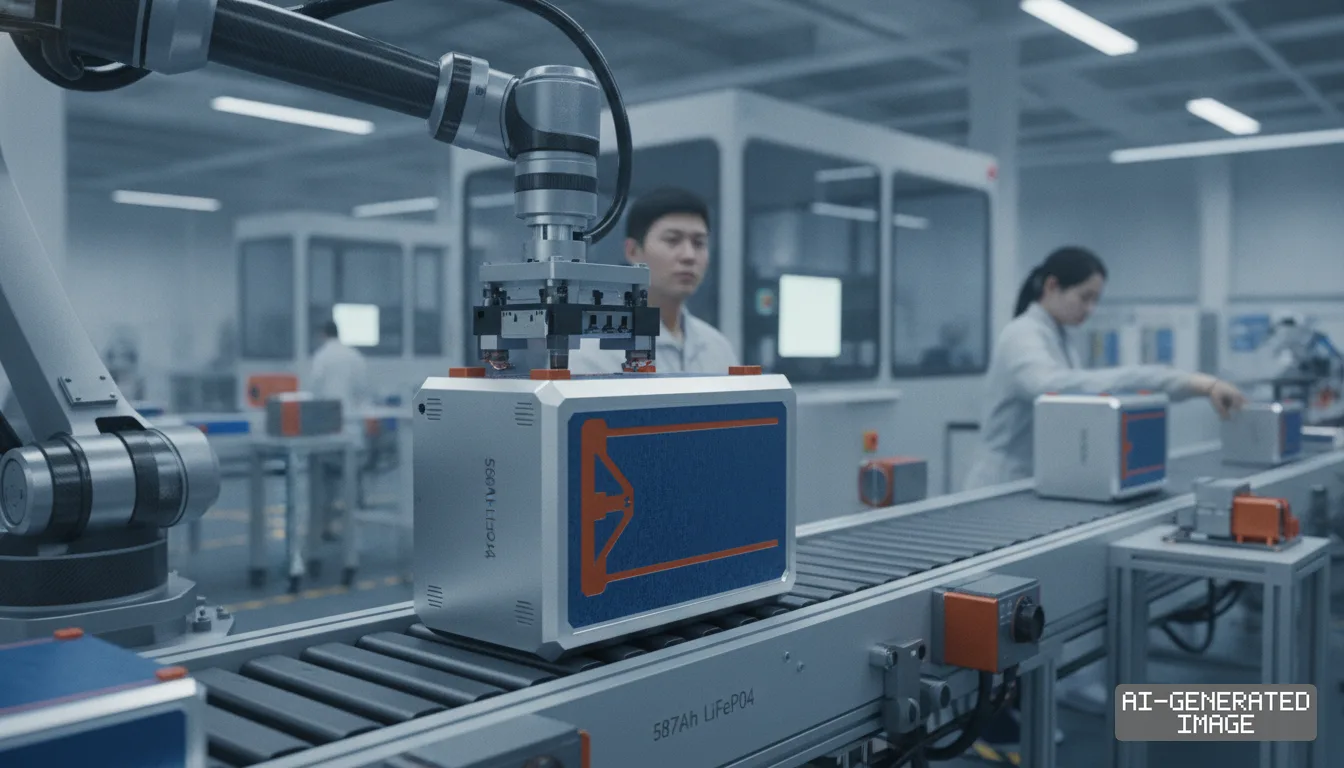
Contemporary Amperex Technology revised wholesale prices across its energy storage battery lineup on Sept. 22, 2026, listing its high-capacity 587Ah cells for direct online purchase.
The company posted the 587Ah lithium iron phosphate cell on its CATL Mall platform at 0.415 yuan ($0.065) per watt-hour. That rate equals roughly $65 per kilowatt-hour for utility buyers.
A minimum order of 324 units costs approximately 265,000 yuan ($39,500). The batch yields 608 kilowatt-hours of storage, equivalent to roughly 0.5% of a standard 100-megawatt-hour grid installation.
The listing marks the first time CATL opened spot procurement for the 587Ah format to smaller integrators. The battery maker previously reserved the product for multi-gigawatt utility developers under closed contracts.
CATL first unveiled the 587Ah cell in June 2025 at an engineering event in Shanghai. The company integrated the format into its TENER container systems, which pack 6.25 megawatt-hours into a 20-foot enclosure.
Cumulative shipments of the 587Ah cell topped 2 gigawatt-hours by December 2025, according to company production records. The company manufactures the units at its Jining facility in Shandong province.
The factory runs a daily throughput exceeding 220,000 cells on dedicated lines. Each 587Ah unit delivers an energy density of 434 watt-hours per liter and an initial conversion efficiency of 96.5%.
CATL adjusted rates across its legacy storage inventory alongside the new listing. The platform lifted 280Ah cells by 1.1% to 0.470 yuan per watt-hour, the company confirmed on Sept. 21.
The price of 314Ah cells rose 2.0% to 0.403 yuan per watt-hour. The adjustments reflect higher input overhead and routine dynamic pricing policies, CATL said in a statement.
China imposed a 2% consumption tax on domestic battery shipments on Sept. 1, 2026. The tax prompted cell manufacturers across the country to recalculate baseline wholesale tariffs.
Competitor EVE Energy added a 2% surcharge across its commercial cell catalog in early September. The move passed the domestic fiscal levy directly through to system integrators.
CATL shipped 121 gigawatt-hours of energy storage batteries in 2025, according to its annual filing. That volume accounted for 18% of its 661 gigawatt-hours of total battery output.
The company generated 62.4 billion yuan ($8.6 billion) from storage systems in 2025. That revenue represented 14.7% of its annual corporate turnover of 423.7 billion yuan.
The new wholesale floor sets an aggressive pricing benchmark for international grid developers. Overseas power producers increasingly base procurement tenders on spot price indexes published in China.
South Korean manufacturers face mounting competitive exposure in the utility storage market. Korean cell makers rely on nickel-rich chemistries that carry production costs roughly 30% above Chinese iron-phosphate alternatives.
LG Energy Solution derives roughly 12% of its battery sales from stationary grid storage. The Seoul-based manufacturer is converting 30 gigawatt-hours of cell capacity to iron-phosphate production to defend utility accounts.
Samsung SDI generates about 8% of its energy revenue from stationary power projects. The company began sampling prismatic iron-phosphate storage cells this year to blunt Chinese market gains.
CATL held 36.5% of the worldwide energy storage cell market in 2024, according to SNE Research. Its manufacturing scale allows the producer to compress unit packaging costs below rival reach.
By packing 587Ah cells into 6.25-megawatt-hour containers, developers reduce balance-of-plant wiring and container counts by 20%. That structural saving cuts engineering expenses for utility substations.
The online portal still requires buyers to hold a valid Chinese corporate registration. Foreign developers must purchase units through domestic intermediaries or local subsidiaries to access the spot quote.
Grid equipment vendors will review fourth-quarter procurement schedules on Oct. 15, 2026. That milestone will test whether international component buyers accept the higher tax-adjusted rates for older cells.
CATL has not published bilateral supply contract pricing for utility developers such as HyperStrong. The company keeps multi-year terms confidential, leaving the discount gap between spot lots and multi-gigawatt orders unconfirmed.
Impact map
How this development propagates across the region and out to global buyers.
| Event | Korea | China | Japan | Global impact |
|---|---|---|---|---|
| CATL 587Ah online listing | LG Energy Solution and Samsung SDI face 30% cost gap on utility LFP orders | CATL and EVE Energy pass 2% domestic battery consumption tax to integrators | Utilities shield procurement via long-term deals but face higher container import benchmarks | Utility battery container BOM falls roughly 20% on reduced wiring and enclosure count |
In this story
- Companies
- Contemporary Amperex Technology
- Tickers
- 300750.SZ3750.HK
- Exposed
- LG Energy SolutionSamsung SDIEVE Energy
- Policy
- TariffsTax Credits
- Impact
- PricingSupply ChainOrder Book
Track every Tariffs development → Track every Tax Credits development →
Related briefings
- CATL holds 314Ah storage cell prices steady at 0.423 yuan Also on EVE Energy, Samsung SDI, LG Energy Solution
- CATL opens direct online sales of 587Ah cells at $65 per kWh Also on EVE Energy, Samsung SDI, LG Energy Solution
- CATL tops 15 Chinese automakers combined in first-half profits Also on EVE Energy, Contemporary Amperex Technology, Pricing
- Chinese EVs capture 35% Korea market share under 8% tariff Also on Tax Credits, Samsung SDI, LG Energy Solution
Sources
Reporting
Confidence: medium — how we grade this
The documents behind this briefing are linked above. East Asia Brief produces its English text with AI assistance under human editorial review, and does not translate or republish other outlets' articles. See our methodology and AI policy. Spotted an error? Tell us.
The Morning Brief
What changed in Korean, Chinese and Japanese industry overnight — and what it means for your supply chain. One email, weekday mornings, US time. Free.
The Morning Brief is in preparation. Leave your address and we will write to you once — when the first issue is ready. Nothing before that.