China curbs tunnel boring machine exports ahead of Nov. 18
The commerce ministry mandate covers cutterheads, drive systems and walking excavators, threatening metro and border tunneling projects across India and Southeast Asia.
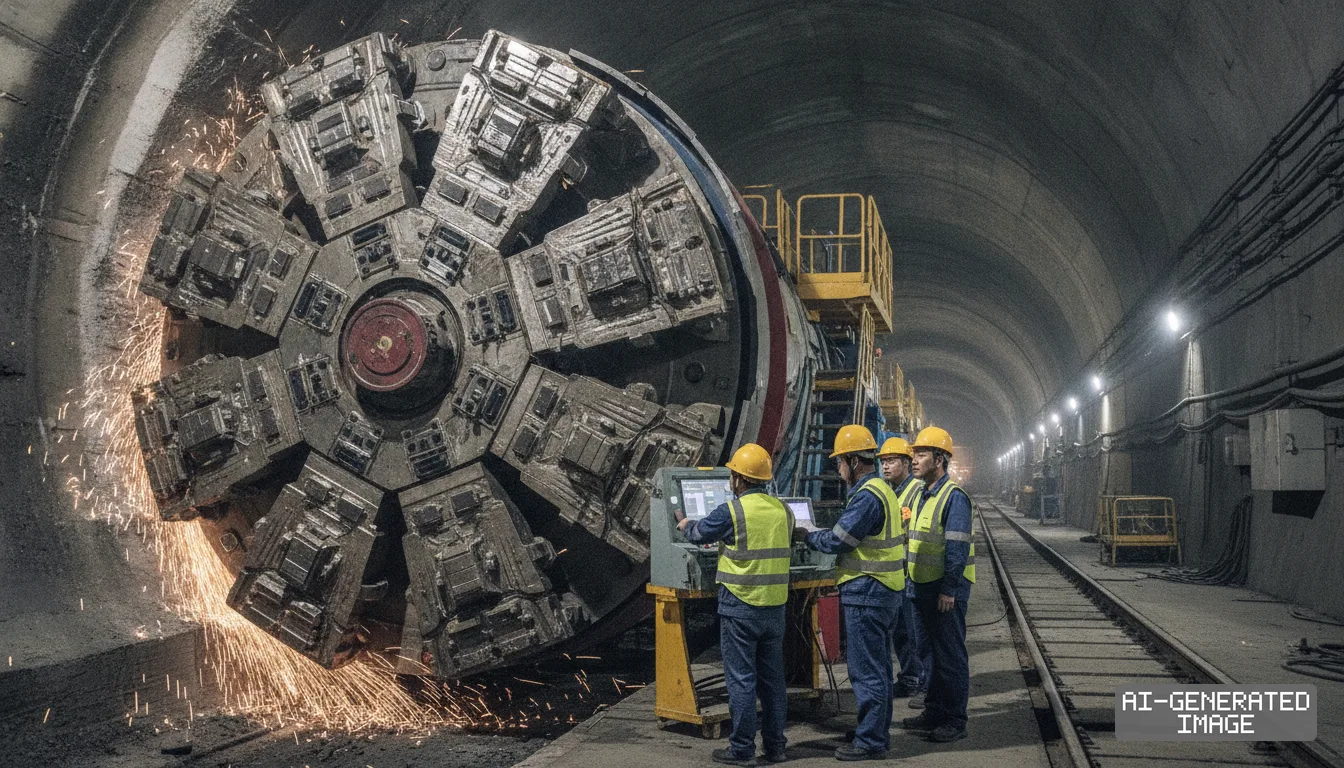
China's Ministry of Commerce notified foreign trade partners on Oct. 26 of dual-use export controls targeting tunnel-boring machines and high-altitude excavation systems ahead of a Nov. 18 enforcement deadline.
The Ministry of Commerce and the General Administration of Customs issued the mandate under Announcement No. 50 of 2026. Chinese manufacturers account for nearly 70% of the global tunnel-boring machine market.
Chinese customs logged $793 million in outbound tunneling machinery shipments in 2025. The licensing regime covers full-face boring shields, core mechanical sub-assemblies, heavy walking excavators and specialized highland concrete sprayers.
The directive places complete full-face tunnel boring machines under export classification code 2B906. That category covers earth pressure balance shields, slurry shields, open hard-rock excavators and double-shield rock-tunneling machines.
Trade restrictions extend down the manufacturing chain to specialized components cataloged under code 2A906. Controlled components include rotating cutterheads, cutting tools, screw conveyors, segment erectors and central main drive assemblies.
Remanufacturing technologies specifically engineered for the controlled machines fall under export classification 2E906. The ministry also restricted proprietary electro-hydraulic proportional control technologies used in heavy walking excavation systems.
Secondary controls capture all-terrain walking excavators designated under code 2B904. The machines meet the threshold if they clear 1.2-meter vertical obstacles, navigate 1.5-meter water depths or cross three-meter trenches.
High-altitude concrete spraying systems operating above 3,000 meters elevation face restrictions under code 2B903. The rule targets wet shotcrete machines fitted with engines exceeding 75 kilowatts and 680 newton-meters of torque.
Exporters shipping controlled equipment to destinations involved in territorial disputes with Beijing must obtain individual export licenses. Shipments to other jurisdictions require export registrations paired with binding non-diversion declarations.
The export licensing requirement lands directly on strategic transport and civil infrastructure programs across South Asia. India relies on imported Chinese boring machines to advance metropolitan rail systems and deep Himalayan road links.
German machinery builder Herrenknecht AG manufactures full-face shield machines in Chinese facilities for regional clients. Chinese customs authorities previously held at least three China-assembled Herrenknecht machines destined for Indian infrastructure projects.
State-owned producer China Railway Construction Heavy Industry Corporation, known as CRCHI, commands over 25% of global installations. CRCHI manufactured more than 180 machines in 2023 across its Chinese assembly bases.
The company has delivered more than 1,200 tunnel boring machines to domestic and international engineering projects. CRCHI and China Railway Engineering Equipment Group together supply the majority of shields sold across Asia.
Indian infrastructure conglomerate Larsen & Toubro operates imported shield fleets across major regional transit packages. Its tunneling contracts deploy 6.5-meter diameter metro boring units and large 13-meter diameter shields for multi-lane roadway corridors.
Supply disruptions threaten delivery timelines on the 508-kilometer Mumbai-Ahmedabad High-Speed Rail Corridor. That high-speed bullet train alignment requires heavy boring shields to excavate a seven-kilometer undersea rail tunnel through coastal rock formations.
Contractors across Southeast Asia face similar procurement friction on complex urban tunneling tenders. Transit extensions in Hanoi, Bangkok and Jakarta rely on Chinese shield components and proprietary cutting tool replenishment.
Tunneling shields require regular tool replacement because rock wear erodes cutterhead discs within several hundred meters of boring. Licensing delays could turn standard tool replenishment cycles into prolonged construction shutdowns, engineering managers said.
Procuring alternative cutterheads, bearings or main drives from manufacturers in Germany or Japan raises equipment costs by 20% to 35%. Non-Chinese component manufacturers also operate production backlogs stretching past 14 months for specialized drive assemblies.
India allocated $1.2 billion in August 2026 under a production-linked incentive program to build domestic tunneling machinery by 2033. State engineering firm Bharat Earth Movers Limited will direct that initiative, but domestic assembly lines remain years away.
The tunneling directive coincides with Announcement No. 51 of 2026, which revised dual-use export controls on heavy dredging components. Chinese regulators have tightened scrutiny over heavy industrial systems used for maritime reclamation and subterranean engineering.
Full-face boring machines carry strategic dual-use utility because heavy cutters can excavate hardened underground command centers and military transport galleries. Beijing framed the restrictions as non-proliferation safeguards intended to protect national security.
All licensing requirements and registration filings take effect Nov. 18, 2026. Exporters must clear pending transit shipments or file official authorization requests with provincial commerce bureaus before that enforcement date.
The notice does not state whether subsea excavation equipment forms an independent regulatory class outside standard shield machinery. The commerce ministry has also not published a list of countries designated as sensitive destinations.
Customs border posts will enforce the dual-use catalog through interagency inspection protocols managed alongside the commerce ministry. Overseas engineering contractors must verify equipment classifications with Chinese component suppliers before contracts take effect.
Impact map
How this development propagates across the region and out to global buyers.
| Event | Korea | China | Japan | Global impact |
|---|---|---|---|---|
| TBM dual-use export control rule | no direct domestic disruption, but overseas civil engineering affiliates face higher third-party tool replacement costs | CRCHI and CREG face stringent licensing reviews on sensitive Asian export corridors | Komatsu and Kawasaki Heavy Industries face incoming replacement inquiries against 14-month delivery backlogs | Asian metro and rail tunnel capital equipment costs rise an estimated 20% to 35% on component realignments |
In this story
- Companies
- China Railway Construction Heavy Industry CorporationHerrenknecht AGLarsen & ToubroBharat Earth Movers Limited
- Tickers
- 688425.SS
- Exposed
- China Communications Construction Company
- Policy
- Export Controls
- Impact
- Supply ChainCost StructureCompliance
Track every Export Controls development →
Related briefings
- China curbs dredger component exports under dual-use control Also on China Communications Construction Company, Export Controls, Compliance
- India pushes rare earth magnet output to counter China curbs Also on Larsen & Toubro, Export Controls, Cost Structure
- TSMC tests rare-earth-free motors as China magnet curbs loom Also on Export Controls, Compliance, Cost Structure
- China curbs Japan dual-use exports citing military buildup Also on Export Controls, Compliance, Cost Structure
Sources
Primary documents
Reporting
Confidence: high — how we grade this
The documents behind this briefing are linked above. East Asia Brief produces its English text with AI assistance under human editorial review, and does not translate or republish other outlets' articles. See our methodology and AI policy. Spotted an error? Tell us.
The Morning Brief
What changed in Korean, Chinese and Japanese industry overnight — and what it means for your supply chain. One email, weekday mornings, US time. Free.
The Morning Brief is in preparation. Leave your address and we will write to you once — when the first issue is ready. Nothing before that.