China curbs tunnel boring machine exports under dual-use law
New licensing rules require clearance for shield cutters and plateau excavators, threatening subterranean railway tunnels and urban transit projects.
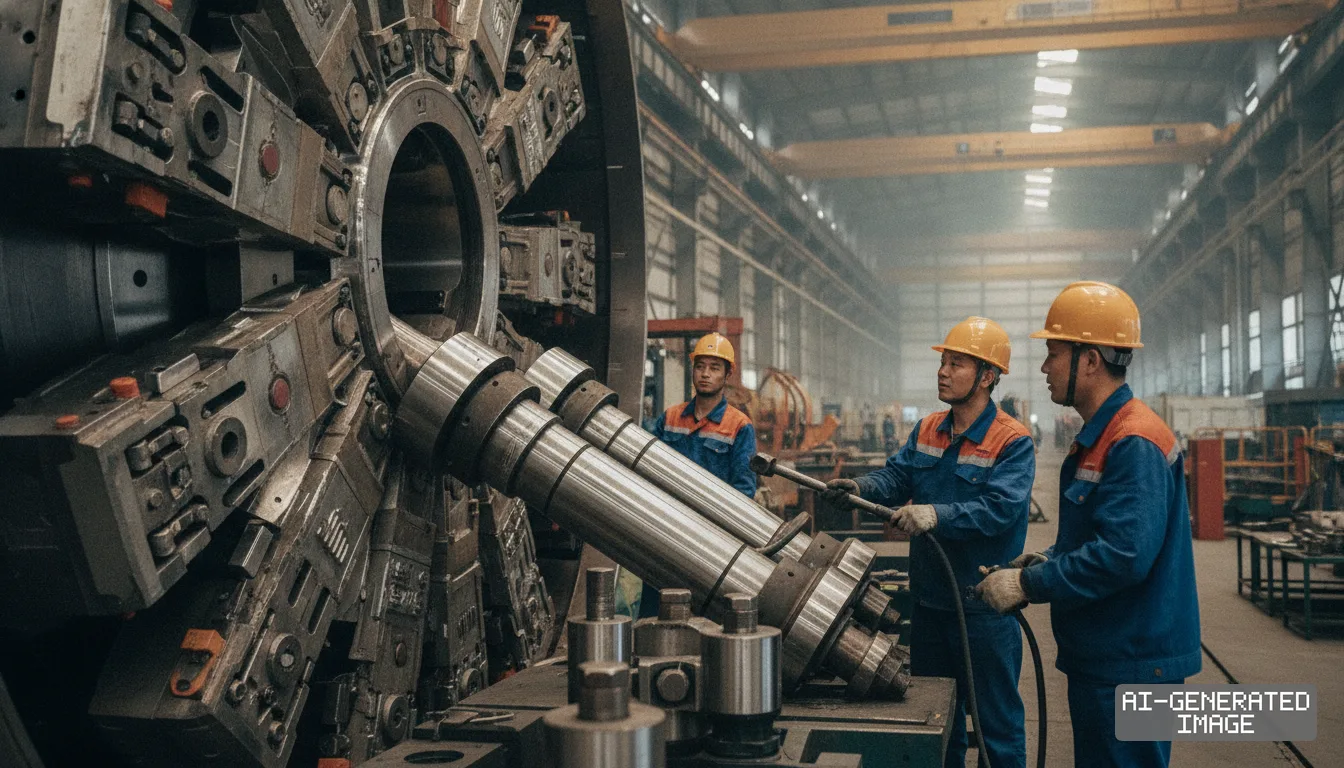
China's Ministry of Commerce enacted dual-use export controls on tunnel boring machines on Oct. 21, 2026, requiring prior government permits for excavation equipment that commands roughly 70% of global shield machine output.
Chinese plants manufacture over 600 full-face tunneling machines annually for domestic and foreign civil engineering projects. Chinese customs records show overseas shipments of tunneling machinery totaled $1.2 billion last year, representing more than half of cross-border shield trade.
The licensing mandate applies to earth pressure balance, slurry balance and hard-rock tunnel boring machines under commodity code 8430313010. The equipment excavates circular tunnels for urban subways, high-speed rail networks, water conveyance passages and underground defensive installations.
The directive restricts four critical mechanical subsystems alongside complete machines. Exporters must obtain permits for cutterheads, screw conveyors, segment erectors and main drive units, as well as proprietary remanufacturing and overhaul technologies under control code 2E906.
Specialized all-terrain walking excavators face parallel restrictions under code 2B904. The controls apply to any multi-axis walking machine capable of clearing 1.2-meter vertical steps, crossing trenches wider than 3 meters or climbing grades steeper than 40 degrees.
Beijing also placed high-altitude wet shotcrete spraying machines under export licensing. The rule covers equipment engineered for sites higher than 3,000 meters above sea level with engines exceeding 75 kilowatts and low-temperature hydraulic systems rated to minus 20 degrees Celsius.
The regulatory order establishes a dual-tier compliance framework based on export destinations. Shipments bound for sensitive countries involved in territorial disputes with China face mandatory case-by-case review and require explicit ministerial clearance before departure.
Consignments destined for other markets require trade registration filings and formal end-user declarations. Buyers in approved destinations must submit written undertakings pledging that imported Chinese equipment will not be diverted or re-exported to disputed territories.
The measure imposes extraterritorial compliance obligations on foreign enterprises and individuals outside China. Third-party entities cannot re-export or transfer Chinese-origin tunneling machines or components to designated dispute zones without written approval from Beijing regulators.
State-owned equipment builder China Railway Construction Heavy Industry faces direct licensing exposure under the rule. The Changsha-based manufacturer generates roughly 14% of its 10.1 billion yuan ($1.42 billion) in total revenue from overseas tunneling machinery sales.
China Railway Engineering Equipment Group, based in Zhengzhou, holds a 30% share of global shield machine deliveries. The state-run supplier has delivered more than 1,400 tunneling units to rail and water projects across Singapore, Malaysia, Italy and the Middle East.
Foreign equipment makers that build machinery in Chinese factories must clear the same export reviews. German manufacturer Herrenknecht produces shield machines at plants in Guangzhou, where Chinese customs authorities previously held three India-bound tunneling units during border tensions.
International infrastructure contractors depend heavily on Chinese tunneling systems to meet fixed construction schedules. Tunnel boring machines are custom-engineered for specific rock strata and tunnel diameters, preventing engineering teams from easily swapping hardware once drilling starts.
Cutterhead tooling and drive units suffer severe mechanical wear during excavation through fractured rock. Contractors must import replacement disc cutters, bearings and hydraulic assemblies on rolling schedules to prevent multi-month stoppages on active underground boring sites.
Indian civil transit programs face immediate schedule exposure from the licensing requirements. Metro tunnel drives in Delhi, Chennai and Bengaluru rely on Chinese-assembled shield equipment, alongside the Mumbai-Ahmedabad bullet train corridor under construction by national railway authorities.
The restrictions also target high-altitude engineering capabilities along disputed frontier regions. The controlled walking excavators and cold-weather shotcrete sprayers match the exact technical specifications required to excavate all-weather military tunnels through Himalayan passes.
The Ministry of Commerce issued the restrictions under the Dual-Use Items Export Control Regulations approved by the State Council. The announcement accompanied revised export controls on heavy dredging vessels and specialized unmanned aerial vehicles published the same week.
Beijing has systematically brought dual-use civil construction equipment under sovereign export oversight. In 2017, commerce authorities restricted exports of large trailing suction hopper dredgers, restricting international access to heavy land-reclamation hardware across the South China Sea.
Contractors outside China must now conduct detailed supply chain audits for wear components. Maintenance contracts and spare-part orders must trace original component foundries to determine whether re-export declarations apply to ongoing overseas tunneling projects.
The notice does not state which countries are designated as sensitive nations in territorial disputes with China, and the ministry has not published a formal registry of barred destinations.
The export licensing restrictions take effect Nov. 18, 2026, under Announcement No. 50 of 2026 issued jointly with the General Administration of Customs.
Impact map
How this development propagates across the region and out to global buyers.
| Event | Korea | China | Japan | Global impact |
|---|---|---|---|---|
| TBM export controls | engineering firms face screening on Chinese cutterhead components for domestic rail lines | CRCHI faces licensing overhead on 14% of revenue derived from foreign equipment orders | Komatsu and Kawasaki Heavy see higher inquiry rates for non-China shield deliveries | transit project timelines face delay risk on long-lead TBM manufacturing and component re-export curbs |
In this story
- Companies
- China Railway Construction Heavy IndustryHerrenknecht
- Tickers
- 688425.SS
- Exposed
- China Railway Engineering Equipment Group
- Policy
- Export Controls
- Impact
- Supply ChainComplianceCapex
Track every Export Controls development →
Related briefings
- China curbs tunnel boring machine exports under dual-use law Also on China Railway Construction Heavy Industry, Herrenknecht, Export Controls
- OpenAI abandons China chip curbs as Nvidia protects exports Also on Export Controls, Compliance
- China MOFCOM restricts AI model and chip IP export transfers Also on Export Controls, Compliance
- China curbs dredger component exports under dual-use control Also on Export Controls, Compliance
Sources
Primary documents
Reporting
Confidence: high — how we grade this
The documents behind this briefing are linked above. East Asia Brief produces its English text with AI assistance under human editorial review, and does not translate or republish other outlets' articles. See our methodology and AI policy. Spotted an error? Tell us.
The Morning Brief
What changed in Korean, Chinese and Japanese industry overnight — and what it means for your supply chain. One email, weekday mornings, US time. Free.
The Morning Brief is in preparation. Leave your address and we will write to you once — when the first issue is ready. Nothing before that.