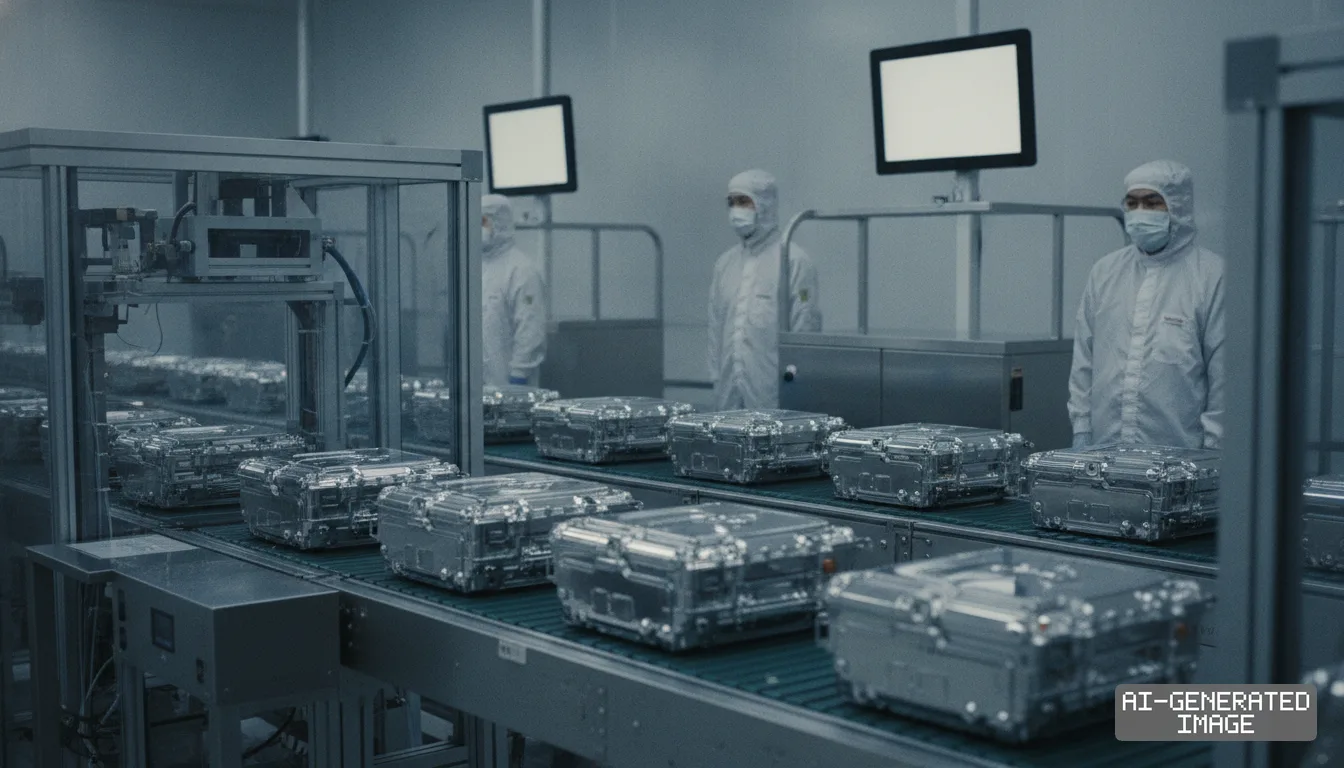
US push to blacklist CXMT heightens export risks for Korean memory
Congressional demands to sanction ChangXin Memory follow existing Commerce Department rules that already restrict high-bandwidth chip exports.

U.S. Senator Tom Cotton urged the Commerce Department on Nov. 12 to add Chinese memory producer ChangXin Memory Technologies to the Entity List, intensifying pressure on South Korean chipmakers.
The demand coincides with congressional efforts to fold the AI Overwatch Act, the Chip Security Act and the MATCH Act into defense legislation. Those bills target unauthorized transshipments to Chinese data centers.
The baseline Commerce Department rule in 89 FR 96790 already restricts memory bandwidth density exceeding 2 gigabytes per second per square millimeter, covering 100% of commercial HBM3 and HBM3E stacks.
South Korea manufactures more than 90% of the world's high-bandwidth memory, making its fabrication lines immediately sensitive to Washington's regulatory perimeter.
Lawmakers in Washington want Commerce Secretary Howard Lutnick to sever American tool shipments to CXMT before the Chinese firm scales domestic high-bandwidth memory lines. The company remains China's primary domestic DRAM champion.
The push follows congressional inquiries into illicit hardware diversions. Lawmakers claim commercial accelerators and associated memory packages reached restricted Chinese entities through third-country routing.
The legislative package would broaden export licensing review. The AI Overwatch Act requires interagency notifications for high-performance processors, while the Chip Security Act mandates location verification hardware.
The third bill, the MATCH Act, directs the White House to align export controls among allied nations. That statute specifically pressures Seoul and Tokyo to mirror American equipment and memory curbs.
For Samsung Electronics and SK hynix, the regulatory scrutiny tests strategies designed to ring-fence advanced memory production while sustaining legacy DRAM volumes.
The two South Korean memory manufacturers have complied with the interim final rule implemented on Jan. 1, 2025. That measure applied the Foreign Direct Product Rule to high-bandwidth memory stacks.
The Foreign Direct Product Rule gives Washington extraterritorial jurisdiction over foreign products made with American software or electronic design automation tools.
South Korea's Ministry of Trade, Industry and Energy notified domestic industry on Dec. 3, 2024, that standalone HBM shipments to destinations in Country Group D:5 require specific export licenses.
The ministerial notice clarified that HBM integrated into approved host logic packages escapes the direct standalone export ban. That exception allowed Korean suppliers to deliver HBM stacks to certified graphic processor assemblers.
SK hynix ships the bulk of its HBM3E output to Nvidia, insulating its premium memory order book from direct Chinese licensing friction. Direct sales to Chinese customers accounted for roughly 12% of its DRAM revenue before controls tightened.
Samsung Electronics maintains a broader footprint across general-purpose DRAM modules, legacy HBM2E stacks and foundry packaging. The company noted in regulatory commentary that U.S. curbs on Chinese computing chips constrained regional shipments.
Direct exports of bare HBM stacks to Chinese domestic accelerator designers like Huawei remain entirely prohibited under the 2 gigabytes per second density standard.
Any expansion of technical parameters to include legacy high-bandwidth interfaces or dense LPDDR5 modules would squeeze Korean revenue defenses further.
South Korean memory makers have responded by shifting front-end wafer capacity toward next-generation HBM4 packaging lines. The architectural shift moves final assembly closer to domestic lines and Western customer hubs.
The Commerce Department has not issued a new export rule or lowered the 2 gigabytes per second bandwidth density ceiling, and neither Samsung Electronics nor SK hynix posted disclosures of supply disruptions on Nov. 12.
U.S. lawmakers are negotiating to finalize the National Defense Authorization Act before the legislative term concludes in December 2026, setting the calendar for any statutory expansion of export controls.
Impact map
How this development propagates across the region and out to global buyers.
| Event | Korea | China | Japan | Global impact |
|---|---|---|---|---|
| Congressional NDAA and CXMT Entity List push | Samsung Electronics and SK hynix face tighter scrutiny over legacy HBM and China DRAM channels | CXMT faces equipment cutoffs if designated on Entity List | Tokyo Electron and tool suppliers face alignment pressure under proposed MATCH Act | AI server supply chains tighten compliance screening for third-country data center shipments |
In this story
- Companies
- Samsung ElectronicsSK hynixChangXin Memory Technologies
- Tickers
- 005930.KS000660.KS
- Exposed
- Nvidia
- Policy
- Export Controls
- Impact
- ComplianceSupply ChainOrder Book
Track every Export Controls development →
Related briefings
- Analysts reject Elon Musk warning on China memory chip glut Also on ChangXin Memory Technologies, Nvidia, SK hynix
- Micron unveils vertical HBM architecture to stack on AI GPUs Also on ChangXin Memory Technologies, Nvidia, SK hynix
- Micron Cuts DRAM Lead of SK hynix to One Point on HBM Demand Also on ChangXin Memory Technologies, Nvidia, SK hynix
- Korean HBM skirts US export curbs disguised on server boards Also on ChangXin Memory Technologies, SK hynix, Samsung Electronics
Sources
Primary documents
Reporting
Confidence: high — how we grade this
The documents behind this briefing are linked above. East Asia Brief produces its English text with AI assistance under human editorial review, and does not translate or republish other outlets' articles. See our methodology and AI policy. Spotted an error? Tell us.
The Morning Brief
What changed in Korean, Chinese and Japanese industry overnight — and what it means for your supply chain. One email, weekday mornings, US time. Free.
The Morning Brief is in preparation. Leave your address and we will write to you once — when the first issue is ready. Nothing before that.