South Korea reviews 260,000 Nvidia GPU deliveries after CEO exit
The science ministry held emergency talks to secure 14,000 remaining B200 accelerators by early 2027 following the sudden departure of Jensen Huang.
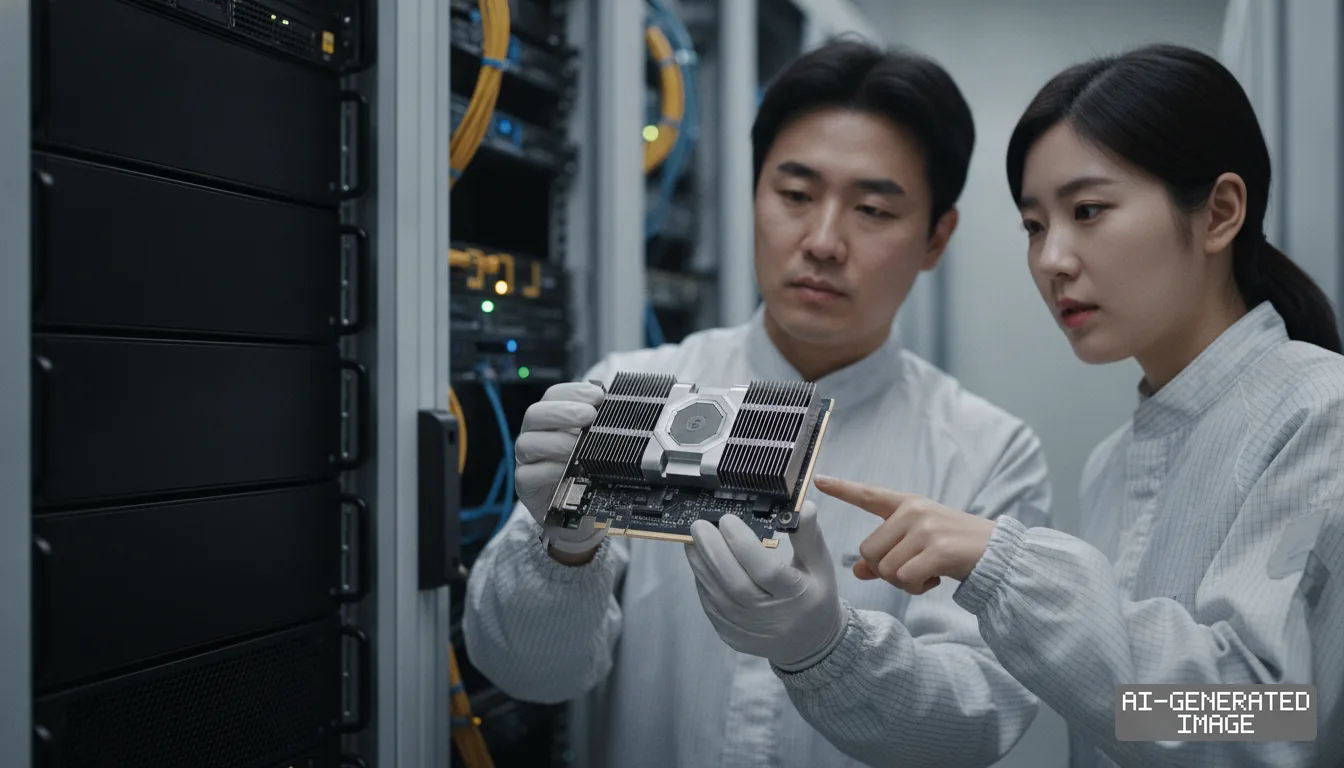
South Korea’s science ministry held emergency supply talks on Nov. 13 with Nvidia Korea to confirm shipment schedules following the sudden exit of chief executive Jensen Huang.
The government reviewed existing procurement pacts to ensure delivery of 260,000 advanced graphics processing units earmarked for domestic data centers and enterprise research clusters.
Seoul has already secured 21,000 units of its direct target of 35,000 Nvidia B200 accelerators, representing 60% of its initial state compute allotment.
The remaining 14,000 processors under the direct procurement line will arrive by early 2027, the Ministry of Science and ICT said.
An additional 15,000 chips are moving through separate delivery pipelines established for the National AI Computing Center, bringing total public-sector procurement to 50,000 accelerators.
Second Vice Minister Ryu Je-myeong convened the morning meeting with Nvidia Korea executives in Seoul, seeking formal assurances on contracted delivery timetables.
Deputy Prime Minister and Science Minister Bae Kyung-hoon affirmed through an official briefing that enterprise cooperation programs and hardware distribution lines remain binding commitments.
The regulatory check follows Nvidia’s regulatory filing confirming that Jensen Huang resigned as president, chief executive, and board director, effective immediately.
Nvidia accepted Huang's departure on Nov. 11, ending his 33-year tenure at the company he co-founded in 1993.
Chief Financial Officer Colette Kress has taken over as interim chief executive while keeping her role managing corporate finances, according to the Form 8-K filing.
The board appointed director Harvey C. Jones, an investor on the board since 1993, as its first-ever chair to oversee governance during the leadership transition.
South Korea’s National AI Strategy Initiative held a separate review at 14:00 on Nov. 13 to assess broader risks across domestic semiconductor infrastructure.
Standing Vice Chairman Ha Jung-woo led the inter-agency session alongside officials from the science ministry and the Ministry of Trade, Industry and Energy.
The strategy group focused on potential schedule slippage for next-generation platforms and assessed the stability of advanced memory supply chains linked to US server designs.
Domestic memory producers SK hynix and Samsung Electronics manufacture the bulk of high-bandwidth memory chips required to feed Nvidia’s high-performance AI accelerators.
Both Korean chipmakers hold long-term agreements to deliver sixth-generation HBM4 modules for Nvidia’s upcoming architecture, code-named Vera Rubin.
SK hynix and Samsung Electronics book substantial shares of operating profit from high-density memory stacks, making enterprise roadmaps central to capital expenditure plans.
Shipments of Vera Rubin compute modules are scheduled to begin initial rollouts in December, according to government deployment roadmaps.
Korean officials confirmed that current purchase orders for B200 accelerators and early Vera Rubin evaluation systems show no signs of cancellation or volume reduction.
Industry strategists remain focused on how permanent management changes might alter development schedules for later hardware revisions, including HBM4E and seventh-generation HBM5 modules.
A protracted executive search could slow engineering sign-offs for customized memory controllers, an area where bespoke base dies require close architectural integration.
Samsung Electronics and SK hynix are tracking whether architectural milestones set under Huang will face reprioritization as the interim executive team manages investor scrutiny.
Seoul is also monitoring joint technological initiatives, including platform links that combine Nvidia’s proprietary NVLink interconnect with Korean neural processing units.
The science ministry executed a memorandum on Nov. 9 pairing Nvidia with SK Telecom and chip designer Rebellions to integrate domestic processors into NVLink-based data architectures.
Government officials confirmed that plans to host Nvidia’s annual GTC developer conference in Seoul will continue on schedule despite the executive reshuffle.
Corporate procurement leads are evaluating supply continuity as Nvidia prepares to release third-quarter fiscal 2027 earnings on Nov. 17.
Kress has called an all-hands internal corporate meeting for Nov. 18 to outline operational priorities to engineering teams and division managers.
The board has not published a timeline for appointing a permanent successor to Huang, nor has it disclosed candidates under consideration.
The science ministry has not published cumulative shipment figures for private domestic conglomerates, which hold preliminary purchase allocations totaling roughly 210,000 processors.
Samsung Group, SK Group, and Hyundai Motor Group have targeted shipments of 50,000 units each, while internet firm Naver has reserved 60,000 units.
Nvidia’s disclosure documents do not settle whether future hardware designs will maintain current memory sourcing ratios across competing Korean vendors beyond 2027.
South Korean authorities said inter-agency monitoring teams will meet weekly to track import clearances and verify quarterly memory deliveries as US earnings approach.
Impact map
How this development propagates across the region and out to global buyers.
| Event | Korea | China | Japan | Global impact |
|---|---|---|---|---|
| Nvidia CEO transition | SK hynix and Samsung verify HBM4 Rubin commitments, state compute targets on track | domestic accelerator developers evaluate competitive window amid US executive shift | memory testing and substrate toolmakers track Vera Rubin verification schedules | hyperscalers await Nov. 17 fiscal results for guidance on long-term hardware roadmap |
In this story
- Companies
- NvidiaSK hynixSamsung Electronics
- Tickers
- NVDA000660.KS005930.KS
- Exposed
- SK TelecomRebellions
- Policy
- Procurement Rules
- Impact
- Supply ChainOrder BookCapex
Track every Procurement Rules development →
Related briefings
- SK hynix and OpenAI hold direct HBM talks for custom silicon Also on SK Telecom, SK hynix, Samsung Electronics
- KKR deploys record $3 billion into South Korea AI hardware Also on SK Telecom, SK hynix, Samsung Electronics
- Korea expands tax credits for artificial intelligence compute infrastructure Also on SK Telecom
- HD Hyundai launches 600-ton autonomous warship with Anduril Also on Procurement Rules, Order Book
Sources
Primary documents
Reporting
Confidence: high — how we grade this
The documents behind this briefing are linked above. East Asia Brief produces its English text with AI assistance under human editorial review, and does not translate or republish other outlets' articles. See our methodology and AI policy. Spotted an error? Tell us.
The Morning Brief
What changed in Korean, Chinese and Japanese industry overnight — and what it means for your supply chain. One email, weekday mornings, US time. Free.
The Morning Brief is in preparation. Leave your address and we will write to you once — when the first issue is ready. Nothing before that.