HD Hyundai launches 600-ton autonomous warship with Anduril
The Ulsan shipyard prototype targets US Navy uncrewed fleet contracts using integrated combat software from the American defense contractor.
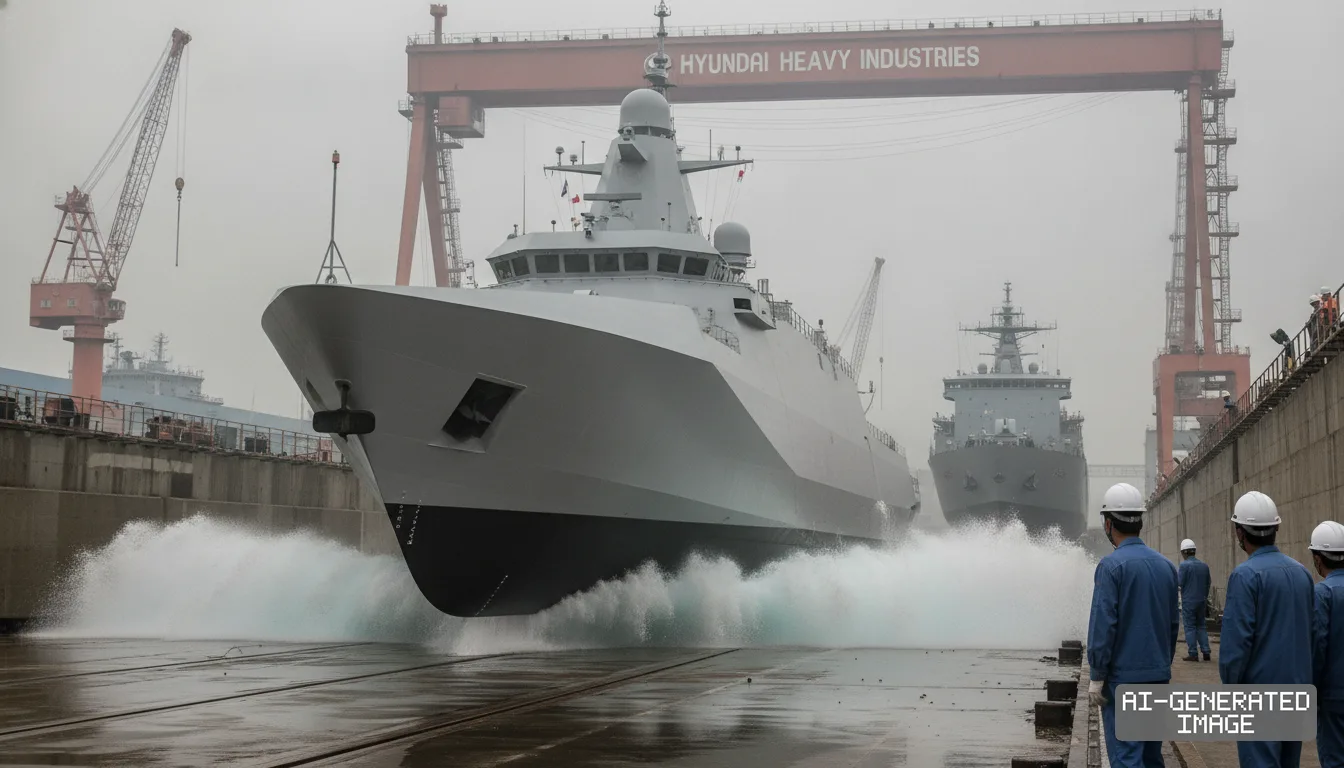
HD Hyundai Heavy Industries launched a 600-metric-ton autonomous naval combat vessel on Nov. 12, 2026, partnering with defense contractor Anduril Industries to pursue United States Navy uncrewed fleet contracts.
The prototype entered the water at the Ulsan shipyard in southeastern South Korea. The facility accounts for roughly 10% of global commercial shipbuilding output and serves as the primary naval construction base for the shipbuilder.
Displacing 600 metric tons, the autonomous surface craft is designed to conduct intelligence, surveillance, reconnaissance and surface strike missions. The hull operates entirely without human personnel aboard during tactical sorties.
HD Korea Shipbuilding & Offshore Engineering supplied its proprietary VAone autonomy suite. The system controls vessel navigation, monitors propulsion machinery in real time and executes automated damage-mitigation routines without sailor intervention.
The platform builds on autonomous maritime algorithms created by Avikus, an HD Hyundai subsidiary. Avikus has delivered commercial autonomous navigation systems to approximately 500 merchant vessels across international commercial shipping lanes.
Anduril integrated its Lattice mission-autonomy software directly into the vessel command architecture. The artificial intelligence platform fuses external sensor feeds, directs cooperative vehicle swarms and manages offensive weapon payloads.
The launch follows a joint maritime trial completed off Long Beach, California, on Oct. 19. During that three-and-a-half-hour test, the companies operated a 368-ton former US Navy craft before 40 defense officials.
The earlier trial validated emergency responses to simulated engine breakdowns, coordinated formation sailing and real-time mission reassignment. Telemetry streamed continuously to a shore control station throughout the California transit.
The two companies formalized their maritime alliance on April 13, 2024, aiming to accelerate dual-use vessel manufacturing. Executive leaders signed a binding development and construction pact in Seoul on Nov. 19, 2025.
Engineering teams completed the critical design review on April 20, 2026, during the Sea-Air-Space exposition in Maryland. Formal steel cutting and hull assembly began immediately afterward in Ulsan.
The shipbuilders signed a joint certification protocol with the American Bureau of Shipping in May 2026. The classification society is establishing safety and structural compliance frameworks specifically tailored for crewless warships.
The program positions the partnership for prospective Pentagon unmanned initiatives, including the Medium Unmanned Surface Vessel portfolio. The Pentagon has sought low-cost distributed platforms to counter naval fleet expansion by the Chinese People's Liberation Army Navy.
Chinese shipyards currently outbuild American yards by a three-to-one ratio in total hull tonnage. The gap has driven American defense planners toward mass-manufactured autonomous vessels that offset crew constraints and drydock shortages.
The US Navy signaled plans in September to acquire 30 medium autonomous surface vessels. That procurement push encourages defense contractors to validate modular hull designs capable of high-rate assembly and rapid subsystem modification.
Anduril previously refurbished a shipyard at the historic Foss facility in Seattle to assemble autonomous craft. The technology firm also partners with Louisiana-based Edison Chouest Offshore to provide domestic production infrastructure.
Under the operational model, HD Hyundai validates initial naval architecture and power integration on South Korean slipways. Subsequent production hulls destined for American service will undergo final manufacturing inside American yards.
HD Hyundai Heavy Industries generated 11.9 trillion won ($8.6 billion) in consolidated revenue in 2025. Its naval and special ship division contributes roughly 10% of sales, targeting export expansion beyond domestic navy orders.
The project highlights growing bilateral defense-industrial integration between Seoul and Washington. United States naval leaders have actively encouraged allied shipyards to assist with vessel sustainment, fleet repair and modular combatant construction.
Sea trials off the Ulsan coast will run through late 2026. The vessel will transit to the United States in early 2027 to begin operational testing and customer demonstrations in domestic waters.
The companies have not disclosed total development expenditures or unit production targets. The prototype remains an internally financed demonstration asset, and the US Navy has not awarded a procurement contract for the vessel.
The Pentagon continues testing competing autonomous hull prototypes from several domestic defense consortia. Formal evaluations for next-generation medium uncrewed surface combatant production are slated to open in late 2027.
Impact map
How this development propagates across the region and out to global buyers.
| Event | Korea | China | Japan | Global impact |
|---|---|---|---|---|
| 600-ton autonomous warship launch | HD Hyundai opens naval export channel to US, backing special ship division targeting 10% revenue expansion | PLAN fleet expansion countered by low-cost distributed uncrewed surface vessels | Mitsubishi Heavy Industries faces faster US-Korea allied autonomous surface craft fielding | Western naval procurement pivots toward commercial shipyard scaling and AI mission software |
In this story
- Companies
- HD Hyundai Heavy IndustriesAnduril Industries
- Tickers
- 329180.KS
- Exposed
- HD Korea Shipbuilding & Offshore Engineering
- Policy
- Procurement Rules
- Impact
- Order BookCapexSupply Chain
Track every Procurement Rules development →
Related briefings
- HD Hyundai Tests Autonomous Drone Ship With Anduril in U.S. Also on Anduril Industries, Procurement Rules, HD Korea Shipbuilding & Offshore Engineering
- HD Hyundai Draws U.S. Navy Focus on Anduril $6.6B Project Also on Anduril Industries, HD Hyundai Heavy Industries, Order Book
- China curbs drone tech exports to US defense contractors in 2026 Also on Anduril Industries
- HD Hyundai forms US shipyard venture with Kiewit Maritime Also on Procurement Rules, HD Korea Shipbuilding & Offshore Engineering, Order Book
Sources
Reporting
Confidence: medium — how we grade this
The documents behind this briefing are linked above. East Asia Brief produces its English text with AI assistance under human editorial review, and does not translate or republish other outlets' articles. See our methodology and AI policy. Spotted an error? Tell us.
The Morning Brief
What changed in Korean, Chinese and Japanese industry overnight — and what it means for your supply chain. One email, weekday mornings, US time. Free.
The Morning Brief is in preparation. Leave your address and we will write to you once — when the first issue is ready. Nothing before that.