Samsung and SK hynix slide as AI peak-out doubts rattle memory
Samsung Electronics posted 107.44 trillion won in operating profit and full order books for 2027, but mounting skepticism over cloud capex weighed on DRAM equity multiples.
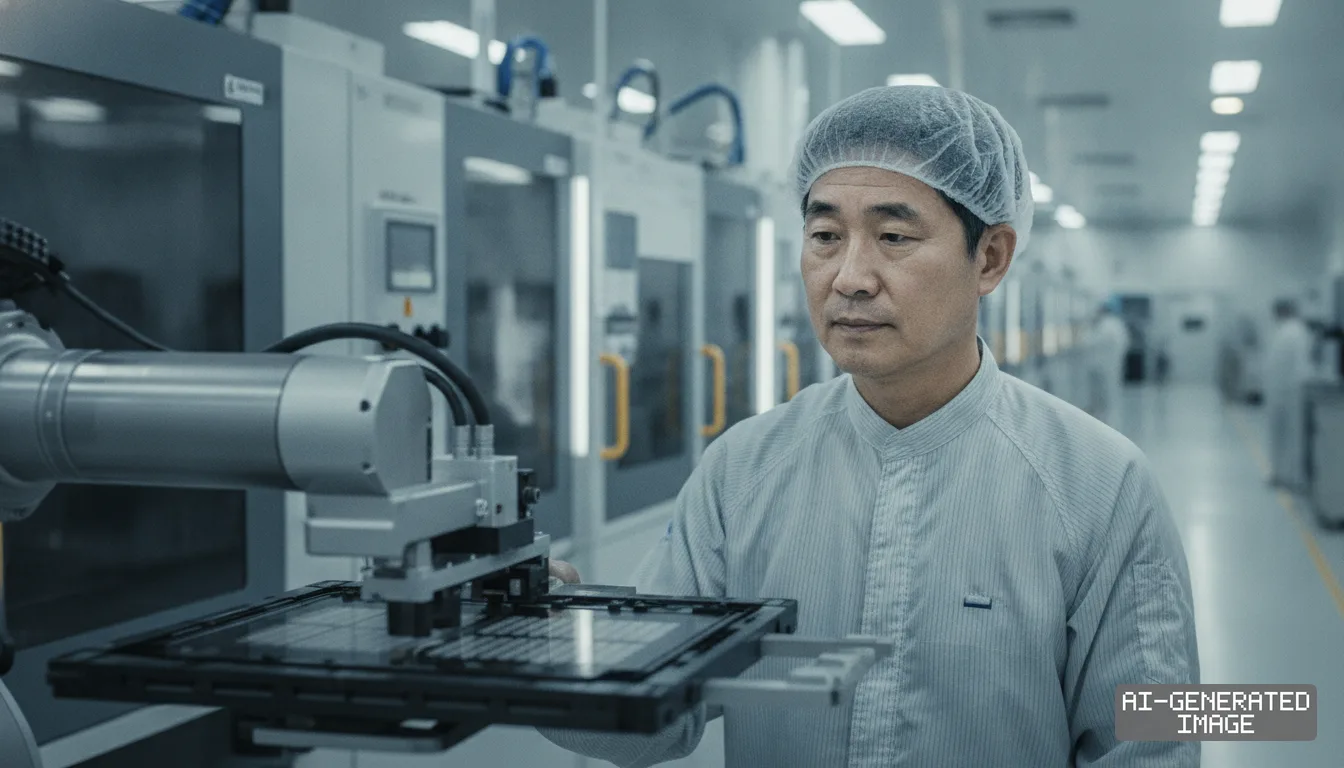
Samsung Electronics and SK hynix confronted intensifying investor doubts on Nov. 22, 2026, as memory share prices slid despite record third-quarter profits and sold-out advanced AI chip orders.
The two South Korean manufacturers dominate global dynamic random-access memory (DRAM) supply. Together, they account for more than 70% of worldwide DRAM output and nearly the entire merchant market for high-bandwidth memory.
Samsung Electronics reported third-quarter revenue of 195.25 trillion won ($146.4 billion) and operating profit of 107.44 trillion won. Its Device Solutions division generated 106.5 trillion won, representing 99% of total corporate operating profit.
SK hynix posted third-quarter revenue of 104.62 trillion won ($75.3 billion) and operating profit of 83.33 trillion won. Its operating margin reached 80%, marking the highest profitability recorded in commercial semiconductor manufacturing.
Those operational results failed to prevent sustained selling across Seoul equity markets. Shares of both companies dropped more than 10% from October highs, pulling forward price-to-book valuations down toward 1.2 times.
The price compression reflects an escalating market debate over an artificial intelligence spending peak. Institutional investors are questioning whether cloud hyperscalers will maintain their unprecedented capital expenditure programs through the coming fiscal years.
United States technology conglomerates generate roughly 60% of all high-end server memory procurement. Any moderation in cloud infrastructure budgets directly reduces factory wafer utilization for Korean semiconductor lines, analysts said.
Downstream caution has already appeared in enterprise infrastructure filings. SoftBank Group booked a 597.2 billion yen ($3.9 billion) quarterly loss following cancellations of power generation equipment orders intended for American data centers.
Korean executives maintain that forward demand remains resilient. Samsung Electronics said in October that its planned 2027 production volume for high-bandwidth memory has already been fully committed under customer supply pacts.
SK hynix told investors that binding agreements cover more than half of its total manufacturing capacity through 2028. The company is accelerating the transition of its Cheongju M15X facility to advanced packaging processes.
Yet quarterly filings submitted to the Financial Supervisory Service on Nov. 16 reveal contractual flexibility. The documents state that delivery schedules and purchase volumes remain subject to adjustment based on customer requirements.
Nvidia included comparable disclosures in its annual regulatory filings. The processor designer noted that supply commitments can be rescheduled or canceled before formal manufacturing purchase orders are issued to memory vendors.
Pricing patterns across spot and contract markets have further fed investor anxiety. Commodity DRAM spot prices dropped 5% over the past month, while NAND flash spot pricing fell 20%.
Long-term contract prices have shown far greater stability. Fixed quarterly contract prices for high-density server modules continued to rise, pushing the premium of contract pricing over spot transactions past 20%.
Disparity between fixed contracts and spot rates signals conflicting market forces. Contract stability reflects contracted artificial intelligence demand, while weakening spot markets indicate soft consumer demand for personal computers and smartphones.
Chinese competition is compounding pressure on older product categories. ChangXin Memory Technologies has expanded domestic production of legacy DDR4 memory, eroding pricing power and forcing Korean producers to accelerate advanced node conversions.
Industry supply data suggests severe tightness will persist across high-end lines through 2027. Global DRAM demand is forecast to grow 25% against supply expansion of 18%, keeping supply fulfillment near 70%.
High-bandwidth memory demand is projected to expand 56% next year, outpacing manufacturing supply growth of 50%. Next-generation artificial intelligence accelerators require up to 65% more memory content per processor unit.
Advanced packaging dynamics also limit potential market oversupply. Producing high-bandwidth memory requires three times as many silicon wafers as standard DDR5 modules, reducing the net volume of memory chips leaving wafer fabs.
To defend profitability, SK hynix approved 100 trillion won ($75 billion) in shareholder returns for fiscal 2026. The program includes cash dividends of 20,000 won per share alongside substantial open-market share cancellations.
Samsung Electronics separately authorized a quarterly cash dividend of 4,601 won per share. The payout totaled 30 trillion won ($21.7 billion), underscoring management confidence in ongoing cash flow generation from AI hardware.
Portfolio restructuring will also provide additional cash cushions. SK hynix plans to complete a bond conversion in December 2026 that secures an indirect 14.1% equity holding in Japanese peer Kioxia.
The quarterly filings do not state binding cancellation penalty amounts or guaranteed take-or-pay minimums, and neither company has published exact wafer allocation figures between high-bandwidth memory and commodity DRAM lines.
Securities models project quarterly memory operating profits will reach a cyclical high in the second quarter of 2027, as SK hynix prepares cleanroom operations at its Yongin semiconductor campus.
Impact map
How this development propagates across the region and out to global buyers.
| Event | Korea | China | Japan | Global impact |
|---|---|---|---|---|
| AI memory peak-out debate | Samsung and SK hynix trade near 1.2x book value despite 80% margins | CXMT expands legacy DDR4 capacity to capture unserved commodity demand | SoftBank absorbs 597.2 billion yen loss from canceled US data center power deals | Cloud hyperscalers face rising scrutiny over AI hardware returns into 2027 |
In this story
- Companies
- Samsung ElectronicsSK hynix
- Tickers
- 005930.KS000660.KS
- Exposed
- NvidiaSoftBank Group
- Impact
- CapexPricingSupply Chain
Related briefings
- SoftBank drops $1 trillion SK hynix bid after bank talks Also on SoftBank Group, Nvidia, SK hynix
- Japan offers U.S. chip investment to win semiconductor tariff relief Also on SoftBank Group, Pricing
- Rapidus forms 17-firm design alliance to back 2nm chip ramp Also on SoftBank Group
- Foreign funds pull 724 billion won from Kospi as chips slide Also on Nvidia, SK hynix, Samsung Electronics
Sources
Primary documents
Reporting
Confidence: high — how we grade this
The documents behind this briefing are linked above. East Asia Brief produces its English text with AI assistance under human editorial review, and does not translate or republish other outlets' articles. See our methodology and AI policy. Spotted an error? Tell us.
The Morning Brief
What changed in Korean, Chinese and Japanese industry overnight — and what it means for your supply chain. One email, weekday mornings, US time. Free.
The Morning Brief is in preparation. Leave your address and we will write to you once — when the first issue is ready. Nothing before that.