Korea chip tool makers hold price targets despite KOSPI drop
Domestic analysts maintained target price gains of up to 30% for equipment suppliers even as a 5.21% benchmark drop pushed memory valuations toward historic lows.
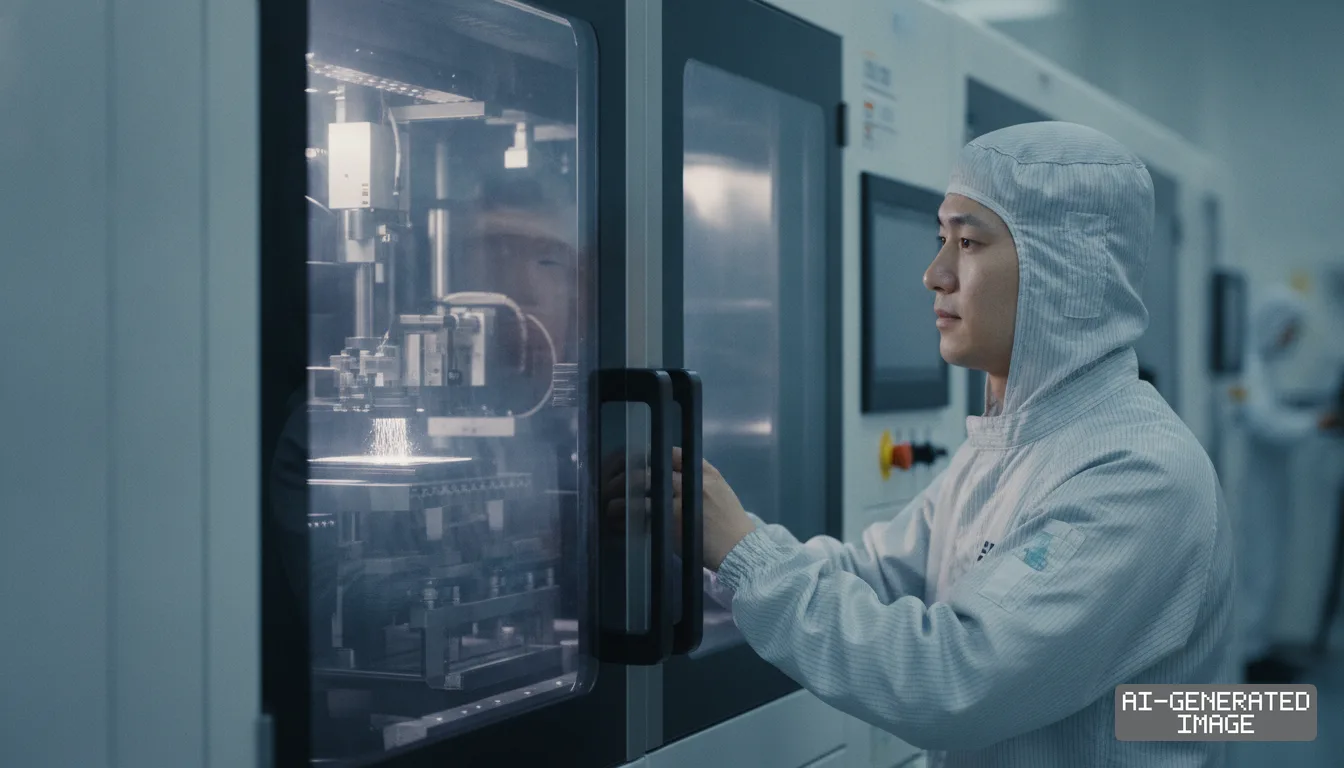
South Korean semiconductor equipment manufacturers held upward price target revisions on Nov. 22, 2026, defying a sharp equity decline that drove domestic manufacturing valuations toward historical lows.
The benchmark Korea Composite Stock Price Index dropped 5.21% on Nov. 20 to close at 4,869.96, accumulating a weekly slide of 7.95% amid heavy international selling.
Global technology sentiment deteriorated rapidly during the same trading session, with the Philadelphia Semiconductor Index sliding 10.73% as investors liquidated hardware holdings across North American and East Asian exchanges.
Samsung Securities calculated that the 12-month forward price-to-earnings multiple for the domestic benchmark dropped to approximately 4.2 times, penetrating levels previously recorded during major cyclical downturns.
The sharp price contraction compressed equity multiples across wafer materials, chemical suppliers and advanced toolmakers, even as operational backlogs for advanced memory packaging remained insulated from spot price weakness.
Data compiled by financial intelligence provider FnGuide on Nov. 22 showed equity analysts raising price targets on four specialized equipment and component makers over the preceding three months.
PSK Holdings logged the largest target adjustment among tracked suppliers, with its consensus price target increasing 30.05% from 191,600 won to 249,167 won ($180) across domestic brokerage houses.
The equipment supplier manufactures high-performance desmear systems and reflow machinery essential for packaging high-bandwidth memory modules, shielding its order books from standard consumer electronics weakness.
Test socket and probe card specialist TSE recorded an average price target increase of 10% across brokerages during the same three-month tracking window, the FnGuide dataset showed.
TSE supplies advanced interface boards and contact hardware required to verify high-speed memory dies, benefiting from structural capacity additions in specialized testing facilities across South Korea.
High-pressure annealing tool fabricator HPSP secured an average price target increase of 7.84%, reflecting steady commercial deliveries for sub-3-nanometer logic processes and cutting-edge DRAM fabrication steps.
The company builds high-pressure hydrogen annealing equipment that repairs crystalline interface defects at lower thermal budgets, a technical requirement that fabricators cannot bypass during advanced node transitions.
Thermal treatment tool maker YEST registered an average target increase of 7.25% over the three-month period, driven by rising demand for high-pressure deuterium annealing tools among domestic clients.
YEST provides specialized annealing equipment engineered to prevent gate leakage in high-density memory devices, capturing capital spending earmarked for next-generation DRAM and NAND production lines.
The positive target revisions for mid-tier toolmakers contrasted sharply with downward adjustments applied to South Korea's primary integrated device manufacturers, according to the tracking dataset.
Samsung Electronics saw its consensus price target reduced by 4.7% from 491,875 won to 468,571 won, as macro portfolio rebalancing pressured large-cap technology equities.
SK hynix recorded a 7.7% downward target adjustment from 3,317,917 won to 3,062,000 won, despite retaining dominant market share in high-bandwidth memory shipments to leading artificial intelligence accelerators.
The divergence between component suppliers and memory makers highlights the defensive nature of specialized tool contracts, which rely on multi-quarter facility schedules rather than quarterly wafer spot prices.
Equipment vendors generally secure binding customer orders six to twelve months prior to tool delivery, providing visible revenue recognition even when equity market volatility dampens broader investor sentiment.
South Korea's Ministry of Trade, Industry and Energy announced it will convene its second working-level consultation on regional growth engines on Nov. 23 and 24.
The government session will focus on building regional semiconductor chemical material hubs and coordinating infrastructure investments for domestic anchor corporations across major industrial clusters, the ministry said.
The ministry notice does not evaluate secondary market valuations, and financial regulators have not published an official benchmark defining equipment multiples as an absolute trough.
Domestic wafer fabricators continue cleanroom installations at domestic memory campuses, while delivery dates for specialized packaging tools remain locked under existing customer contracts through mid-2027.
Impact map
How this development propagates across the region and out to global buyers.
| Event | Korea | China | Japan | Global impact |
|---|---|---|---|---|
| Semiconductor valuation compression | Mid-tier tool targets rise up to 30.05% while memory leaders absorb 4.7% to 7.7% target cuts | Domestic foundries maintain legacy equipment orders from regional vendors | Packaging materials suppliers maintain long-term delivery agreements | Semiconductor equity multiples compress as advanced packaging tool backlogs remain locked |
In this story
- Companies
- PSK HoldingsTSEHPSPYESTSamsung ElectronicsSK hynix
- Tickers
- 031980.KQ131290.KQ403870.KQ122640.KQ005930.KS000660.KS
- Policy
- Subsidies
- Impact
- Order BookPricingCapex
Track every Subsidies development →
Related briefings
- PSK Holdings operating profit hits 58 billion won on HBM orders Also on PSK Holdings, SK hynix, Samsung Electronics
- Hanmi Semiconductor Wins Tool Order for Musk's Terafab Plant Also on HPSP, SK hynix, Subsidies
- Korean chip toolmakers target Musk's $16.8 billion Texas fab Also on HPSP, Subsidies, Order Book
- Kioxia sheds two-thirds of market value as Chinese NAND rivals surge Also on SK hynix, Samsung Electronics, Pricing
Sources
Primary documents
Reporting
Confidence: high — how we grade this
The documents behind this briefing are linked above. East Asia Brief produces its English text with AI assistance under human editorial review, and does not translate or republish other outlets' articles. See our methodology and AI policy. Spotted an error? Tell us.
The Morning Brief
What changed in Korean, Chinese and Japanese industry overnight — and what it means for your supply chain. One email, weekday mornings, US time. Free.
The Morning Brief is in preparation. Leave your address and we will write to you once — when the first issue is ready. Nothing before that.