China Ministry of Commerce nears critical mineral export ban deadline
One-year waivers on Chinese rare earths, gallium and germanium expire in November as chipmakers and defense contractors face tightening supply chains without legal extension.
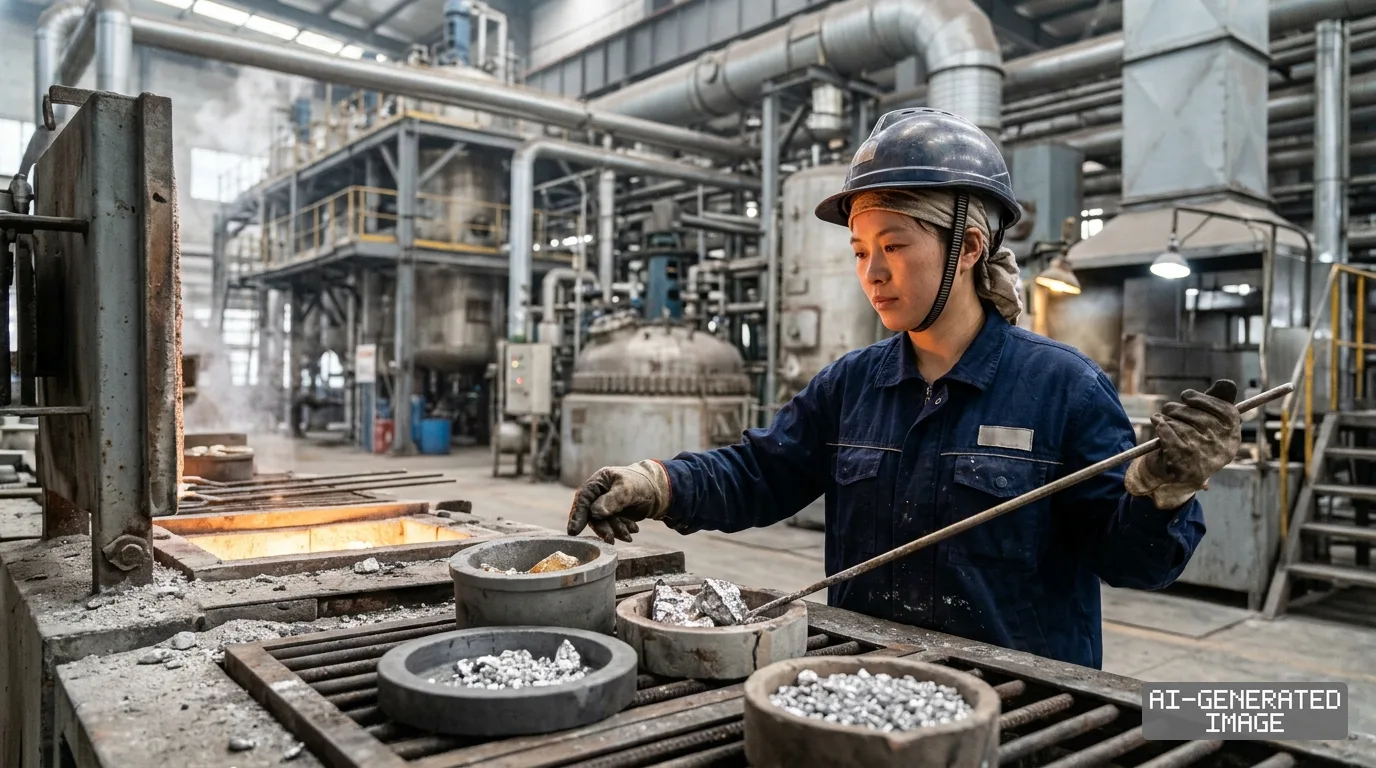
China's Ministry of Commerce reached Oct. 31, 2026, without issuing official extensions for expiring suspensions that had paused sweeping export bans on rare earths, gallium, germanium, antimony and battery components.
The looming expirations threaten Western supply chains reliant on Chinese processing. China controls roughly 99% of global refined gallium supply and about 60% of global refined germanium production, according to international trade registries.
China also mined 48% of global antimony output in 2023, while holding over 70% of heavy rare earth processing capacity worldwide. Those market concentrations leave advanced semiconductor, optical and defense manufacturers vulnerable to sudden disruptions.
The first deadline arrives on Nov. 10, 2026, under Announcement No. 70 of 2025. That decree temporarily suspended six regulatory packages issued on Oct. 9, 2025, by the ministry and the General Administration of Customs.
Those paused rules covered five heavy rare earths including holmium, erbium, thulium, europium and ytterbium. They also targeted critical extraction and separation technologies, synthetic diamond superhard materials — lab-grown industrial abrasives used for precision cutting — and high-density lithium-ion cells.
The package also contained Announcement No. 61, an extraterritorial provision. That rule would require foreign companies outside China to secure Chinese export licences if their finished goods contain 0.1% or more of Chinese-origin rare earths by value.
A second regulatory deadline falls on Nov. 27, 2026, governed by Announcement No. 72 of 2025. That notice temporarily suspended Article 2 of Announcement No. 46, an export restriction enacted in December 2024.
Article 2 had prohibited exports of gallium, germanium, antimony and superhard materials to the United States. The suspension offered American buyers a temporary reprieve, though shipments remained subject to standard dual-use export screening.
Article 1 of the 2024 decree was never suspended. China has maintained an outright ban on shipments of dual-use minerals to American military end-users and defense applications throughout the entire year, customs officials said.
Separate permanent restrictions also remained in force without interruption. Under Announcement No. 18 of 2025, China enforces case-by-case export licensing on seven medium and heavy rare earths, including dysprosium, terbium and yttrium.
Those seven elements are indispensable for neodymium-iron-boron permanent magnets — compact alloys providing strong magnetic force — used in electric vehicle traction motors and wind turbine generators. Exporters must submit detailed end-user certificates for every single consignment, trade lawyers said.
Trade flows have contracted sharply during the control period. Chinese germanium metal exports dropped to 7,520 kg between January and September 2025, down from 36,656 kg during the corresponding period in 2023, customs data showed.
European spot prices for 99.999% pure germanium metal climbed from $3,150 per kg in January 2025 to $5,380 per kg by October 2025. American germanium metal imports plunged 67% to 7,000 kg during 2025.
American gallium metal imports rose to 25,000 kg in 2025 as companies rushed to build buffer inventories. The unit import cost escalated from $439 per kg in 2024 to $580 per kg during 2025.
Compound semiconductor fabricator Coherent Corp. faces direct exposure through its gallium arsenide and germanium wafer lines. Materials procurement for optoelectronic substrates accounts for roughly 18% of Coherent's annual cost of goods sold, corporate filings showed.
Defense contractor RTX Corp. integrates gallium into active electronically scanned array radars — advanced antenna arrays that steer radio beams electronically — for fighter aircraft. Radar and tactical sensor hardware accounts for approximately 22% of revenue across the company's defense electronics division, procurement documents indicated.
Belgian materials refiner Umicore SA processes germanium concentrates for thermal imaging lenses and solar cells. Specialty materials generate roughly 14% of the group's recurring operating profit, leaving its refining operations vulnerable to raw feedstock shortages.
State-owned supplier China Northern Rare Earth Group dominates upstream extraction. The conglomerate holds more than 65% of China's annual government smelting quota, concentrating control over domestic light and medium rare earth supplies.
Western governments have accelerated domestic processing initiatives to blunt Chinese leverage. The United States and European allies expanded funding through the Minerals Security Partnership, yet commercial recycling facilities and overseas mines require years to commission.
Processing know-how forms a persistent barrier for non-Chinese competitors. China's restrictions on extracting and separating intellectual property prevent Western chemical processors from rapidly scaling solvent extraction facilities, metallurgy engineers at regional smelters said.
Antimony supplies present similar operational bottlenecks for ammunition producers. United States net import reliance on antimony stands at 91%, with prices rising from $9.80 per pound in August 2024 to over $20 per pound.
The regulatory clock leaves buyers facing hard deadlines next month. The suspension on five heavy rare earths and battery materials expires Nov. 10, while the temporary waiver on gallium, germanium and antimony expires Nov. 27.
The ministry has not published any regulatory circular confirming whether a bilateral trade framework discussed in late September will legally push the Nov. 10 and Nov. 27 deadlines into 2027.
Chinese customs offices at major ports continue processing outbound cargoes under standard individual dual-use export permits issued earlier this autumn, shipping manifests logged at regional ports showed.
Impact map
How this development propagates across the region and out to global buyers.
| Event | Korea | China | Japan | Global impact |
|---|---|---|---|---|
| Expiration of critical mineral suspensions | downstream chipmakers face higher spot prices for optical and compound materials | China Northern Rare Earth Group retains export control compliance leverage | magnet refiners maintain individual licence filings under existing 2025 decrees | US defense and optoelectronics sectors absorb supply constraints on optical grade metals |
In this story
- Companies
- CoherentRTXUmicoreChina Northern Rare Earth Group
- Tickers
- COHRRTXUMI.BR600111.SS
- Policy
- Export Controls
- Impact
- Supply ChainPricingCost Structure
Track every Export Controls development →
Related briefings
- China germanium hits record 28,500 yuan on export control gap Also on Umicore, Export Controls, Pricing
- IQE warns China export curbs choke indium phosphide supplies Also on Coherent, Export Controls, Pricing
- Chalmers maps automotive gallium recovery under China curbs Also on Umicore, Export Controls, Cost Structure
- FIC Global triples Malaysia optical capacity for AI networks Also on Coherent
Sources
Primary documents
Reporting
Confidence: high — how we grade this
The documents behind this briefing are linked above. East Asia Brief produces its English text with AI assistance under human editorial review, and does not translate or republish other outlets' articles. See our methodology and AI policy. Spotted an error? Tell us.
The Morning Brief
What changed in Korean, Chinese and Japanese industry overnight — and what it means for your supply chain. One email, weekday mornings, US time. Free.
The Morning Brief is in preparation. Leave your address and we will write to you once — when the first issue is ready. Nothing before that.