FIC Global triples Malaysia optical capacity for AI networks
The Taiwan-listed group will invest NT$1.6 billion to expand its Johor campus to 18 surface-mount lines by late 2027 after US client Coherent fully booked initial output.
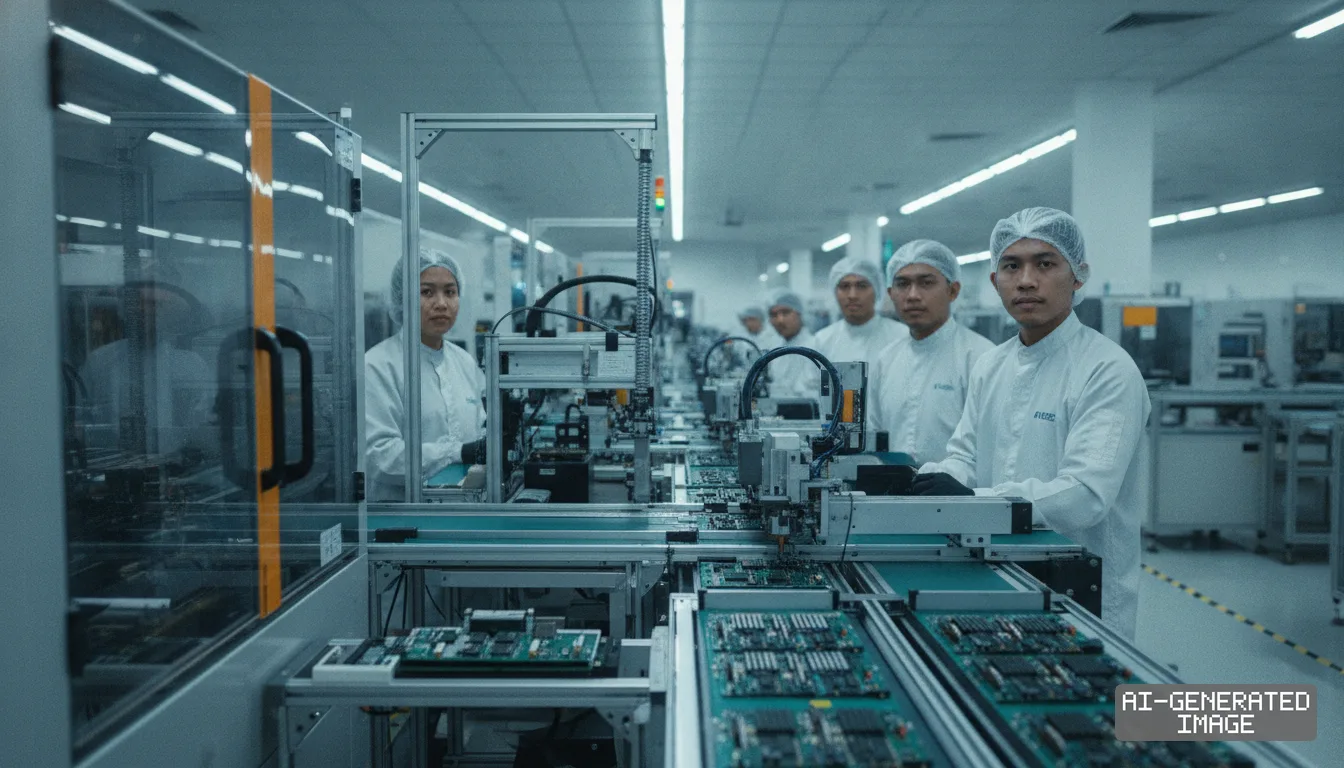
Taiwan-listed FIC Global said Oct. 16, 2026, it will triple production capacity for high-speed optical transceivers at its Malaysian plant to resolve artificial intelligence network bottlenecks.
The investment totals NT$1.6 billion ($50 million) for the campus in Johor. The capital expenditure will expand surface-mount technology lines from eight to 18 by the end of 2027.
The expansion will raise monthly production capacity to two million units by late 2027, the company said. Output will reach three million units monthly by late 2028.
Optical transceivers convert electrical signals from computer processors into light pulses for fiber optic cables. The hardware links compute nodes inside warehouse-scale data centers.
Hyperscale operators are shifting from copper wiring to optical links to move data between graphics processing units. Copper links lose signal strength and generate excessive heat at higher speeds.
The company's operating subsidiary, PRO3C Malaysia, opened the site at Senai Airport City on Oct. 15. The facility completed customer qualification in November 2025 before ramping commercial volumes.
American photonics supplier Coherent Corp. fully booked the initial production capacity of the first Johor factory. Coherent contracted the lines for 800-gigabit and 1.6-terabit pluggable optical modules.
Optical communication hardware generates more than 50% of revenue at FIC Global. The company holds less than 10% of the worldwide optical module market today, according to management estimates.
Management set a target to control more than 30% of global optical transceiver manufacturing within three years. Rapid factory construction in Southeast Asia forms the core of that commercial strategy.
Surging demand for large-scale training clusters has left transceiver supply trailing orders by a factor of three. Compute nodes sit idle when networking equipment cannot deliver timely interconnect bandwidth.
The Johor site packages advanced components including flip-chip transceivers, linear pluggable optics and silicon photonics. Flip-chip packaging bonds bare silicon dies directly onto circuit boards without wire leads.
Silicon photonics integrates laser emitters and light modulators onto silicon wafers. The architecture reduces power draw and latency across high-performance computing clusters running generative workloads.
FIC Global designed the Johor facility as an operational twin to its planned Singapore center. The cross-border strategy integrates Malaysian factory execution with Singaporean procurement, logistics and client accounts.
The arrangement capitalizes on the Johor-Singapore Special Economic Zone. The zone offers corporate tax incentives and streamlined customs clearance across the shared international border.
International cloud customers are accelerating procurement outside mainland China. US trade scrutiny on Chinese networking gear has prompted suppliers to establish clean Southeast Asian production lines.
FIC Global also maintains manufacturing lines in Guangzhou and Shenzhen. Those Chinese facilities operate eight lines and plan to reach 10 lines to supply domestic mainland customers.
The company plans to concentrate all export-oriented capital expenditure in Malaysia. The strategy prevents trade restrictions from disrupting shipments bound for North American server clusters.
Front-end surface-mount assembly in optical module manufacturing runs under complete factory automation. Human operators still perform optical inspection because microscopic laser diode tints vary between production batches.
Local assembly lines rely on imported optical subassemblies and specialized printed circuit boards. Tight global availability of high-layer printed circuit boards limits assembly velocity across competing contract manufacturers.
The company will add assembly capacity in phases as customer orders clear testing milestones. The first tranche of additional assembly equipment arrives at Senai Airport City in early 2027.
The company has not disclosed specific order values or backlog volumes for Coherent. Regulatory filings by the parent company omit individual client revenue shares and unit pricing terms.
Manufacturing lines for 1.6-terabit modules will enter commercial service in early 2027, the company said. Customer verification runs for 3.2-terabit co-packaged optical hardware begin in mid-2027.
Impact map
How this development propagates across the region and out to global buyers.
| Event | Korea | China | Japan | Global impact |
|---|---|---|---|---|
| AI optical transceiver expansion | memory chipmakers gain reliable transceiver supply for HBM server racks | domestic lines capped at 10 lines as export orders redirect to Malaysia | optical material suppliers see increased shipments to Johor packaging lines | optical transceiver bottlenecks ease as monthly capacity scales to 2 million units |
| AI optical transceiver expansion | memory chipmakers gain reliable transceiver supply for HBM server racks | domestic lines capped at 10 lines as export orders redirect to Malaysia | optical material suppliers see increased shipments to Johor packaging lines | optical transceiver bottlenecks ease as monthly capacity scales to 2 million units |
In this story
- Companies
- FIC GlobalCoherent
- Tickers
- 3701.TWCOHR
- Impact
- Supply ChainCapexOrder Book
Related briefings
- IQE warns China export curbs choke indium phosphide supplies Also on Coherent
- HD Hyundai expands Vietnam shipyard to defend tanker orders Also on Order Book
- TSMC signals advanced packaging backup if Intel ramp delays hit AI chips Also on Order Book
- TSMC weighs Texas fab campus to broaden US foundry footprint Also on Order Book
Sources
Reporting
Confidence: medium — how we grade this
The documents behind this briefing are linked above. East Asia Brief produces its English text with AI assistance under human editorial review, and does not translate or republish other outlets' articles. See our methodology and AI policy. Spotted an error? Tell us.
The Morning Brief
What changed in Korean, Chinese and Japanese industry overnight — and what it means for your supply chain. One email, weekday mornings, US time. Free.
The Morning Brief is in preparation. Leave your address and we will write to you once — when the first issue is ready. Nothing before that.