Tokyo Electron lifts profit goal on AI chip equipment demand
The Japanese chip toolmaker expects annual operating income to top 1 trillion yen for the first time as advanced packaging and leading-edge logic orders offset legacy weakness.
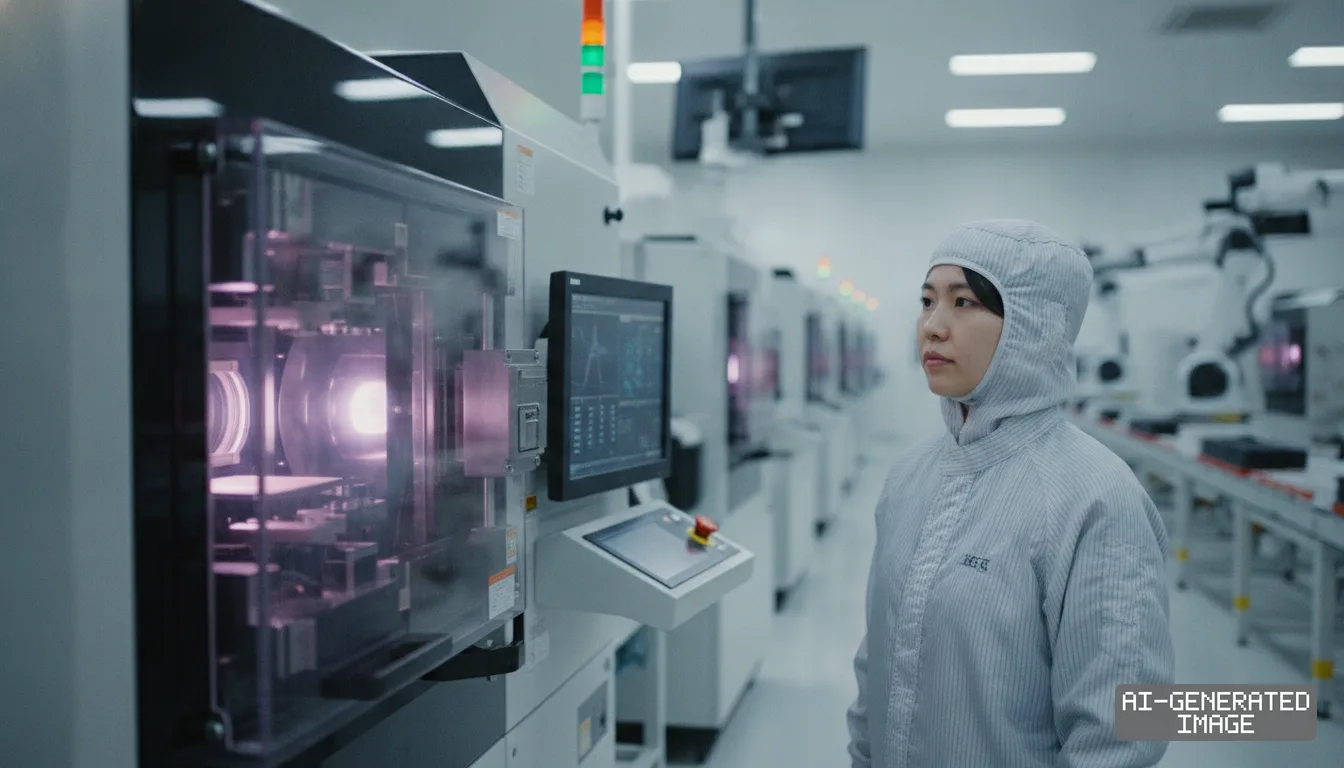
Tokyo Electron raised its full-year operating profit forecast Oct. 30, 2026, citing resilient demand for advanced packaging and leading-edge etching tools used in artificial intelligence processors.
The Japanese chip equipment maker lifted its operating profit projection for the fiscal year ending March 2027 to 1.169 trillion yen ($7.4 billion), an 87.1% increase from the prior year.
Full-year net sales are forecast to reach 3.7 trillion yen ($23.5 billion), up 51.4% from fiscal 2026. The revision marks the first time annual operating income will surpass 1 trillion yen.
Second-quarter revenue reached 935 billion yen ($5.9 billion) for the three months ended Sept. 30. That represented a 27.7% increase from the preceding quarter and a 48.4% jump from a year earlier.
Quarterly operating income climbed 39.7% sequentially to 295.3 billion yen ($1.87 billion), up 86.4% year-on-year. The operating profit margin reached 31.6% during the September quarter, company filings showed.
Cumulative revenue for the first six months totaled 1.6674 trillion yen ($10.6 billion), rising 41.3% year-on-year. Operating profit for the half-year rose 67.2% to 506.7 billion yen ($3.2 billion).
First-half net income grew 56.0% from a year earlier to 376.9 billion yen ($2.4 billion). All three first-half financial figures established record highs for the company, according to its financial statement.
Tool deliveries for dynamic random-access memory (DRAM) drove the revenue expansion. New wafer fab equipment shipments for DRAM surged 45% from the preceding quarter, fueled by server builds.
Surging demand for high-bandwidth memory (HBM) — memory stacks placed next to computing dies — absorbed higher shipments of wafer coating, development and etching tools, the company said.
High-bandwidth memory production requires through-silicon vias, which are vertical electrical connections etched directly through silicon wafers. Tokyo Electron manufactures the specialized dielectric etching platforms used to create those microscopic holes.
The company also provides temporary bonding and debonding systems used to handle thinned wafers. Those systems support advanced packaging, which joins separate chips into a single modular unit.
Foundries also accelerated procurement of extreme ultraviolet (EUV) coater-developer tools for advanced logic chips. Tokyo Electron holds a dominant global market share in coater-developers deployed on EUV lithography lines.
Leading-edge chipmakers order those tools for two-nanometer and three-nanometer logic nodes. Process complexity at smaller geometries increases the number of deposition and etch steps required per finished wafer.
Capital spending for mature legacy nodes softened across several regional markets. Sustained investment in artificial intelligence accelerators and high-density memory clusters compensated for that slower mature-node volume, Tokyo Electron said.
Management noted that artificial intelligence workloads are expanding hardware requirements beyond graphic processors into central processing units, DRAM, NAND flash and solid-state storage. The company described that multi-device spread as a structural driver across wafer fabrication steps.
Shipments of new semiconductor production equipment in the second half will reach 1.56 trillion yen ($9.9 billion), the company said. That projection represents a 59% increase compared to the previous year.
The company forecast the global wafer fab equipment market will reach $160 billion in calendar 2026. It projected the market will expand further to exceed $210 billion in calendar 2027.
Both market projections represent year-on-year growth rates of roughly 30%. Tool spending by memory manufacturers and foundry operators drives the majority of that equipment demand, Tokyo Electron said.
To support manufacturing demand, the company expanded cleanroom capacity at its Miyagi and Kumamoto manufacturing centers. Those facilities produce plasma etching systems and single-wafer cleaning tools shipped to global wafer fabrication plants.
Alongside its earnings release, the company announced a share repurchase program worth up to 150 billion yen ($955 million). The board authorized the buyback to improve capital efficiency and shareholder returns.
The open-market share repurchase begins Nov. 1, 2026, and runs through March 31, 2027. The company previously completed a 1-to-5 stock split that took effect on Oct. 1, 2026.
Tokyo Electron plans to announce its third-quarter financial results on Feb. 5, 2027. Tool delivery schedules across advanced packaging and logic lines will determine whether equipment shipments meet that revised full-year forecast.
The earnings release does not state the exact order backlog figure for advanced packaging systems. Tokyo Electron groups new tool sales into DRAM, non-volatile memory and non-memory categories without publishing product-line sub-totals.
Impact map
How this development propagates across the region and out to global buyers.
| Event | Korea | China | Japan | Global impact |
|---|---|---|---|---|
| AI wafer fab equipment demand surge | Memory makers expand HBM3E and HBM4 capacity, lifting orders for Japanese coating and etching tools | Mature-node tool deliveries moderate amid ongoing export curbs while domestic packaging options ramp slowly | Tokyo Electron posts record H1 profit of 506.7 billion yen on AI-driven DRAM and packaging backlog | Wafer fab equipment market projected to hit |
| AI wafer fab equipment demand surge | Memory makers expand HBM3E and HBM4 capacity, lifting orders for Japanese coating and etching tools | Mature-node tool deliveries moderate amid ongoing export curbs while domestic packaging options ramp slowly | Tokyo Electron posts record H1 profit of 506.7 billion yen on AI-driven DRAM and packaging backlog | Wafer fab equipment market projected to hit $160 billion in 2026 and exceed $210 billion in 2027 |
In this story
- Companies
- Tokyo Electron
- Tickers
- 8035.T
- Impact
- Order BookCapexPricing
Related briefings
- Tokyo Electron nears 1 trillion yen profit on memory capex Also on Tokyo Electron, Pricing, Order Book
- Japan Linear Guide Makers Expand Ultra-Clean Units for 2nm Fab Robotics Also on Tokyo Electron, Pricing, Order Book
- CXMT starts 5th-gen DRAM output, bypassing US tool controls Also on Tokyo Electron, Pricing
- TSMC revenue rises 53% on AI demand to record NT$514 billion Also on Tokyo Electron, Pricing
Sources
Primary documents
Reporting
Confidence: high — how we grade this
The documents behind this briefing are linked above. East Asia Brief produces its English text with AI assistance under human editorial review, and does not translate or republish other outlets' articles. See our methodology and AI policy. Spotted an error? Tell us.
The Morning Brief
What changed in Korean, Chinese and Japanese industry overnight — and what it means for your supply chain. One email, weekday mornings, US time. Free.
The Morning Brief is in preparation. Leave your address and we will write to you once — when the first issue is ready. Nothing before that.