US Delays SK hynix China Export Licenses, Stalling Marcy Fab
Solidigm conditioned a planned $45 billion NAND investment in New York on tool shipments to Dalian as Washington tightens dual-use restrictions on Korean fabs.
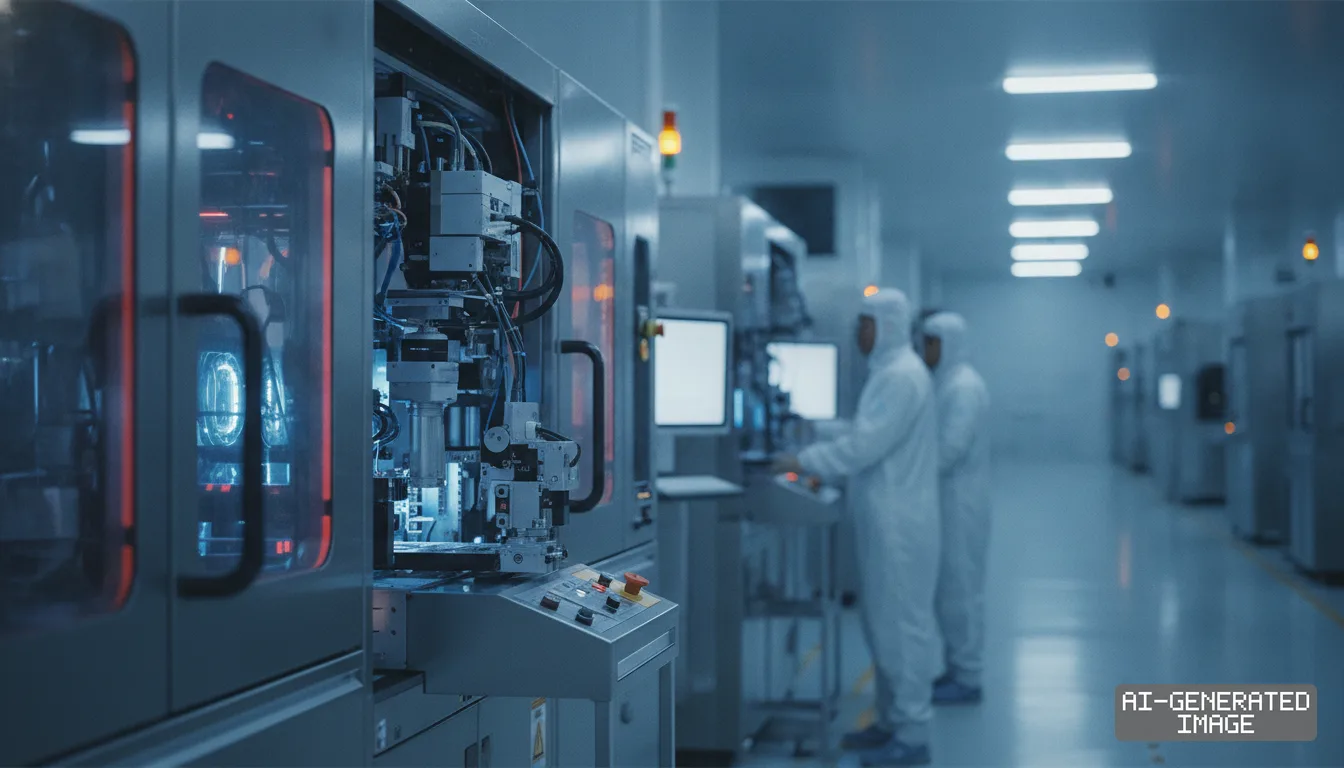
The U.S. Department of Commerce held up export licenses on Nov. 3, 2026 for chipmaking tools bound for SK hynix's fabrication plant in Dalian, China, stalling a proposed $45 billion American expansion.
SK hynix planned to invest about $45 billion across two NAND flash memory plants in Marcy, New York through its Solidigm subsidiary, a project that could potentially expand to $100 billion over time.
The South Korean chipmaker sought to fund the upstate New York site using operational cash generated by installing new equipment inside Module B, an empty cleanroom building at its Dalian fab completed in 2023.
American tool vendors Applied Materials, Lam Research and KLA hold pending shipment orders for the Dalian site. U.S. export controls require individual Commerce Department licenses to deliver advanced deposition, etching and inspection tools into Chinese cleanrooms.
Solidigm relies on the Dalian site for roughly half of its enterprise solid-state drive output. Equipping the remaining cleanroom space would let the company scale production without acquiring greenfield land in East Asia.
Solidigm executives met approximately 10 times with Commerce officials after late August 2026 to negotiate approvals. Federal officials signaled in late October that Washington would not authorize equipment shipments intended to raise production capacity in China.
Commerce Under Secretary Jeffrey Kessler reiterated that export licensing rules prevent foreign chipmakers from upgrading manufacturing nodes in Chinese facilities, according to people familiar with the interagency discussions cited by Reuters on Nov. 3.
Washington granted an annual export authorization for the Dalian facility on Dec. 30, 2025, permitting routine maintenance for calendar year 2026. That waiver followed the expiration of SK hynix's blanket Validated End-User status on Dec. 31, 2025.
SK hynix requested additional licenses to install production machinery in Dalian for 2027 deliveries. Commerce officials have withheld those permits, leaving the memory maker unable to finalize construction schedules or procurement budgets for the New York site.
The Marcy proposal is distinct from SK hynix's advanced packaging facility in West Lafayette, Indiana. The company broke ground on that $3.87 billion packaging site on Aug. 27, 2026, supported by $458 million in federal direct funding.
The Indiana plant processes high-bandwidth memory modules for artificial intelligence graphics processors. The proposed Marcy facility would instead fabricate NAND flash memory wafers, the basic storage components used in enterprise servers and personal computers.
Financing options for the Marcy buildout narrowed before the licensing delays emerged. Solidigm formally ended an internal review of a potential initial public offering on Oct. 23, 2026, closing off an independent equity funding channel.
SK hynix said tool installations in Dalian remain subject to ongoing consultation with U.S. authorities. The company said its procurement requests focus on operational efficiency rather than an unauthorized expansion of total wafer capacity.
Solidigm said it routinely evaluates strategic manufacturing locations worldwide to support memory customers. The company said it has not finalized binding construction plans or capital expenditure commitments for any single site.
The licensing dispute illustrates the structural bind confronting South Korean memory manufacturers. Samsung Electronics and SK hynix operate high-volume fabrication lines in China while simultaneously pledging billions of dollars in domestic U.S. investments under the CHIPS Act.
SK hynix acquired the Dalian complex from Intel in a two-stage transaction valued at $9 billion. The purchase gave the South Korean firm intellectual property and manufacturing lines dedicated to floating-gate NAND flash memory architectures.
Federal CHIPS Act guardrails restrict recipients of U.S. subsidies from expanding leading-edge logic or memory capacity in foreign countries of concern by more than 5%. Equipping Dalian's vacant shell risks breaching those federal national security provisions.
State officials in Albany had hoped the Marcy Nanocenter would host a second major memory project alongside Micron Technology's planned complex in Clay, New York. Wolfspeed currently operates a silicon carbide wafer fab on the Marcy campus.
For Applied Materials, Lam Research and KLA, delayed approvals defer tool deliveries originally slated for early 2027. China accounted for roughly 30% to 40% of revenue across the three U.S. equipment makers during the most recent fiscal quarter.
SK hynix generates the bulk of its operating profit from DRAM and high-bandwidth memory built at Korean fabs in Icheon and Cheongju. NAND memory margins remain thinner, leaving capital expenditures for flash fabs tightly constrained by operating cash.
The current Commerce Department export authorization covering maintenance at Dalian expires on Dec. 31, 2026. SK hynix and U.S. regulators remain in discussions regarding equipment delivery permits for the first quarter of 2027.
The U.S. Department of Commerce has not published a formal license denial, and neither SK hynix nor Solidigm has submitted binding regulatory filings committing capital to the Marcy site or disclosing final plant specifications.
Wafer processing at Dalian continues under the 2026 maintenance authorization while Solidigm evaluates factory proposals from local development authorities in New York and other potential manufacturing hubs.
Impact map
How this development propagates across the region and out to global buyers.
| Event | Korea | China | Japan | Global impact |
|---|---|---|---|---|
| Dalian export license hold | SK hynix delays $45B Marcy NAND project as Dalian Module B cleanroom sits idle | Dalian fab capped at legacy nodes without new U.S. etching and deposition tools | Tokyo Electron faces deferred tool purchase orders as memory upgrades stall | Applied Materials, Lam and KLA see early-2027 deliveries held up by Commerce reviews |
In this story
- Companies
- SK hynix
- Tickers
- 000660.KS
- Exposed
- Applied MaterialsLam ResearchKLAMicron TechnologyWolfspeed
- Policy
- Export Controls
- Impact
- Supply ChainCapexCompliance
Track every Export Controls development →
Related briefings
- Solidigm $45 Billion Fab Speculation Collides With SK hynix Financing Limits Also on Wolfspeed, Micron Technology, SK hynix
- Samsung denies Chinese tool testing as US tightens fab controls Also on KLA, Lam Research, Applied Materials
- Samsung and SK hynix upgrade China memory fabs to 286 layers Also on KLA, Lam Research, Applied Materials
- Nextin wins $18.8 million SK hynix wafer inspection order Also on KLA, SK hynix
Sources
Primary documents
Reporting
Confidence: high — how we grade this
The documents behind this briefing are linked above. East Asia Brief produces its English text with AI assistance under human editorial review, and does not translate or republish other outlets' articles. See our methodology and AI policy. Spotted an error? Tell us.
The Morning Brief
What changed in Korean, Chinese and Japanese industry overnight — and what it means for your supply chain. One email, weekday mornings, US time. Free.
The Morning Brief is in preparation. Leave your address and we will write to you once — when the first issue is ready. Nothing before that.