KT deploys 5G AI welding robots at HD Hyundai Samho yard
A 16 billion won state-backed trial links private 5G standalone networks and AI radio access nodes to automate block fabrication in Yeongam through 2027.
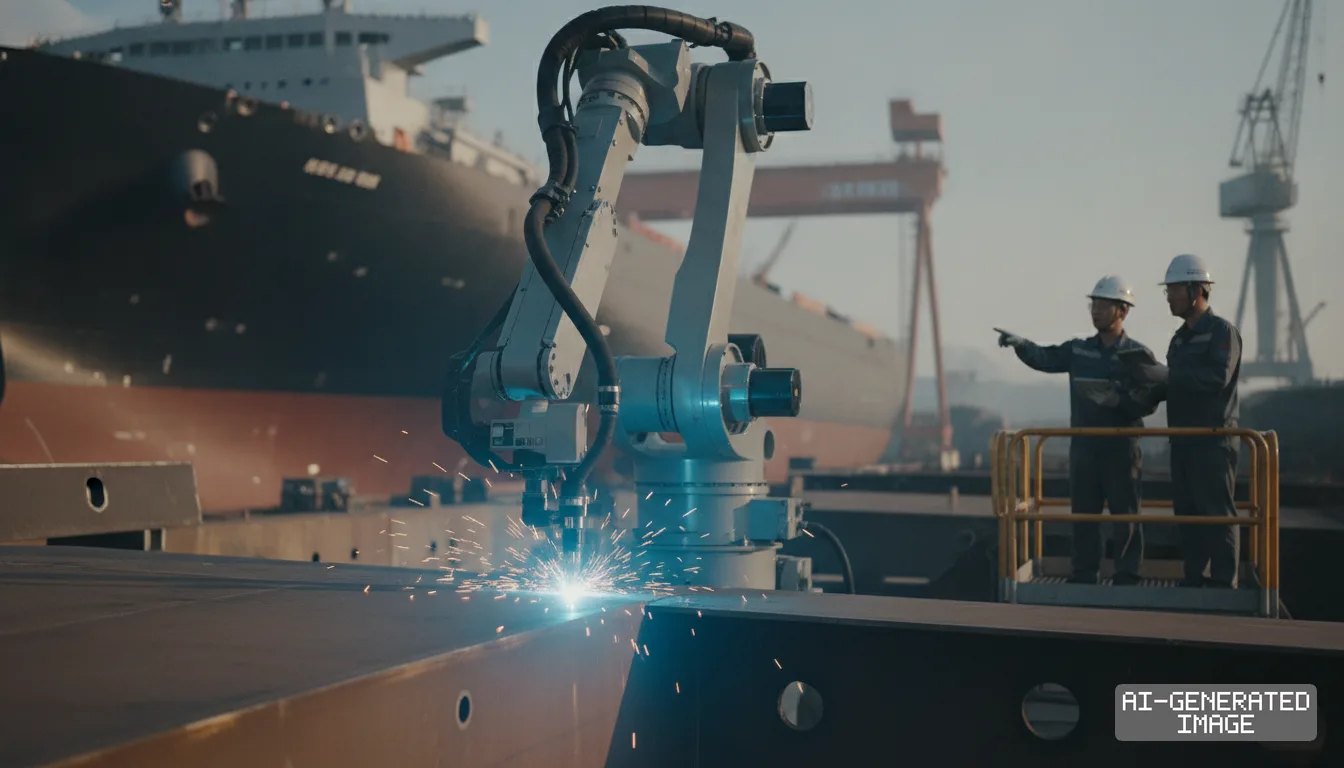
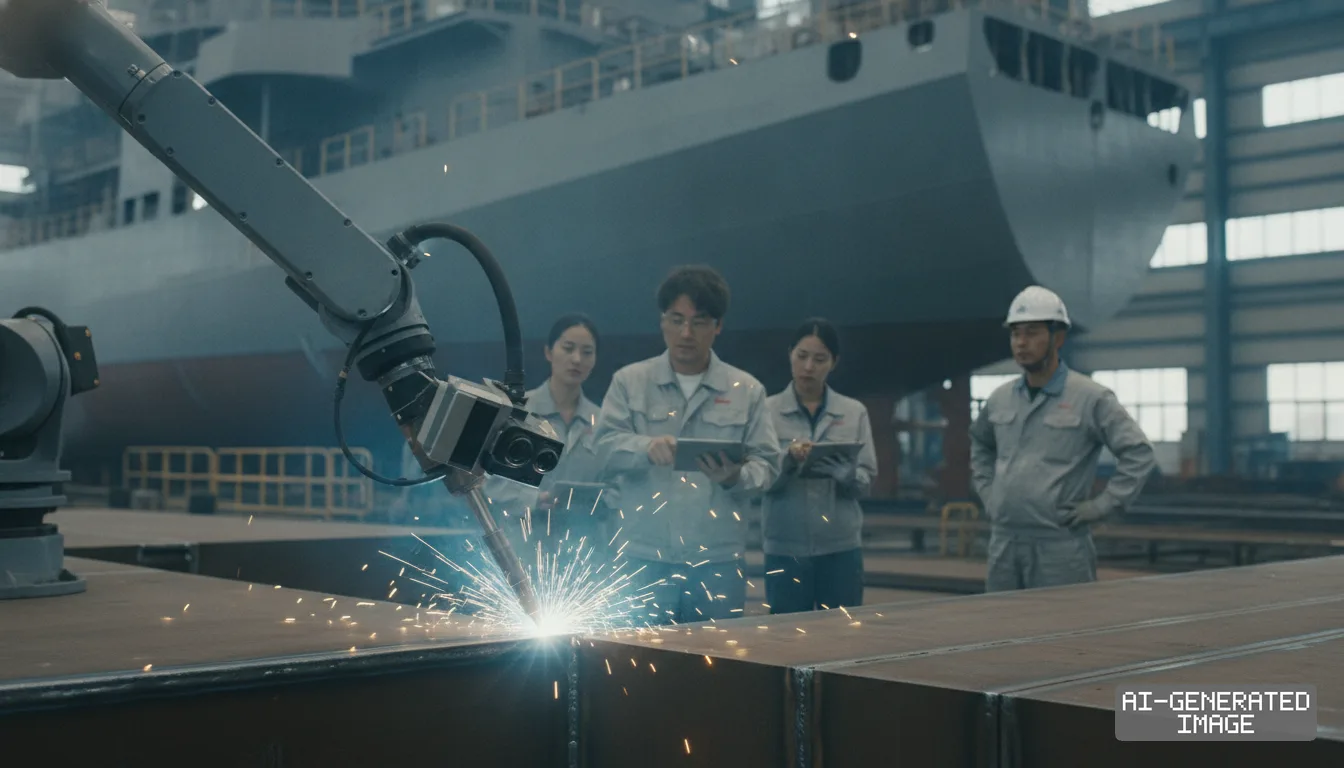
KT began field trials Sept. 11, 2026, of an artificial-intelligence welding robot system operating over dedicated 5G standalone network infrastructure at HD Hyundai Samho's shipyard in Yeongam.
The deployment forms the central testbed of a 16 billion won ($12 million) state project administered by the Ministry of Science and ICT and the National Information Society Agency. The program funds industrial networking through 2027.
The project targets heavy fabrication bottlenecks at HD Hyundai Samho, a shipbuilder that constructs large liquefied natural gas carriers and container vessels. KT leads the operating consortium alongside Samsung Electronics, equipment vendor Solid and academic partners.
South Korean shipbuilders face acute labor shortages among skilled welders and hull painters. The Yeongam trial tests whether high-bandwidth wireless networks can remove human operators from confined, hazardous double-hull blocks without sacrificing joint quality.
Heavy industrial yards present severe physical hurdles for commercial automation. Thick steel bulkheads deflect radio frequency signals, while electrical noise from arc-welding rigs causes high packet loss across standard Wi-Fi or public cellular links.
Existing robotic welding systems operate largely in semi-automated modes. Human technicians must transport the equipment into narrow compartments, align the torches manually and remain on standby to correct mechanical stalls or positional drift.
Previous efforts to add autonomous machine vision struggled with hardware constraints. On-device computing processors add prohibitive weight and drain mobile robot batteries within hours, limiting operational duty cycles inside confined ship spaces.
Offloading processing to remote commercial cloud servers introduced latency spikes of over 50 milliseconds. Those communication lags caused welding heads to overrun seam tolerances and fail structural ultrasonic inspection standards.
To bypass those bottlenecks, the consortium deployed a private 5G standalone (SA) architecture across the yard's block assembly and surface coating workshops. 5G SA uses independent core infrastructure rather than relying on legacy 4G anchor bands.
The private network applies network slicing to partition dedicated radio frequency resources. Robotic control loops run on an isolated slice that guarantees microsecond packet priority, even when yard workers generate peak data traffic nearby.
The infrastructure incorporates AI radio access network (AI-RAN) technology. AI-RAN integrates radio transmission equipment with distributed graphics processing unit (GPU) edge servers installed directly inside the fabrication facility.
By running computing tasks at the base station level, the system executes real-time computer vision inference within single-digit milliseconds. The setup removes bulky computing payloads from the mobile robots without relying on external cloud data centers.
Under the trial protocol, HD Hyundai Samho introduced quadrupedal walking robots equipped with articulated welding arms. The four-legged chassis traverses uneven steel floors, climbing over structural ribs and temporary piping that halt wheeled platforms.
Cameras and optical sensors mounted on the robot feed continuous high-resolution video across the 5G uplink. Edge GPUs process the imagery to map seam trajectories and automatically adjust voltage, wire-feed speed and torch angles in real time.
The trial also encompasses autonomous hull coating robots. These mobile units scan curved steel plate surfaces, identify bare patches through visual segmentation algorithms and spray protective coatings with uniform thickness.
Replacing human sprayers inside enclosed double hulls mitigates direct exposure to toxic volatile organic compounds. Automated application also reduces paint overspray waste, lowering input material costs on large commercial vessels.
KT and Samsung Electronics are testing multi-vendor interoperability for the radio gear at KT's research center in Umyeon-dong, southern Seoul. The facility evaluates reduced-capability (RedCap) lightweight 5G modems designed to trim component costs and sensor power consumption.
The telecom carrier plans to use operational logs from Yeongam to calibrate its proprietary AI network orchestrator. That software monitors traffic patterns across radio cells and reroutes spectrum bandwidth autonomously before signal interference degrades robotic telemetry.
For commercial yards, automation is becoming an operational necessity rather than a marginal efficiency gain. Shipyards in South Korea hold vessel delivery order books stretching past 2028, but domestic recruitment of certified manual welders continues to fall.
Shipbuilders have relied increasingly on subcontracted foreign labor to meet tight construction delivery schedules. Automating structural welding and blasting operations stabilizes yard productivity and shields operating margins from rising industrial wage rates.
The consortium will continue field validation at the Yeongam shipyard through December 2027. Project participants plan to test autonomous communications equipment maintenance robots alongside the primary welding units during the second development phase.
The project notices do not specify the total number of robotic systems to be deployed across the yard, and HD Hyundai Samho has not published a target date for full commercial adoption.
Impact map
How this development propagates across the region and out to global buyers.
| Event | Korea | China | Japan | Global impact |
|---|---|---|---|---|
| AI-RAN shipyard robotic network | HD Hyundai Samho cuts block assembly labor exposure across Yeongam drydocks | CSSC yards maintain labor-heavy manual welding lines, widening tech gap | Imabari Shipbuilding accelerates sensor retrofits on gantry cranes | Commercial shipyard berth turnaround times contract as structural welding automates |
In this story
- Companies
- KTHD Hyundai Samho
- Tickers
- 030200.KS
- Exposed
- Samsung ElectronicsSolid
- Policy
- Subsidies
- Impact
- Supply ChainCost StructureCapex
Track every Subsidies development →
Related briefings
- South Korea engine builders expand methanol test benches for 2027 ship handoffs Also on HD Hyundai Samho
- SK hynix and foundries advance hybrid bonding for AI silicon in 2027 Also on Samsung Electronics
- Samsung opens Yokohama chip packaging lab to rival TSMC lead Also on Samsung Electronics
- US chip suppliers commit $2 billion to South Korea semiconductor supply chain Also on Samsung Electronics
Sources
Reporting
Confidence: medium — how we grade this
The documents behind this briefing are linked above. East Asia Brief produces its English text with AI assistance under human editorial review, and does not translate or republish other outlets' articles. See our methodology and AI policy. Spotted an error? Tell us.
The Morning Brief
What changed in Korean, Chinese and Japanese industry overnight — and what it means for your supply chain. One email, weekday mornings, US time. Free.
The first issue goes out shortly. Sign up now and you will not miss it.