Doosan Robotics names Kwon Young-min CEO to reverse losses
The collaborative robot maker is shifting resources toward turnkey automated software after losing 26.5 billion won in the first half of 2026 despite booking 236% revenue growth.
Doosan Robotics implemented a sweeping executive transition on Sept. 22, 2026, deploying industrial machinery veteran Kwon Young-min as chief executive to turn its fast-growing collaborative robotic systems into a profitable automation business.
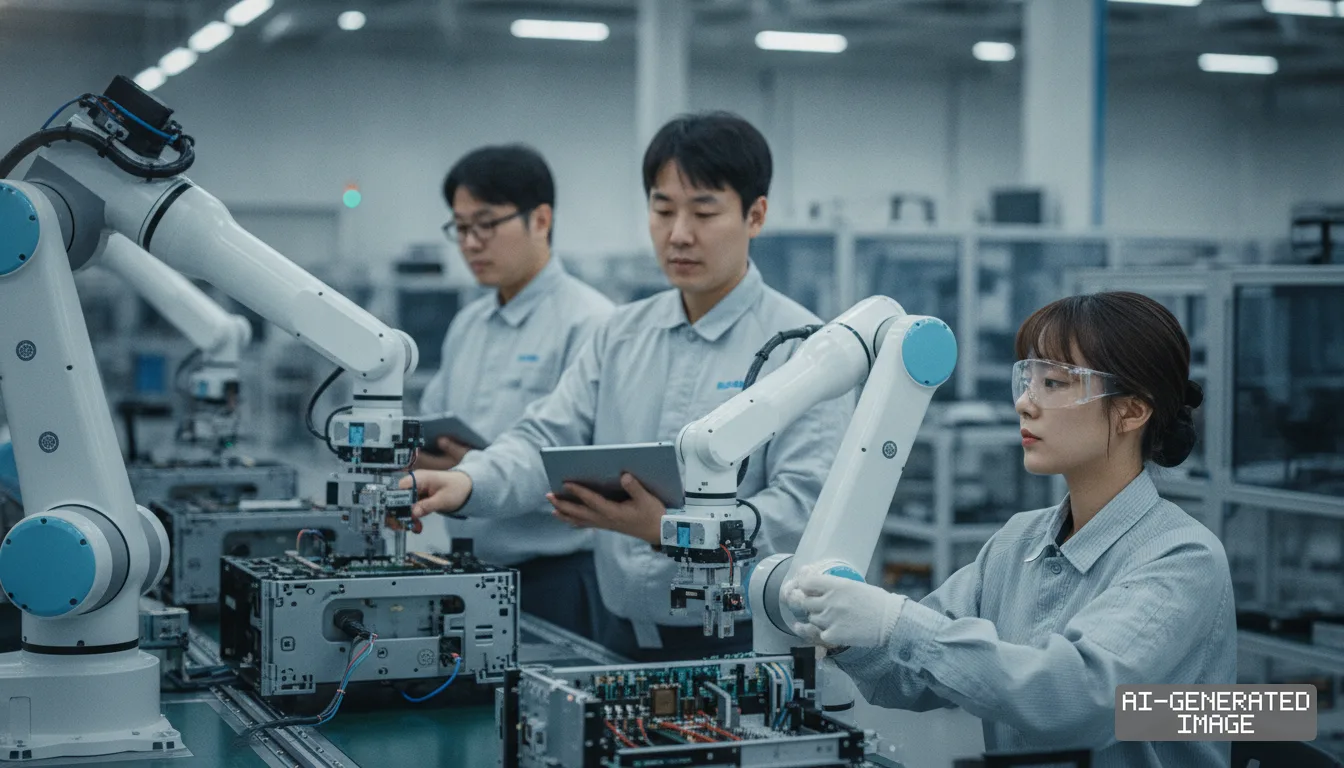
The company is South Korea's largest manufacturer of collaborative robots — lightweight articulated arms designed to operate alongside factory personnel without safety fences. The management shakeup follows persistent red ink across the group's robotics portfolio.
Doosan Robotics posted 32.97 billion won ($24.8 million) in consolidated revenue for the first half of 2026, up 236% over the prior year. Operating losses reached 26.49 billion won ($19.9 million) over the same six months.
The top-line jump stems from integrating overseas solution providers, yet operating cash flow remained negative at 18.7 billion won ($14.1 million) through June. The incoming leadership team takes over a company facing steep commercialization hurdles.
The board formally named Kwon following an initial personnel announcement on Sept. 18. Kwon replaces Kim Min-pyo, who departed 18 months ahead of his three-year mandate under the company's prior three-person co-chief executive structure.
The prior leadership group included co-chief executives Park In-won, Cho Gil-sung and Kim, who joined the board on March 31, 2025. That three-way management model struggled to contain costs as sales expanded into overseas markets.
Doosan Robotics recorded an operating loss of 41.2 billion won ($31 million) in 2024. That operating deficit widened to 59.5 billion won ($44.7 million) in 2025, driven by overseas marketing expenses and research outlays.
Kwon previously served as chief executive of hydraulic component builder Doosan Mottrol from 2021 until this month. He joined parent company Doosan Corp. in 2000 within the conglomerate's strategic planning division.
His industrial background includes overseeing sales in China for Doosan Infracore and serving as chief strategy officer for equipment maker Doosan Bobcat between 2018 and 2020. Kwon holds an engineering degree from Yonsei University and an accounting master's degree from the University of Illinois.
The executive appointment signals an operational pivot away from selling standalone robot hardware. Doosan Robotics plans to concentrate capital on integrated process automation packages combining artificial intelligence vision with precision machine control.
Selling standalone robotic arms exposed the company to margin pressure from Chinese hardware rivals. Providing complete automation suites allows the manufacturer to capture system integration charges and recurring software maintenance contracts.
North America serves as the primary testing ground for this commercial realignment. The regional market accounted for 53% of the company's total revenue during the first six months of 2026.
That regional footprint expanded after Doosan Robotics paid 35.6 billion won ($26.8 million) in July 2025 to acquire an 89.59% stake in ONExia, an automation specialist based in Pennsylvania.
ONExia builds turnkey automation cells tailored for end-of-line packaging and palletizing tasks across industrial warehouses. The acquired business held an order backlog of approximately $15 million at the time of integration.
Doosan Robotics merged its local subsidiary into the Pennsylvania facility to build domestic production lines. The regional hub supplies completed robotic systems directly to North American consumer goods and automotive factories.
The manufacturer also expanded its balance sheet liabilities to fund that international buildout. The company secured a 50 billion won ($37.6 million) long-term bank facility during the first half of 2026.
That credit line marked the company's first long-term debt issuance since its founding. The borrowing raised the corporate debt-to-equity ratio to 34.21% at the end of June, up from 14.57% at the close of 2025.
Cash reserves and liquid short-term financial instruments stood at 252.36 billion won ($189.7 million) on June 30. That liquidity pool provides sufficient capital runway to reorganize manufacturing lines and expand software development teams.
The restructuring plan includes deploying physics-informed AI models to reduce installation setup times at client facilities. Reducing programming overhead allows field technicians to deploy robotic palletizing stations within hours rather than weeks.
Industrial clients increasingly demand guaranteed payback schedules before approving automation budgets. Turnkey integration allows Doosan Robotics to price projects based on labor displacement metrics rather than bare machinery list prices.
Parent firm Doosan Corp. retains operational control over the robotics business with a 49.98% equity holding as of June 30. The parent group reduced its ownership stake from 68.11% through secondary block sales earlier this year.
Doosan Robotics faces rising pressure to demonstrate positive quarterly operating margins before its cash balances erode. Competitors in Japan and Europe already operate profitable specialized automation arms alongside their base machinery production lines.
The regulatory filing does not show a formal disclosure of the chief executive change on South Korea's Financial Supervisory Service repository as of Sept. 22, 2026, leaving the registration timeline unconfirmed.
The company is scheduled to report third-quarter financial results to the Korea Exchange in mid-November 2026. That disclosure will provide the first audit of Kwon's cost controls and integration progress across the North American business units.
Impact map
How this development propagates across the region and out to global buyers.
| Event | Korea | China | Japan | Global impact |
|---|---|---|---|---|
| Doosan Robotics CEO transition and automation pivot | Doosan Robotics overhauls executive suite after 26.49 billion won half-year operating loss | Infracore sales expertise leveraged as Chinese cobot hardware price pressure intensifies | Fanuc and Yaskawa face renewed competition in North American palletizing and packaging cells | Industrial robotic arm market shifts from hardware sales to turnkey SI solutions worth 53% of revenue |
In this story
- Companies
- Doosan Robotics
- Tickers
- 454910.KS
- Exposed
- ONExiaDoosan Bobcat
- Impact
- CapexOrder BookCost Structure
Related briefings
- Doosan Robotics targets 2028 humanoid trials on factory lines Also on Doosan Robotics, Order Book
- LG taps Samsung Foundry for appliance AI chips under Korean state project Also on Doosan Robotics, Order Book
- Korean electronics component suppliers deploy AI dual-arm robots as factory labor pool shrinks Also on Doosan Robotics, Cost Structure
- Doosan Robotics links cobots to peaq to verify machine logs Also on Doosan Robotics
Sources
Reporting
Confidence: medium — how we grade this
The documents behind this briefing are linked above. East Asia Brief produces its English text with AI assistance under human editorial review, and does not translate or republish other outlets' articles. See our methodology and AI policy. Spotted an error? Tell us.
The Morning Brief
What changed in Korean, Chinese and Japanese industry overnight — and what it means for your supply chain. One email, weekday mornings, US time. Free.
The Morning Brief is in preparation. Leave your address and we will write to you once — when the first issue is ready. Nothing before that.