Doosan Robotics links cobots to peaq to verify machine logs
The collaborative robot maker deployed its first A-series arm on peaqOS to convert joint torque telemetry into tamper-proof operating proofs for industrial equipment lenders.
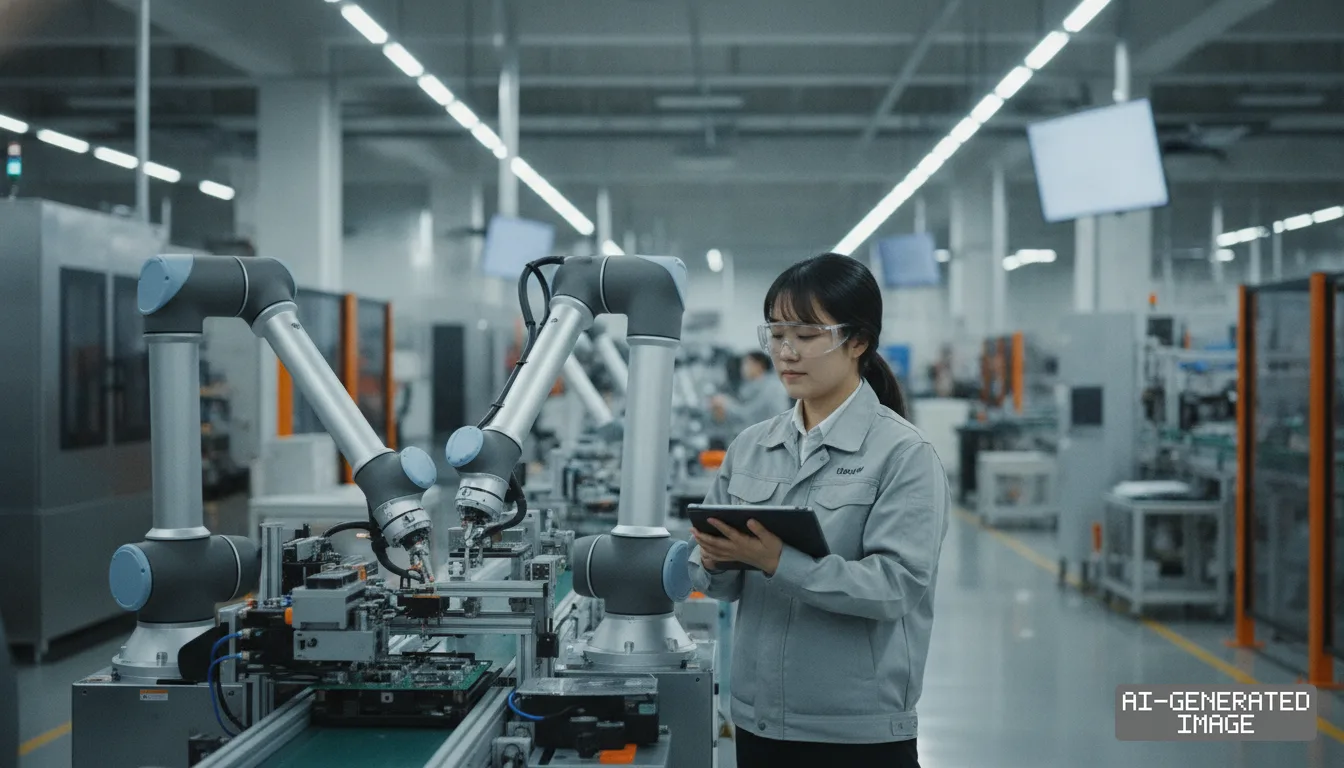
Doosan Robotics teamed up with decentralized infrastructure network peaq on Sept. 18, 2026, to verify collaborative robot operating data on-chain for industrial equipment financing and automation.
Doosan Robotics ranks among the world's five largest collaborative robot manufacturers. The Suwon-based company exports six-axis cobots across 45 countries for precision assembly, palletizing and machine tending.
The pilot project deploys peaqOS Pro across one A-series arm, the initial unit of Doosan's commercial fleet targeted for verifiable telemetry integration.
European technology investor Advanced Blockchain AG announced the partnership through a regulatory corporate filing on Sept. 18, 2026. The German firm incubated peaq to connect real-world machines with decentralized digital ledgers.
Collaborative robots, or cobots, work alongside humans in factory cells without safety cages. Small and medium enterprises use them to automate high-mix, low-volume manufacturing lines.
Financing these machines remains an obstacle for small manufacturing plants across Europe and East Asia. Commercial lenders examine corporate balance sheets rather than equipment productivity when issuing machinery leases.
Under traditional lending criteria, smaller workshops with weak financial statements pay steep borrowing premiums. Lenders cannot verify whether an installed cobot operates reliably or sits idle on factory floors.
Secondary equipment markets face identical challenges when appraising used industrial machinery. Buyers and insurers lack independent records detailing how heavily previous owners taxed internal gears and joints.
The partnership addresses these valuation gaps by converting physical operating logs into verifiable digital records. Telemetry from the machine generates an objective operational history accessible to third-party underwriters.
Doosan Robotics uses factory-installed torque sensors embedded across all six articulation joints of the robot arm. The setup eliminates the need for retrofitted hardware or external monitoring attachments.
Joint torque sensors measure actual mechanical force and structural strain during production cycles. Standard industrial arms typically estimate payload loads from motor electrical currents, introducing measurement drift.
Factory operators often refuse outside data connections to protect sensitive manufacturing processes. Plant managers fear external network links could reveal proprietary cycle times, component specifications or output targets.
The joint technical stack resolves corporate privacy concerns through local edge computing. All raw motion logs and sensor calculations remain confined inside the internal robot controller.
The edge processor generates cryptographic attestations — mathematical proof values confirming that logged operations occurred. Only these zero-knowledge proof summaries upload to the public blockchain registry.
External financial institutions verify equipment utilization, working hours and load stresses through the digital registry. Lenders evaluate machine creditworthiness without accessing proprietary production files or camera feeds.
Physical AI is central to where we are taking this company, Michael Ryu, head of Europe at Doosan Robotics, said in the partnership release.
The software architecture also tests automated monetization mechanisms for idle robot capacity. When an arm pauses between scheduled assembly shifts, its processor can sell idle compute cycles.
Revenues earned from distributed edge computing tasks deposit into a digital wallet assigned to the robot. The funds can offset monthly lease obligations or finance routine maintenance services automatically.
Doosan Robotics plans to evaluate integrating the software with its Dart-Suite application environment. Dart-Suite serves as a proprietary application marketplace where factory engineers download customized manufacturing programs directly to robots.
The demonstration phase assigns the first connected A-series unit to the Technical University of Munich. Supervised student engineering teams are building decentralized machine applications in Germany.
The university cohort is preparing for the robot.innovate hackathon running from Oct. 23 to Oct. 28, 2026. The competition brings international developers to Munich Urban Colab and the Garmisch campus.
Teams will develop policy-governed autonomy protocols on a Doosan A0509 model. The software must constrain autonomous inspection and pick-and-place tasks within authorized operating boundaries.
Following the hackathon, the companies plan to widen field testing to commercial manufacturing plants. The program will expand data verification capabilities across Doosan's broader product portfolio.
The initiative aligns with broader industrial modernization programs across South Korea and Germany. Factory automation providers are testing software layers that transform production equipment into independent economic actors.
Network operator peaq introduced its Economics 2.0 system upgrade on Sept. 7, 2026. The protocol connects physical machine registration fees directly to token burn mechanisms on mainnet.
The corporate filings do not identify prospective banking partners, commercial loan facility limits or underwriting interest rates for the machine-rating pilot.
Doosan Robotics did not submit a regulatory filing on the pilot to South Korea's Financial Supervisory Service. Capital spending for the early validation trials fell below mandatory statutory disclosure thresholds.
Commercial deployment reviews will begin after the Munich hackathon concludes on Oct. 28, 2026. The partners plan to present technical evaluation results to industrial automation clients later that quarter.
Impact map
How this development propagates across the region and out to global buyers.
| Event | Korea | China | Japan | Global impact |
|---|---|---|---|---|
| machine telemetry on-chain | Doosan Robotics deploys verified operating records across A-series cobot fleet | no direct exposure, domestic cobot makers retain standard balance-sheet leasing | FANUC and Yaskawa maintain proprietary telemetry without public on-chain credit proofs | equipment lenders gain verifiable machine-run data to appraise residual collateral value |
In this story
- Companies
- Doosan Robotics
- Tickers
- 454910.KS
- Exposed
- Advanced Blockchain AGUniversal Robots
- Policy
- Economic Security
- Impact
- Supply ChainCompliance
Track every Economic Security development →
Related briefings
- Bigwave Robotics partners with automation suppliers to scale US physical AI Also on Universal Robots, Compliance
- Doosan Robotics targets 2028 humanoid trials on factory lines Also on Doosan Robotics
- LG taps Samsung Foundry for appliance AI chips under Korean state project Also on Doosan Robotics
- Korean electronics component suppliers deploy AI dual-arm robots as factory labor pool shrinks Also on Doosan Robotics
Sources
Reporting
Confidence: medium — how we grade this
The documents behind this briefing are linked above. East Asia Brief produces its English text with AI assistance under human editorial review, and does not translate or republish other outlets' articles. See our methodology and AI policy. Spotted an error? Tell us.
The Morning Brief
What changed in Korean, Chinese and Japanese industry overnight — and what it means for your supply chain. One email, weekday mornings, US time. Free.
The Morning Brief is in preparation. Leave your address and we will write to you once — when the first issue is ready. Nothing before that.