Daifuku expands cleanroom transport backlogs as Asian chipmakers accelerate fab builds
Surging orders for overhead hoist transport systems across Japanese, Taiwanese, and South Korean wafer fabs lift cleanroom logistics backlogs to multi-year highs.
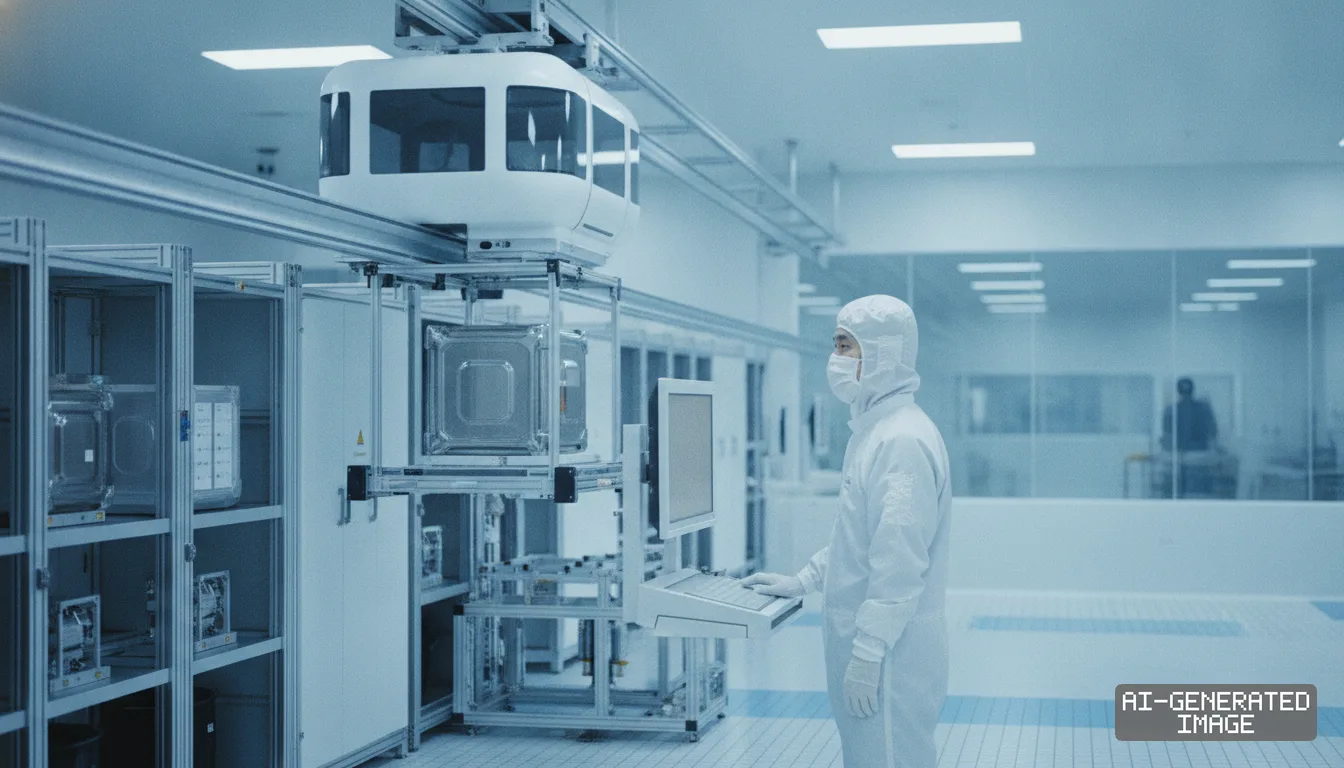
Daifuku Co., Ltd. has recorded an expansion in its cleanroom automated material handling system order book, driven by simultaneous installations of overhead hoist transport networks across newly constructed semiconductor and advanced display facilities in East Asia. The Osaka-based factory automation manufacturer has scaled assembly operations at its primary Shiga Works production hub to deliver specialized ceiling-mounted rail systems, automated storage stockers, and robotic transfer pods designed for 300-millimeter wafer fabrication plants.
The surge in equipment contracts reflects an unprecedented overlap of greenfield wafer fab construction across Japan, Taiwan, and South Korea. Automated material handling systems, commonly designated as AMHS in fab engineering, represent the primary mechanical backbone inside modern cleanrooms. Because human presence generates particulate contamination that destroys microscopic circuit patterns on silicon wafers, advanced fabs operate under full mechanical enclosure. Daifuku designs and builds the overhead hoist transport (OHT) vehicles that glide along high-precision ceiling tracks at speeds exceeding five meters per second, picking up and setting down Front Opening Unified Pods (FOUPs) directly onto the load ports of photolithography, etch, chemical vapor deposition, and inspection tools.
In Japan, the rollout centers on major regional fab construction sites where production lines are moving from structural shell completion to internal cleanroom fit-out. Daifuku has secured installation packages for Japan Advanced Semiconductor Manufacturing (JASM) in Kumamoto Prefecture, where the second fab structure requires thousands of meters of continuous overhead rail to connect front-end process bays. Simultaneously, the company has deployed engineering integration teams to Chitose, Hokkaido, where Rapidus Corporation is constructing its IIM-1 facility targeting 2-nanometer prototype manufacturing. Additional domestic installations include cleanroom logistics upgrades at Kioxia Corporation and Western Digital joint venture cleanrooms in Kitakami, Iwate Prefecture, and Micron Technology fab expansions in Hiroshima.
The technical specifications required for latest-generation wafer fabs have raised the barrier to entry for cleanroom logistics hardware. In facilities housing extreme ultraviolet (EUV) photolithography systems, mechanical vibration transmitted from ceiling tracks through structural trusses can interfere with sub-nanometer optical alignment. Daifuku has engineered linear motor-driven OHT carriers equipped with active magnetic dampening and non-contact power supply rails to eliminate particulate friction and suppress mechanical oscillation below micro-g acceleration thresholds. The vehicles interface with processing machinery via standardized optical communication transceivers complying with SEMI E84 and SEMI E87 protocols, ensuring millisecond-level handshake timing during pod handoffs.
Beyond the Japanese domestic market, Daifuku is executing extensive delivery contracts in Taiwan and South Korea, where front-end memory and foundry operators are scaling high-density multi-level cleanrooms. In South Korea, Samsung Electronics and SK hynix are integrating high-bay automated storage and retrieval systems (AS/RS) that act as vertical buffer stockers between cleanroom levels, bridging overhead transport loops across multiple stories in mega-scale fab structures at Pyeongtaek and Cheongju. In Taiwan, ongoing foundry expansions across Tainan, Taichung, and Hsinchu require complex cleanway junction switches to maintain continuous vehicle throughput without traffic bottlenecks in high-density process areas.
The delivery cycle for cleanroom material handling systems enforces strict sequencing on fab construction schedules. Structural ceiling grids, seismic bracing, power rails, and primary track loops must be fully installed, certified to Class 1 cleanroom cleanliness standards, and dynamically tested before commercial process tools from vendors such as ASML, Tokyo Electron, and Applied Materials can be moved onto the fab floor. A delay in track deployment pushes back tool hookup schedules and commercial wafer output dates. To mitigate delivery risks, Daifuku has established localized pre-assembly facilities near major industrial clusters in Kumamoto, Hsinchu, and Gyeonggi Province, allowing mechanical track segments to be pre-wired and tested prior to cleanroom delivery.
Competition within the cleanroom automation market remains concentrated among a small group of specialized precision engineering firms. Daifuku competes directly with Kyoto-based Murata Machinery, known as Muratec, which holds major market positions in Japanese and Taiwanese fabs, as well as South Korean specialized equipment makers including SEMES and SFA Engineering, which supply domestic memory lines. Despite regional competition, Daifuku maintains an extensive installed base across global 300-millimeter fabs, supported by proprietary software packages that coordinate real-time dispatch algorithms for thousands of active vehicles operating on a single track network.
Supply chain lead times for high-grade structural aluminum extrusions, precision linear induction motor coils, and optical collision-avoidance sensors have stabilized compared to previous procurement cycles, enabling Daifuku to maintain predictable delivery timelines for contracts scheduled through 2027. The company operates dedicated cleanroom testing facilities at its Komaki and Shiga plants, where complete customer bay layouts are simulated under production loads to validate traffic routing software before on-site installation.
Daifuku is scheduled to report its next quarterly financial figures in November 2026, when updated order intake totals for its Cleanroom Production-Line Systems division will confirm regional installation delivery rates across East Asian semiconductor manufacturing centers.
Impact map
How this development propagates across the region and out to global buyers.
| Event | Korea | China | Japan | Global impact |
|---|---|---|---|---|
| Cleanroom AMHS deployment | memory fab stocker expansion | display logistics delivery | advanced foundry rail buildouts | fab tool move-in sequencing |
In this story
- Companies
- Daifuku Co.Ltd.
- Tickers
- 6383.T
- Exposed
- Rapidus CorporationSamsung ElectronicsSK hynixMurata MachineryTokyo Electron
- Policy
- Economic SecuritySubsidies
- Impact
- Supply ChainOrder BookCapex
Track every Economic Security development → Track every Subsidies development →
Related briefings
- SFA targets 95% unmanned logistics as chip gear sales double Also on Murata Machinery, Order Book
- Japan METI allocates clean power grid grants to anchor Hokkaido semiconductor hub Also on Rapidus Corporation, Tokyo Electron
- Japan mask blank makers qualify High-NA EUV substrates for sub-2nm chips Also on Rapidus Corporation, Samsung Electronics
- Japan Linear Guide Makers Expand Ultra-Clean Units for 2nm Fab Robotics Also on Ltd., Tokyo Electron, Order Book
Sources
This briefing carries no sources block. It was written from our desks’ working knowledge of the sector rather than from documents retrieved for this piece. Read it as orientation and check any figure you intend to act on — how we source briefings.
This briefing carries no linked sources: it was written from our desks' working knowledge of the sector rather than from documents retrieved for this piece. East Asia Brief publishes no citation it cannot link. Our English text is produced with AI assistance under human editorial review. See our methodology and AI policy. Spotted an error? Tell us.
The Morning Brief
What changed in Korean, Chinese and Japanese industry overnight — and what it means for your supply chain. One email, weekday mornings, US time. Free.
The Morning Brief is in preparation. Leave your address and we will write to you once — when the first issue is ready. Nothing before that.