Japan METI allocates clean power grid grants to anchor Hokkaido semiconductor hub
The Ministry of Economy, Trade and Industry will fund dedicated renewable transmission and substation assets to guarantee zero-carbon electricity for advanced wafer fabs in Chitose.
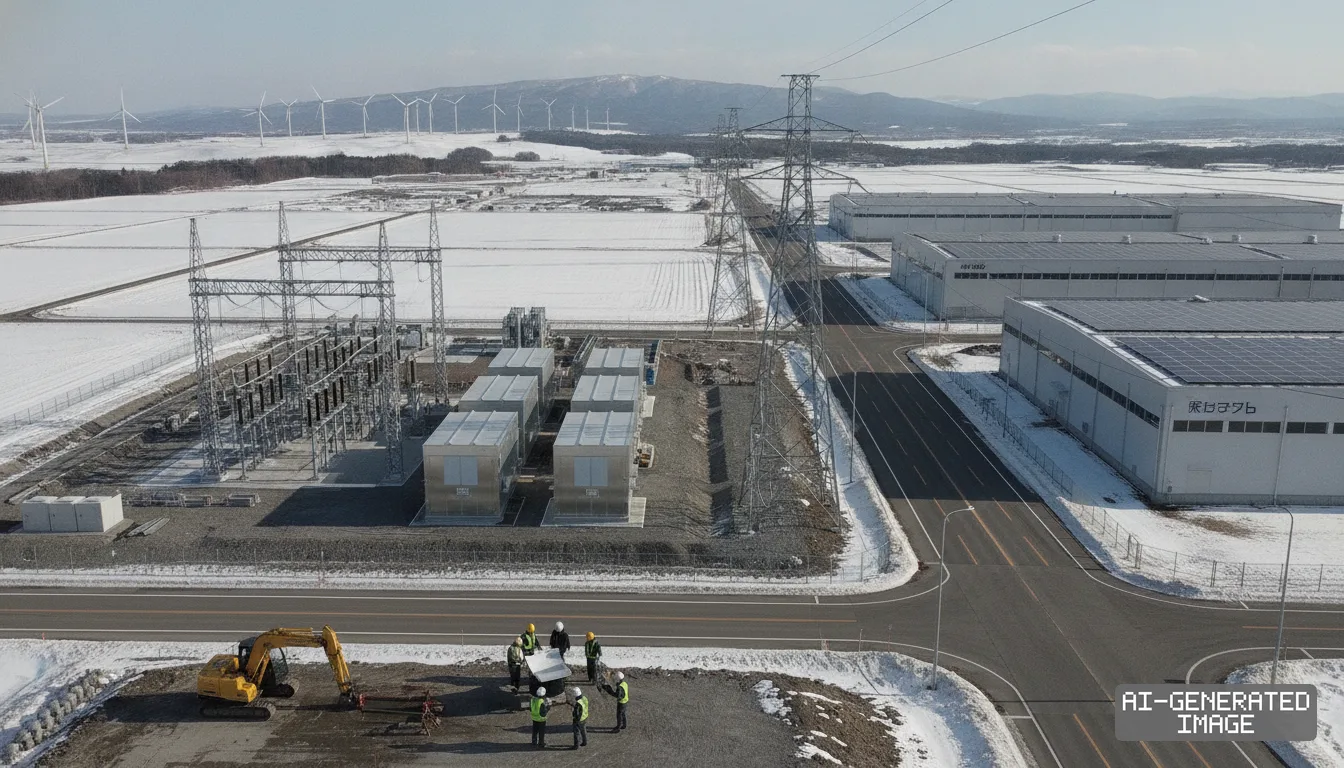
Japan's Ministry of Economy, Trade and Industry has allocated targeted regional infrastructure grants to expand power transmission networks and dedicated clean energy supplies for semiconductor manufacturing in Hokkaido. The capital deployment, administered through the Agency for Natural Resources and Energy under Japan's Green Transformation framework, funds high-voltage grid upgrades, utility-scale battery storage, and substation interconnections connecting renewable generation zones to the industrial corridor in Chitose.
The initiative addresses the power requirements of domestic advanced chip manufacturing, where extreme ultraviolet lithography systems and cleanroom operations create heavy, non-fluctuating electricity demand. Hokkaido possesses Japan's largest technical potential for onshore wind, offshore wind, and solar power generation, but regional grid constraints and bottlenecked interconnectors have historically stranded surplus clean electricity within northern generation basins.
Under the grant mechanism, METI provides direct capital subsidies covering up to half of eligible project costs for transmission lines, transformer substations, and power-conditioning facilities. The financial allocations flow to regional transmission operators and infrastructure consortia working alongside Hokkaido Electric Power Company to establish dedicated high-voltage lines running directly into the Chitose industrial park. The infrastructure buildout synchronizes grid capacity with the scheduled ramp-up of the Rapidus Corporation pilot line and full-scale 2-nanometer fabrication facility, known as Innovative Integration for Manufacturing.
The operational economics of leading-edge semiconductor foundries require continuous electrical supply with zero millisecond-level interruptions. A modern 300-millimeter advanced logic wafer fab operating multi-patterning EUV tools consumes between 100 megawatts and 150 megawatts of continuous electrical load, equivalent to the residential consumption of an urban municipality. Operating these facilities under strict institutional carbon-neutrality mandates requires continuous access to certified renewable sources, rather than relying on grid mixes dominated by imported liquefied natural gas and thermal coal.
METI structured the funding package across three distinct infrastructure tranches to resolve transmission bottlenecks between northern generation hubs and the southern industrial basin. The first tranche finances the construction of high-capacity subterranean and overhead transmission links connecting northern Hokkaido wind corridors directly to the Ishikari and Chitose load centers. The second tranche co-funds high-capacity lithium-ion and flow battery storage facilities situated adjacent to critical distribution substations, designed to absorb frequency variations inherent to intermittent wind generation.
The third tranche underwrites substation transformations that interface private industrial microgrids with the main Hokkaido regional transmission network. That arrangement permits advanced semiconductor fabs to enter into direct off-site corporate power purchase agreements with regional renewable developers without incurring destabilizing transmission wheeling surcharges. The practical consequence for semiconductor operators is a stabilized levelized cost of electricity, mitigating the volatility of imported fossil fuels that drove Japanese retail industrial power tariffs higher over the preceding three years.
The Hokkaido project serves as a test case for Japan's broader industrial policy integration, where state semiconductor capital injections are paired simultaneously with heavy utility infrastructure grants. In southern Japan, rapid semiconductor expansion around Kumamoto Prefecture strained local transport and water distribution infrastructure, prompting retrospective public expenditures to upgrade surrounding public utilities. In Hokkaido, METI structured the energy grid subsidization ahead of full-scale commercial manufacturing operations to prevent power shortages and grid imbalances before high-volume cleanroom operations begin.
Beyond local consumption in Chitose, the grid investment links into the planned Hokkaido-Honshu high-voltage direct current subsea transmission interconnector project. That subsea project, managed under the Organization for Cross-regional Coordination of Transmission Operators, aims to expand bi-directional power transmission capacity between Hokkaido and the Tohoku-Tokyo consumption regions to 1.2 gigawatts. The local transmission reinforcements funded by the new METI grants ensure that power generated by northern offshore wind projects can support both the regional chip cluster and feed baseload green power southward during fabrication maintenance shutdowns.
Private energy developers and industrial infrastructure funds have commenced procurement tenders for high-voltage transformers, switchgear, and utility-scale battery cells required for the substation expansion. Equipment delivery schedules and site preparation in the Chitose utility corridor are structured to achieve electrical energization ahead of scheduled tool installations. METI will audit project milestones semi-annually under national statutory standards governing Green Transformation capital disbursements, with the first progress assessment scheduled for the conclusion of the current fiscal half.
Impact map
How this development propagates across the region and out to global buyers.
| Event | Korea | China | Japan | Global impact |
|---|---|---|---|---|
| Clean grid subsidies | fab utility competition | grid investment watch | Hokkaido chip cluster grid secured | green logic chip procurement |
In this story
- Companies
- Hokkaido Electric Power CoRapidus Corporation
- Tickers
- 9509.T
- Exposed
- Tokyo Electron
- Policy
- SubsidiesEconomic Security
- Impact
- Supply ChainCapexCost Structure
Track every Subsidies development → Track every Economic Security development →
Related briefings
- Daifuku expands cleanroom transport backlogs as Asian chipmakers accelerate fab builds Also on Rapidus Corporation, Tokyo Electron
- Japan mask blank makers qualify High-NA EUV substrates for sub-2nm chips Also on Rapidus Corporation
- SK hynix and foundries advance hybrid bonding for AI silicon in 2027 Also on Tokyo Electron, Cost Structure
- Samsung opens Yokohama chip packaging lab to rival TSMC lead Also on Tokyo Electron, Cost Structure
Sources
This briefing carries no sources block. It was written from our desks’ working knowledge of the sector rather than from documents retrieved for this piece. Read it as orientation and check any figure you intend to act on — how we source briefings.
This briefing carries no linked sources: it was written from our desks' working knowledge of the sector rather than from documents retrieved for this piece. East Asia Brief publishes no citation it cannot link. Our English text is produced with AI assistance under human editorial review. See our methodology and AI policy. Spotted an error? Tell us.
The Morning Brief
What changed in Korean, Chinese and Japanese industry overnight — and what it means for your supply chain. One email, weekday mornings, US time. Free.
The Morning Brief is in preparation. Leave your address and we will write to you once — when the first issue is ready. Nothing before that.