Korea Zinc clears 50% build at $100M Onsan germanium plant
The 14-metric-ton recovery project in Ulsan targets 2028 output to build South Korea's first domestic refining capacity against Chinese export curbs.
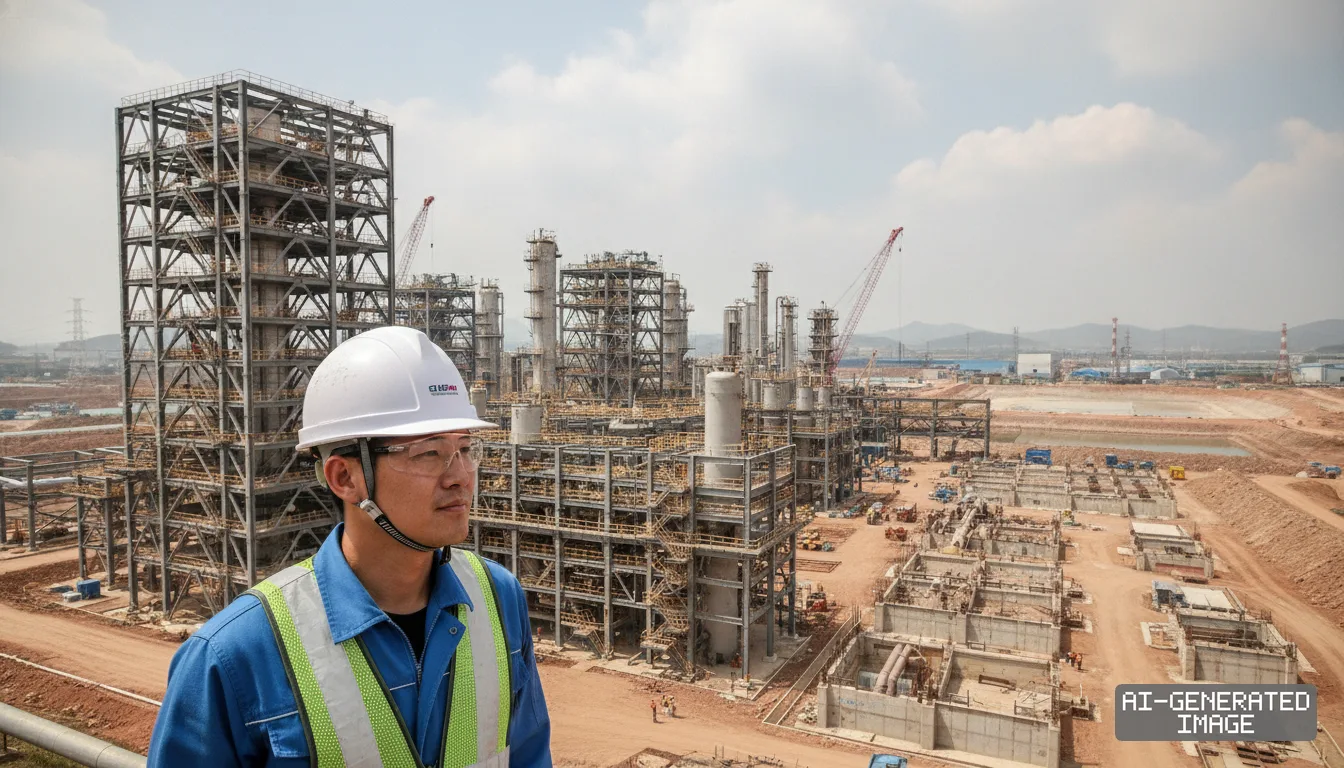
Korea Zinc said Nov. 29 its dedicated germanium plant at the Onsan Smelter had passed the 50% construction mark, keeping its 14-metric-ton annual recovery project on schedule for 2028.
The 140 billion won ($100 million) facility will extract germanium from zinc and lead smelting residues at a former sludge pond site in Ulsan. The installation establishes South Korea's first domestic refining capacity for the strategic metalloid.
China accounts for roughly 68% of global refined germanium output and placed the material under export licensing rules in August 2023. That regulatory control created procurement bottlenecks for allied defense contractors and semiconductor manufacturers.
Workers at the 430,000-pyeong Onsan industrial complex have completed foundation ground work and are currently assembling the main structural frames. The company plans to finish structural work before installing specialized smelting and refining equipment inside the building next year.
The raw material feed requires no external mineral purchases. Korea Zinc will recover trace amounts of germanium from zinc concentrate residues that the company previously treated as industrial waste and stored in holding ponds.
Before the dedicated refinery begins commercial operations, Korea Zinc will market intermediate products. The smelter will produce crude germanium dioxide in 2027 by using existing processing lines at its secondary battery materials subsidiary, Kemco.
Full commercial operations at the dedicated plant will commence in the first half of 2028. The facility will convert the intermediate stream into 99.999% high-purity germanium dioxide, yielding 14 metric tons of metal equivalent annually.
The hydrometallurgical recovery circuit will generate valuable industrial metal credits alongside germanium. The process will extract approximately 1,000 metric tons of zinc, 150 tons of copper and 10 tons of indium each year.
Kim Seung-hyun, head of the Onsan Smelter, said during a press briefing that the recovery yield for germanium currently stands at about 50%. Metallurgical teams are running process research to increase extraction efficiency from the complex ores.
Commercial offtake is already anchored by overseas defense demand. Korea Zinc signed a memorandum of understanding with Lockheed Martin in August 2025 to supply germanium refined entirely outside China, North Korea, Iran and Russia.
Lockheed Martin secured priority procurement rights for the output. The US aerospace contractor requires high-purity germanium for thermal imaging cameras, night-vision equipment and solar arrays used on military satellites.
Kim said China controls more than 95% of specific refined grades in global trade. Allied defense and high-technology demand far exceeds Korea Zinc's planned capacity, which will prevent any commercial marketing surplus, Kim said.
Germanium prices hovered near 17 billion won ($12.2 million) per metric ton following export licensing restrictions in producing nations, Kim said. That market valuation will generate high profit margins from residues that carried zero commercial value, Kim said.
Domestic industrial supply chains have also taken formal steps to secure local feedstocks. Korea Zinc signed a joint cooperation pact with the Korea Institute of Rare Metals and HK Materials in November 2025 to support domestic semiconductor and optical fiber makers.
The germanium installation forms one component of a broader rare-metal expansion at the Ulsan complex. Korea Zinc committed 55.7 billion won ($39.3 million) in October 2025 to build an adjacent gallium extraction line, targeting 15.5 metric tons annually from 2028.
The company is pairing its domestic facilities with US downstream refining. Korea Zinc plans to produce between 30 and 40 metric tons of germanium annually by 2029 through an integrated smelter project under development in Clarksville, Tennessee.
The company has not published regulatory filings detailing when the target capacity was revised from 10 tons to 14 tons or whether the 140 billion won capital expenditure has increased.
Kemco will begin trial production of crude germanium dioxide intermediate in late 2027, followed by integrated equipment commissioning at Onsan ahead of commercial deliveries in early 2028.
Impact map
How this development propagates across the region and out to global buyers.
| Event | Korea | China | Japan | Global impact |
|---|---|---|---|---|
| Korea Zinc germanium refinery | Korea Zinc builds domestic refining capacity of 14 tons, cutting import reliance | MOFCOM export licensing leverage over defense-grade germanium reduced | Optics and sensor makers gain non-Chinese source for germanium tetrachloride | Lockheed Martin secures China-free germanium offtake for defense systems |
In this story
- Companies
- Korea Zinc
- Tickers
- 010130.KS
- Exposed
- Lockheed MartinKemco
- Policy
- Export Controls
- Impact
- Supply ChainCapex
Track every Export Controls development →
Related briefings
- US redirects mineral funds to back Korea Zinc's $7.4B smelter Also on Lockheed Martin, Korea Zinc
- Evolution Metals scales Korea magnet capacity to 10,000 tons Also on Lockheed Martin, Export Controls
- Pentagon awards Elmet $2.45B to cut China tungsten reliance by 2027 Also on Lockheed Martin, Export Controls
- US presses China as rare earth shipments lag Busan pact by 34% Also on Lockheed Martin, Export Controls
Sources
Primary documents
Confidence: high — how we grade this
The documents behind this briefing are linked above. East Asia Brief produces its English text with AI assistance under human editorial review, and does not translate or republish other outlets' articles. See our methodology and AI policy. Spotted an error? Tell us.
The Morning Brief
What changed in Korean, Chinese and Japanese industry overnight — and what it means for your supply chain. One email, weekday mornings, US time. Free.
The Morning Brief is in preparation. Leave your address and we will write to you once — when the first issue is ready. Nothing before that.