Samsung SDI readies US LFP production for 30 GWh grid storage
The South Korean battery maker readies SBB 2.0 container shipments to reach 30 gigawatt-hours of American non-automotive capacity by late 2026.
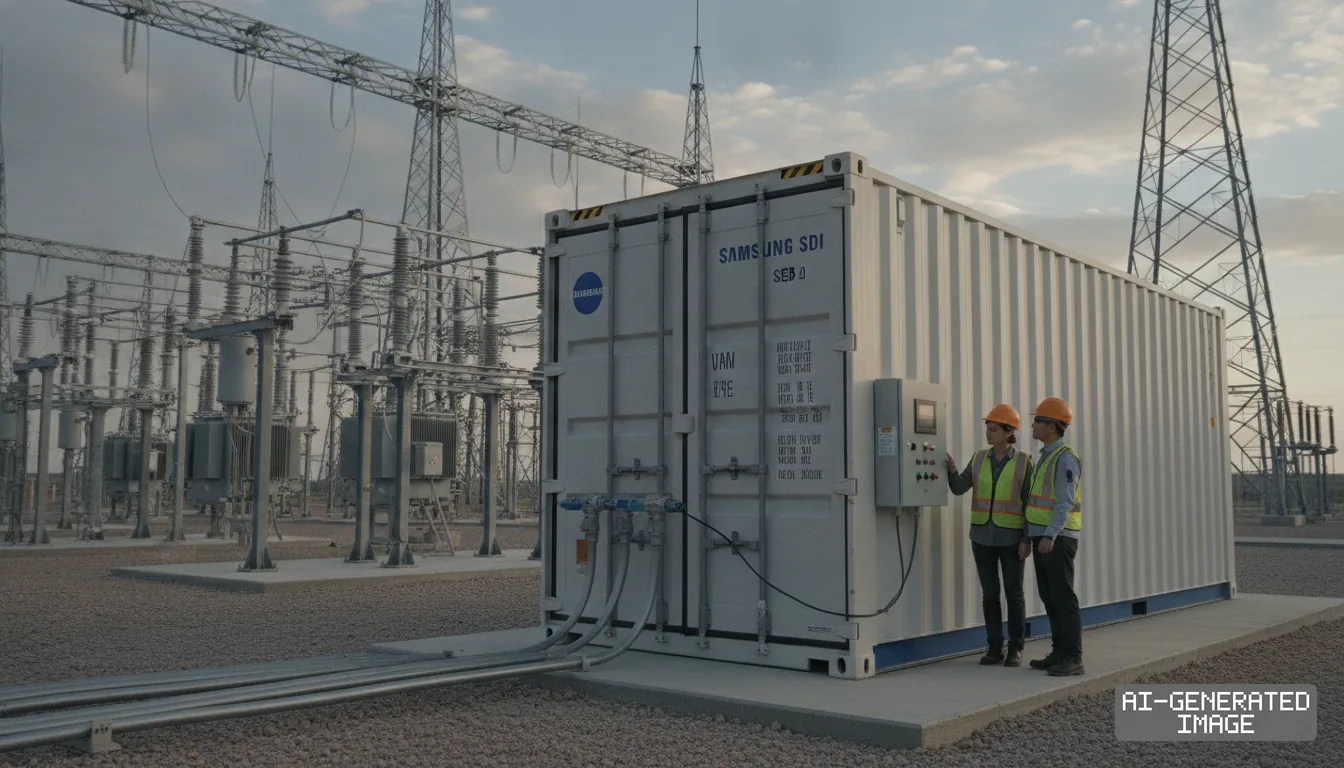
Samsung SDI said Nov. 15, 2026 that it finalized a domestic production network in the United States for lithium iron phosphate batteries aimed at utility-scale energy storage.
The move prepares commercial shipments of the SBB 2.0, a 20-foot container unit housing prismatic cells. The system delivers an all-in-one enclosure that connects directly to transmission grids.
Samsung SDI targets an annual stationary storage battery capacity of 30 gigawatt-hours in the United States by late 2026. That planned capacity accounts for most of its non-automotive production pipeline.
The company plans to showcase the manufactured hardware at the RE+ 2026 clean energy conference in Las Vegas. The trade event begins Nov. 17 and runs through Nov. 19.
Samsung SDI first displayed the SBB 2.0 concept in September 2025 at the same convention. The latest announcement marks the transition from pre-production testing to active assembly on American soil.
The manufacturer adopted the exhibition slogan "AI Thinks, Battery Enables" for the event. The campaign links grid reliability to the power demand of artificial intelligence computing clusters.
Production takes advantage of repurposed floor space within the StarPlus Energy joint venture. Partner Stellantis holds a 51% equity interest in the Kokomo, Indiana facility where initial lines were built.
Samsung SDI shifted manufacturing capacity from electric vehicle battery cells to stationary energy storage systems. The operational change absorbs softening electric vehicle demand across North American assembly corridors.
The SBB 2.0 relies on prismatic cells encased in rigid aluminum cans to resist physical deformation. Integrated safety vents discharge internal pressure before thermal instability can spread across cell arrays.
The battery system incorporates proprietary Enhanced Direct Injection technology. The mechanism injects fire-extinguishing fluid straight into individual modules when sensors detect abnormal temperature spikes during operation.
The enclosure also features a design that halts thermal propagation between adjacent cells. Advanced simulation algorithms model heat dispersion, while physical barrier insulation prevents sympathetic failures within the pack.
Unit Samsung SDI America secured a three-year supply contract in December 2025 valued at more than 2 trillion won ($1.4 billion). The buyer is a major US infrastructure developer.
Deliveries under the 2-trillion-won agreement will begin in 2027 from the domestic lines. The deal marked the first major long-term procurement order for the company's LFP stationary platform.
Chinese battery suppliers dominate global stationary storage with lithium iron phosphate chemistry. Contemporary Amperex Technology Co. Ltd. holds roughly 40% of global battery energy storage installations.
American clean energy rules now grant a 10% investment tax credit bonus for domestic content. Project developers must source qualified domestic equipment to receive maximum federal incentives.
Imported Chinese energy storage cells also face a 25% tariff under adjusted Section 301 rules. Those trade penalties raise landed equipment costs for American grid operators relying on overseas supply.
Samsung SDI operates as the only non-Chinese battery supplier currently preparing domestic prismatic LFP cells in the United States. Rival Korean producers have concentrated their stationary investments on pouch-style cells.
Stationary storage demand in the United States will expand from 59 gigawatt-hours in 2025 to 142 gigawatt-hours by 2030, according to SNE Research data. Utilities favor LFP chemistry for lower cycling costs.
Alongside grid storage, Samsung SDI will introduce its U8A3 uninterruptible power supply battery in Las Vegas. The unit targets continuous power backup for hyperscale artificial intelligence data centers.
The backup unit uses lithium manganese oxide chemistry packaged in a prismatic form factor. The material formulation delivers high discharge rates during instantaneous grid voltage interruptions.
Testing firm UL Solutions certified the U8A3 under its Large-Scale Fire Test standards for indoor installations. Samsung SDI said the unit is the first model globally to satisfy the full benchmark.
Surging electricity consumption at AI computing facilities has tightened power reserve requirements. Data center developers increasingly pair dedicated battery storage with high-voltage utility interconnects to avert brownouts.
The company did not state whether the operational LFP capacity sits entirely within the Indiana joint venture, and officials have not disclosed the specific nameplate gigawatt-hour rating ready at launch.
Commercial discussions for secondary delivery slots will open when RE+ 2026 convenes Nov. 17 in Las Vegas. The company expects initial commercial shipments from the local lines during 2027.
Impact map
How this development propagates across the region and out to global buyers.
| Event | Korea | China | Japan | Global impact |
|---|---|---|---|---|
| US domestic LFP BESS rollout | Samsung SDI captures non-automotive volume, converts Stellantis JV floor space | CATL faces rising 25% tariff barrier and exclusion from 10% IRA domestic content bonus | Panasonic and component suppliers see competition harden in utility ESS projects | Utility operators gain non-Chinese prismatic LFP source to mitigate tariff exposure |
In this story
- Companies
- Samsung SDI
- Tickers
- 006400.KS
- Exposed
- StellantisContemporary Amperex Technology
- Policy
- Local Content RulesTariffs
- Impact
- Supply ChainOrder Book
Track every Local Content Rules development → Track every Tariffs development →
Related briefings
- EU and UK enforce 2027 EV origin rules, risking 10% battery tariffs Also on Stellantis, Local Content Rules, Contemporary Amperex Technology
- MOT secures $7.6M Samsung SDI order for US LFP battery plant Also on Stellantis, Local Content Rules, Samsung SDI
- Samsung SDI signs 1 GWh US battery storage supply contract Also on Stellantis, Local Content Rules, Samsung SDI
- Chinese EV Makers Build 26 EU Plants to Bypass 27% Tariffs Also on Stellantis, Contemporary Amperex Technology, Samsung SDI
Sources
Reporting
Confidence: medium — how we grade this
The documents behind this briefing are linked above. East Asia Brief produces its English text with AI assistance under human editorial review, and does not translate or republish other outlets' articles. See our methodology and AI policy. Spotted an error? Tell us.
The Morning Brief
What changed in Korean, Chinese and Japanese industry overnight — and what it means for your supply chain. One email, weekday mornings, US time. Free.
The Morning Brief is in preparation. Leave your address and we will write to you once — when the first issue is ready. Nothing before that.