MOT secures $7.6M Samsung SDI order for US LFP battery plant
The South Korean toolmaker booked a 10.13 billion won contract for StarPlus Energy line three as battery makers convert North American capacity to energy storage.
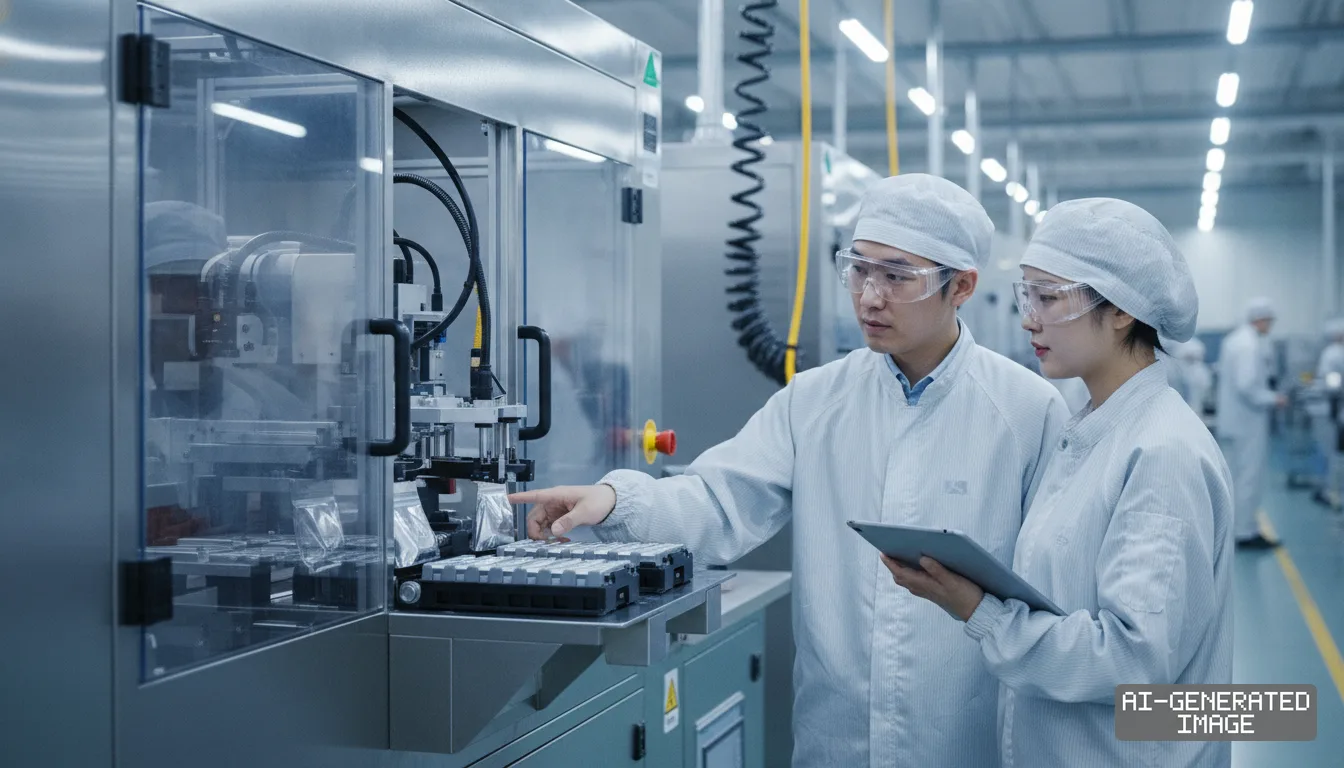
Battery assembly equipment maker MOT disclosed on Oct. 21, 2026, that it secured a 10.13 billion won ($7.60 million) order to supply prismatic cell packaging systems.
The fixed contract represents 13.42% of MOT's 2025 consolidated revenue of 75.45 billion won ($56.64 million). The delivery schedule runs from Oct. 20, 2026, through April 20, 2027, according to the regulatory filing.
The equipment is bound for StarPlus Energy, the Kokomo, Indiana joint venture between Samsung SDI and Stellantis. The facility is converting its third manufacturing line from high-nickel chemistry to lithium iron phosphate cells.
The converted line will produce battery packs for utility-scale energy storage systems. Samsung SDI is repurposing three of the four production lines at the Kokomo complex to serve stationary storage developers.
The plant begins operating its first lithium iron phosphate line in October 2026 for Samsung Battery Box 2.0 container units. A second converted line begins supplying an unnamed North American electric vehicle maker in early 2027.
Line three requires dedicated assembly machinery because large-format energy storage cells differ in volume from automotive cells. The dimensional change forced Samsung SDI to retender the downstream can-packaging equipment.
MOT builds the machinery that inserts wound electrode assemblies into rigid rectangular aluminum cans. The specialized tools handle top-cap placement, laser tab welding and perimeter hermetic sealing before chemical electrolyte injection.
The supplier uses fiber lasers rather than older ultrasonic tools to weld the terminal connections. A specialized laser cleaning process removes surface particles from the jelly roll immediately before cap welding to prevent internal short circuits.
The transaction is not an exclusive award for the entire assembly stage. Peer equipment maker Philenergy disclosed a separate 86.10 billion won ($64.63 million) contract on Oct. 21 to build front-end notching and stacking machinery for the same line.
Philenergy's award equals 259.3% of its 2025 consolidated revenue of 33.20 billion won ($24.92 million). The notching and stacking machines cut individual electrode sheets and stack them before can insertion.
Samsung SDI is Philenergy's largest customer and its second-largest shareholder. Philenergy previously booked a 71.20 billion won assembly machinery order in July for line two at the same Indiana manufacturing site.
Inspection specialist Innometry also won procurement slots for the Indiana plant conversion. Innometry booked an order of roughly 5.00 billion won ($3.75 million) in August to install three-dimensional computed tomography scanning stations.
The fresh contract reinforces MOT's heavy dependence on South Korea's second-largest battery manufacturer. Samsung SDI accounted for 67.64% of MOT's total revenue during the first half of 2026, company disclosures show.
MOT held an order backlog of 71.40 billion won ($53.60 million) at the close of the second quarter. The Indiana booking expands that pipeline by roughly 14% ahead of scheduled overseas shipments next spring.
Commercial payment terms require no upfront cash advance from the client. MOT will receive an interim payment of 70%, or 7.09 billion won, upon equipment delivery, followed by the final 30% after field acceptance.
South Korean battery producers are shifting capital expenditure toward stationary energy storage as electric vehicle growth moderates across Western markets. Factory conversions allow cell manufacturers to commercialize existing cleanrooms with reduced initial outlay.
United States grid-scale storage installations are projected to surge from 88 gigawatt-hours in 2025 to 485 gigawatt-hours by 2030. Higher import tariffs on Chinese battery cells are steering American grid developers toward domestic manufacturing capacity.
Samsung SDI intends to expand its total North American stationary storage manufacturing footprint to 30 gigawatt-hours annually. Producing local lithium iron phosphate cells allows the firm to counter low-cost Chinese rivals that control global utility storage.
The conversion program establishes a domestic supply benchmark for South Korean equipment vendors. The assembly builders are targeting follow-on orders as cell manufacturers modify lines in Europe and North America.
Samsung SDI plans to award additional assembly tooling orders during 2027 for its Synergy Cells joint venture factory in the United States. Similar procurement packages are slated for the company's battery plant in Goed, Hungary.
The regulatory filing does not name Samsung SDI or the Indiana site, keeping the counterparty sealed under a confidentiality clause through April 20, 2027. Neither company published the exact gigawatt-hour nameplate rating for the converted third production line.
MOT must finish delivering and installing the assembly machinery at the Kokomo plant by April 20, 2027. Commercial cell production on the converted line begins following system verification later that year.
Impact map
How this development propagates across the region and out to global buyers.
| Event | Korea | China | Japan | Global impact |
|---|---|---|---|---|
| StarPlus Energy line 3 conversion | MOT and Philenergy secure 96.2 billion won in combined assembly orders | Chinese LFP cell makers lose US market share under tariff and content rules | Japanese separator and foil suppliers adjust specifications for Kokomo prismatic lines | US grid developers gain non-Chinese domestic supply of 276Ah LFP storage cells |
In this story
- Companies
- MOTSamsung SDI
- Tickers
- 443330.KQ006400.KS
- Exposed
- PhilenergyInnometryStellantis
- Policy
- TariffsLocal Content Rules
- Impact
- Order BookCapexSupply Chain
Track every Tariffs development → Track every Local Content Rules development →
Related briefings
- Innometry sweeps Samsung SDI US ESS battery inspection orders Also on Innometry, Stellantis, Samsung SDI
- Philenergy wins $62M battery tool order for US storage site Also on Philenergy, Samsung SDI, Order Book
- Korean battery equipment makers deploy vision robots to cut cell stacking time Also on PhilEnergy, Samsung SDI
- Stellantis pushes Leapmotor European parts past 40% in Spain Also on Local Content Rules, Stellantis, Tariffs
Sources
Primary documents
Reporting
Confidence: high — how we grade this
The documents behind this briefing are linked above. East Asia Brief produces its English text with AI assistance under human editorial review, and does not translate or republish other outlets' articles. See our methodology and AI policy. Spotted an error? Tell us.
The Morning Brief
What changed in Korean, Chinese and Japanese industry overnight — and what it means for your supply chain. One email, weekday mornings, US time. Free.
The Morning Brief is in preparation. Leave your address and we will write to you once — when the first issue is ready. Nothing before that.