Mercedes-Benz centralizes China parts purchasing in new 70-30 JV
The partnership with Beijing Benz Automotive creates a unified sourcing arm under joint operational control despite the German carmaker's controlling equity stake.
Mercedes-Benz Group filed plans on Nov. 27, 2026 to set up a centralized automotive parts procurement joint venture in Beijing with its local manufacturing partner.
The German automaker is executing the project through Mercedes-Benz (China) Investment Co. The regional holding unit oversees corporate strategy and joint investments in the world's largest automotive market.
The new procurement venture allocates a 70% equity stake to Mercedes-Benz China. Beijing Benz Automotive Co., the group's principal assembly partnership, holds the remaining 30% interest.
Both companies will exercise joint corporate control over the procurement entity despite the unequal shareholding split. The venture will acquire passenger car components and supply them directly to Beijing Benz.
The State Administration for Market Regulation in Beijing published details of the application on Friday. The submission confirmed that both corporate partners finalized a formal joint venture contract.
China's antimonopoly agency accepted the corporate combination under its simplified review procedure. That administrative track applies to commercial transactions that do not exceed statutory competition thresholds.
The regulatory filing stated that the combined market share of both applicants in identical product markets remains below 15%. That low concentration figure satisfied preliminary screening requirements.
The disclosure also confirmed that each partner holds less than a 25% share across related upstream and downstream automotive markets. Those limits apply to both component procurement and vehicle manufacturing.
Beijing Benz Automotive serves as the exclusive manufacturing conduit for the German brand's passenger cars assembled in northern China. State-controlled BAIC Motor Corp. owns 51% of that operating company.
Mercedes-Benz Group AG holds 38.665% of Beijing Benz Automotive directly, while its regional China investment affiliate holds 10.335%. Together, the German entities control 49% of the manufacturing partnership.
Beijing Benz Automotive operates vehicle assembly, engine fabrication and traction battery packaging facilities in the capital. The industrial complex assembles 13 distinct models, including electric sport utility vehicles.
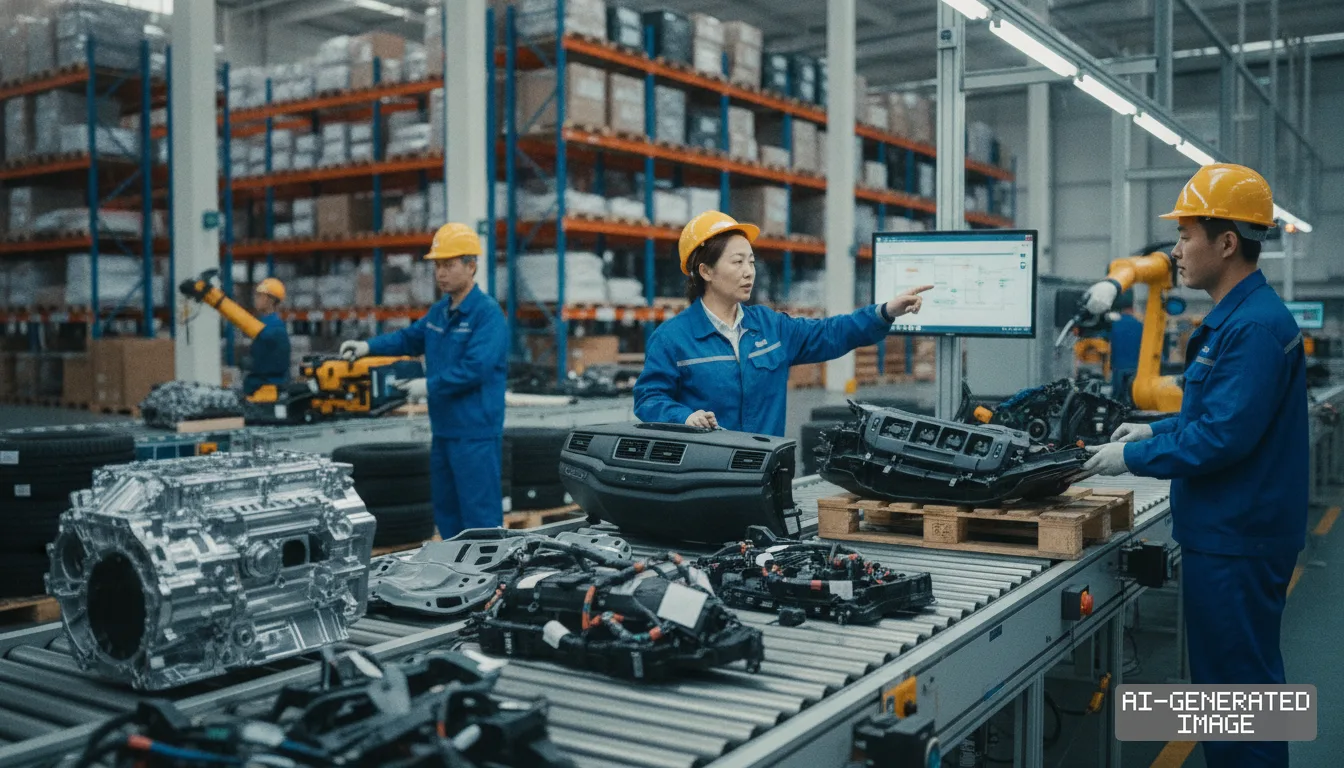
Establishing a dedicated procurement business centralizes component purchasing that was previously split across multiple operational channels. The unified entity will manage contracts directly with domestic parts suppliers.
The procurement unit will supply components exclusively to Beijing Benz Automotive for local vehicle production. It will coordinate sourcing for structural chassis parts, electronic modules and localized battery packs.
Consolidating purchasing volume under a single corporate entity provides greater commercial bargaining power. The German brand aims to lower unit costs during contract negotiations with domestic Chinese component vendors.
Foreign automakers operating in China face aggressive price reductions from domestic electric vehicle manufacturers. Streamlining local supply chains helps European original equipment manufacturers protect operating margins in the region.
The procurement initiative reflects continued integration between Western automotive groups and Chinese industrial suppliers. European carmakers increasingly anchor component purchasing near high-volume Asian production lines.
The development highlights an operational divergence between corporate strategy and trade policy. European Union regulators have imposed anti-subsidy tariffs on imported Chinese electric cars to protect domestic manufacturing.
German carmakers remain heavily dependent on China's localized battery and electronic parts supply networks. European executives continue deepening direct supplier ties in Beijing to maintain global component cost competitiveness.
Local component suppliers based across the Beijing-Tianjin-Hebei industrial corridor will supply the new joint venture. Contracting with a single purchasing office reduces administrative overhead for regional parts vendors.
The procurement structure also accelerates engineering coordination between local part makers and vehicle designers. Closer supplier links shorten lead times for software integration and electronic architecture updates.
Beijing Benz Automotive produced hundreds of thousands of passenger cars last year across its Beijing plants. Centralizing parts procurement directly affects thousands of tier-one and tier-two component contracts.
China's State Administration for Market Regulation opened the formal public comment window on Nov. 27, 2026. The statutory public review period runs through Dec. 6, 2026.
The regulatory filing does not disclose the registered capital or total monetary investment pledged to the venture. Market authorities have also withheld the formal commercial name of the new joint venture.
Following the close of the comment period on Dec. 6, 2026, Chinese regulators will issue an antimonopoly clearance decision. The partners will register the corporate entity with Beijing municipal commerce authorities upon approval.
Impact map
How this development propagates across the region and out to global buyers.
| Event | Korea | China | Japan | Global impact |
|---|---|---|---|---|
| Mercedes-Benz Beijing procurement venture | Hyundai Motor and Korean tier-one suppliers face no direct customer overlap at BBAC facilities | BAIC Motor gains joint control of parts purchasing, lowering per-unit component input costs across 13 models | Denso and Japanese electronic suppliers face heightened price competition against localized Chinese vendors | European carmakers deepen direct China parts sourcing to defend operating margins against EV price pressure |
In this story
- Companies
- Mercedes-Benz GroupBAIC Motor
- Tickers
- 1958.HK
- Policy
- AntitrustTariffs
- Impact
- Supply ChainCost Structure
Track every Antitrust development → Track every Tariffs development →
Related briefings
- CATL expands EV battery swap grid to 3,000 stations in China Also on BAIC Motor, Cost Structure
- BAIC Motor puts 112 battery swap stations up for public auction Also on BAIC Motor
- CATL plans 6,000 EV battery swap stations across 297 Chinese cities Also on BAIC Motor
- European carmakers balk at CATL surcharges under EU rules Also on Mercedes-Benz Group, Tariffs, Cost Structure
Sources
Primary documents
Reporting
Confidence: high — how we grade this
The documents behind this briefing are linked above. East Asia Brief produces its English text with AI assistance under human editorial review, and does not translate or republish other outlets' articles. See our methodology and AI policy. Spotted an error? Tell us.
The Morning Brief
What changed in Korean, Chinese and Japanese industry overnight — and what it means for your supply chain. One email, weekday mornings, US time. Free.
The Morning Brief is in preparation. Leave your address and we will write to you once — when the first issue is ready. Nothing before that.