CATL widens global EV battery lead to 39.4% as Korean share slips
Seven Chinese producers took 73.3% of global volume through August, while North American delivery drops dragged LG Energy Solution and SK On down to 12.7%.
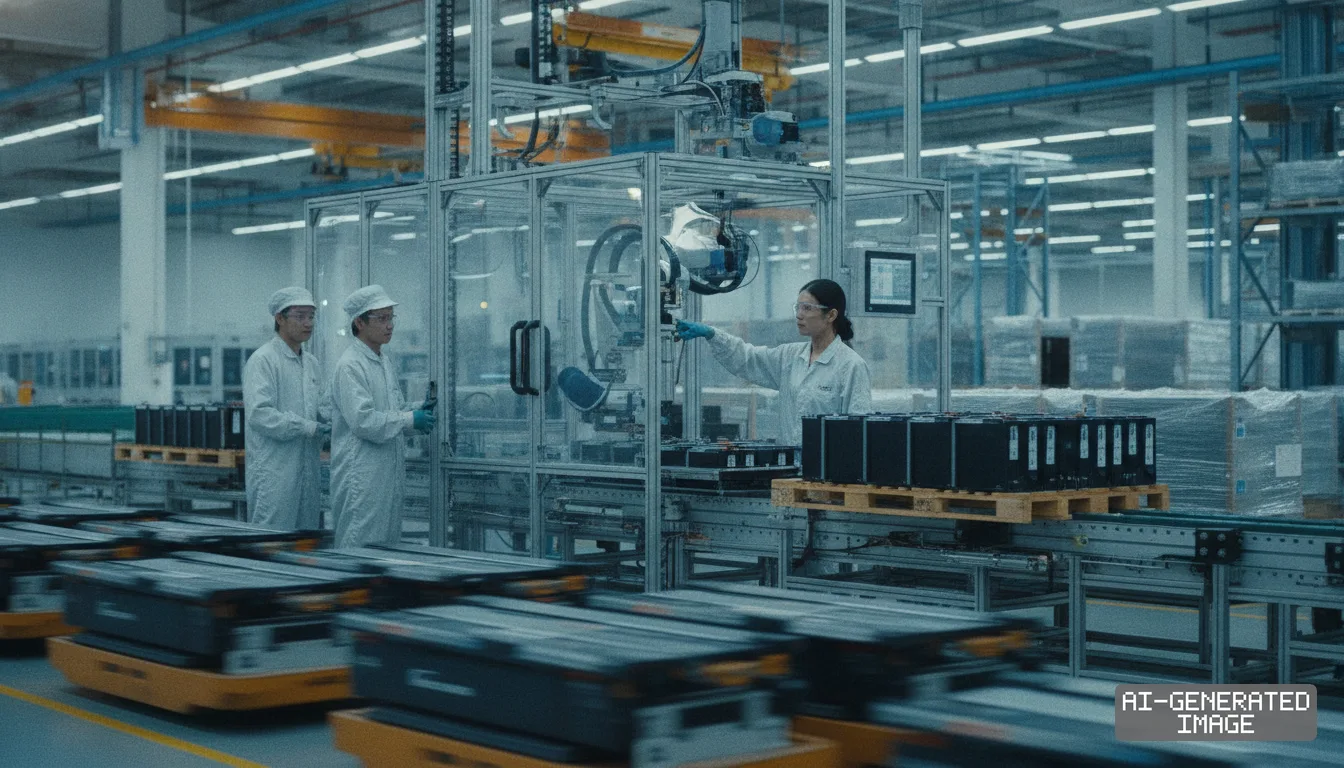
SNE Research reported Oct. 2 that Contemporary Amperex Technology captured 39.4% of the global electric vehicle battery market from January through August 2026. The Chinese cell manufacturer widened its lead over international rivals across commercial and passenger vehicle segments.
The company, known as CATL, installed 333.0 gigawatt-hours of battery capacity over the eight-month period. That volume represented a 25.2% increase compared with the same period a year earlier.
Total battery deployments in electric vehicles registered across 80 countries reached 844.2 GWh through August, rising 19.7% year-on-year. Installation volume in August reached 116.8 GWh, slowing to a 14.3% annual expansion rate.
CATL expanded its global market share by 1.7 percentage points from 37.7% in the prior-year period. Growing shipments to overseas carmakers outside mainland China supported the volume increase.
BYD retained second place worldwide with 127.9 GWh of installed battery capacity, advancing 6.2% year-on-year. Because deployment growth lagged the overall industry, BYD's market share contracted from 17.1% to 15.1%.
CATL and BYD together accounted for 54.6% of the global electric vehicle battery market through August. The two Chinese suppliers maintained an identical combined share to the 54.8% recorded twelve months earlier.
Seven Chinese battery manufacturers held 73.3% of the global market during the eight months, up 3.6 percentage points. The cohort includes CALB, Gotion High-tech, EVE Energy, SVOLT Energy Technology and REPT Battero.
South Korea's three primary battery manufacturers experienced a collective market contraction. The joint market share of LG Energy Solution, SK On and Samsung SDI fell 3.9 percentage points to 12.7%.
LG Energy Solution maintained third place globally with 68.3 GWh of installations, edging up 0.9% year-on-year. Trailing market expansion caused the company's global share to slip from 9.6% to 8.1%.
A steep drop in North American battery consumption drove the Korean supplier's slowdown. LG Energy Solution's volume in North America dropped 42.3% to 14.6 GWh, down from 25.2 GWh a year earlier.
Automakers including General Motors, Tesla and Volkswagen adjusted factory schedules and vehicle assembly rates in the United States. Higher cell consumption across European and Asian markets failed to make up for the North American loss.
SK On ranked eighth globally with 24.9 GWh of installed battery volume, declining 14.5% year-on-year. The company's worldwide market share dropped from 4.1% to 2.9% during the same eight-month timeframe.
SK On experienced a 41.8% plunge in North American installations, falling from 11.7 GWh to 6.8 GWh. Production cuts on electric truck and crossover programs by Ford Motor reduced delivery schedules.
SK On dissolved its operating joint venture with Ford to assume sole ownership of its battery plant in Tennessee. The manufacturer is sourcing upstream materials to introduce lithium iron phosphate cells for future programs.
Samsung SDI remained outside the top 10 global battery suppliers through August 2026. Lower sales volumes for electric models built by BMW, Audi and Rivian Automotive constrained shipments of nickel-rich prismatic cells.
Global vehicle manufacturers have accelerated the adoption of lithium iron phosphate chemistry to reduce pack manufacturing costs. The chemistry dispenses with expensive nickel and cobalt cathodes, lowering raw material procurement expenses.
Chinese manufacturers produce more than nine-tenths of the world's commercial lithium iron phosphate capacity. Korean cell makers focused on high-energy nickel chemistries that faced consumer hesitation and fleet delivery pauses in North America.
LG Energy Solution and SK On have developed entry-tier lithium iron phosphate designs for automakers and utility energy storage. Commercial assembly lines for those products remain scheduled for volume rollouts between late 2026 and 2027.
Regulatory shifts within China will alter cell pricing dynamics across export channels. China's Ministry of Finance and State Taxation Administration introduced a 2% consumption tax on lithium-ion batteries on Sept. 1.
The consumption tax rate will rise to 4% on Sept. 1, 2027, according to government notices. Sodium-ion batteries, solid-state designs and hydrogen fuel cells will remain exempt from the levy through Dec. 31, 2028.
Chinese authorities also lowered the value-added tax export rebate for lithium batteries from 9% to 6% on April 1. Under government notices issued in January, China will eliminate the rebate entirely on Jan. 1, 2027.
The rollback of export tax benefits will lift production costs for Chinese cell suppliers by an estimated 6% to 8%. Exporters have shortened quotation validity windows for deliveries scheduled in early 2027.
Higher export tax burdens could narrow the pricing spread between Chinese suppliers and overseas manufacturing facilities. Overseas automakers must absorb the tax differential or renegotiate battery supply agreements before year-end contract renewals.
CATL has not published an official regulatory disclosure confirming its August cumulative market share or shipment tally. SNE Research did not publish third-quarter operating margin data for the suppliers tracked in the report.
Impact map
How this development propagates across the region and out to global buyers.
| Event | Korea | China | Japan | Global impact |
|---|---|---|---|---|
| Global EV battery market share shift | LG Energy Solution and SK On share drops to 12.7% as North American volume slides over 41% | CATL and BYD capture 54.6% share, lifting total Chinese supply to 73.3% | Panasonic and Japanese cell makers hold under 5% amid slow pack expansion | Cell buyers face 6% to 8% quotation increases as China phases out export rebate |
In this story
- Companies
- Contemporary Amperex TechnologyLG Energy SolutionSK OnBYDSamsung SDI
- Tickers
- 300750.SZ373220.KS006400.KS002594.SZ
- Exposed
- TeslaGeneral MotorsVolkswagenFord MotorBMWRivian Automotive
- Policy
- SubsidiesTariffs
- Impact
- Supply ChainPricingCost Structure
Track every Subsidies development → Track every Tariffs development →
Related briefings
- CATL and Kuehne+Nagel agree on electric freight logistics Also on Volkswagen, BMW, Contemporary Amperex Technology
- BYD plans three European car plants to counter EU tariffs Also on Volkswagen, BYD, Tariffs
- BYD readies 300 kW Flash Charging for entry Seagull city car Also on Volkswagen, BYD, Pricing
- CATL develops tall pickup batteries to bypass US tariffs Also on Ford Motor, SK On, Contemporary Amperex Technology
Sources
Reporting
Confidence: medium — how we grade this
The documents behind this briefing are linked above. East Asia Brief produces its English text with AI assistance under human editorial review, and does not translate or republish other outlets' articles. See our methodology and AI policy. Spotted an error? Tell us.
The Morning Brief
What changed in Korean, Chinese and Japanese industry overnight — and what it means for your supply chain. One email, weekday mornings, US time. Free.
The Morning Brief is in preparation. Leave your address and we will write to you once — when the first issue is ready. Nothing before that.