BYD readies 300 kW Flash Charging for entry Seagull city car
The automaker aims to bring nine-minute charging to sub-$15,000 cars, stepping up pressure on foreign rivals relying on slower packs.
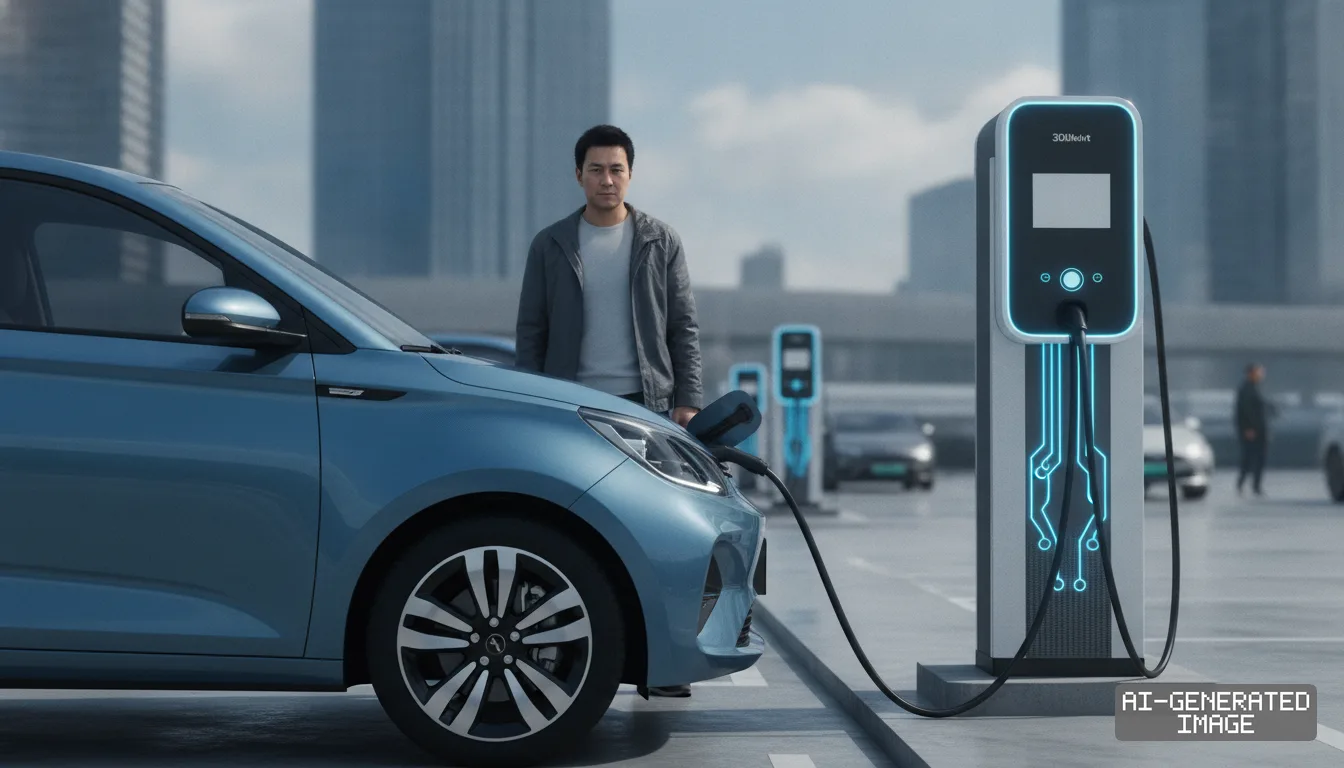
BYD moved to deploy its 300-kilowatt Flash Charging system on the second-generation Seagull on Sept. 25, 2026, extending ultra-fast charging to electric cars priced below 100,000 yuan ($14,200).
The entry-level hatchback accounts for more than 10% of BYD's pure electric passenger car deliveries in China. The updated edition carries 30-kilowatt-hour and 39.2-kilowatt-hour lithium iron phosphate battery packs.
FinDreams Battery, the wholly owned cell subsidiary of BYD, manufactures the lithium iron phosphate packs. The supplier builds the units using cell-to-pack engineering, eliminating module casings to raise volumetric packing space.
Promotional production set photos published Sept. 25 showed the updated hatchback staged beside an active Flash Charging gantry. The vehicle is scheduled to enter Chinese showrooms before the end of 2026.
Filings published by the Ministry of Industry and Information Technology show the vehicle measures 4,205 millimeters in length. The footprint exceeds the first-generation model by 425 millimeters.
The regulatory listing registers a width of 1,810 millimeters and a wheelbase of 2,650 millimeters. Motive power comes from a single front-mounted electric motor delivering 95 kilowatts, equivalent to 127 horsepower.
Zhang Zhuo, general manager of the Ocean sales division at BYD, confirmed the model will carry the Great Seagull name in China. Zhang announced the commercial badge during the Chengdu Motor Show in late August.
Ministry filings record driving ranges of 320 kilometers for the smaller pack and 420 kilometers for the larger configuration. Both figures follow the China Light-Duty Vehicle Test Cycle standard.
Wang Chuanfu, chairman of BYD, introduced the underlying Blade Battery 2.0 platform on March 5, 2026. The platform links updated lithium manganese iron phosphate chemistry with high-current charging electronics.
Blade Battery 2.0 lifts cell-level energy density to between 190 and 210 watt-hours per kilogram. Cathode doping with manganese raises nominal operating cell voltage from 3.2 volts to 3.8 volts.
Flash Charging delivers a peak charging rate of 8C, an engineering multiplier meaning charge current reaches eight times nominal capacity. Under room temperatures, compatible packs replenish from 10% to 70% in five minutes.
Replenishing from 10% to 97% state of charge requires nine minutes at normal ambient temperatures, BYD said. At minus 30 degrees Celsius, internal heating modules complete the same charge cycle in 12 minutes.
BYD brought 10,000 Flash Charging stations into operation across 320 Chinese cities through August 2026. The company set a target of 20,000 operating flash charging stations across China by December.
Competitors in the entry city-car segment remain restricted to slower charging hardware. Most compact battery electric models sold across Europe, Japan and North America cap direct-current intake at 50 to 100 kilowatts.
Volkswagen sells its compact ID.3 hatchback with a 120-kilowatt direct-current ceiling, requiring roughly 35 minutes for an 80% charge. The model accounts for roughly 15% of the German automaker's electric deliveries in China.
Renault equips its European electric hatchbacks with 100-kilowatt direct-current charging inputs. Stellantis caps direct-current fast charging at 100 kilowatts on its comparable mass-market urban electric platforms.
A sub-100,000 yuan price tag forces rival carmakers to defend margins on low-capacity lines. Foreign competitors assemble comparable battery packs at higher procurement costs while using third-party cells that lack ultra-fast charging capabilities.
During a Flash Charging session from 10% to 70%, the larger 39.2-kilowatt-hour Seagull pack draws an average power of 282 kilowatts. Peak charging input reaches 300 kilowatts during initial connection before stepping down as internal temperature rises.
Interior design sketches released Sept. 22 show a redesigned central console and instrument panel. Exterior homologation images show a roof pod housing optical sensors for advanced driver assistance functions.
Export shipments of the model will sell under the Dolphin Mini, Dolphin Surf and Atto 1 badges. The first-generation edition sells across Latin America and Southeast Asia at retail prices below $20,000.
Vehicles shipped to the European Union face a 17% individual countervailing tariff levied on BYD. The special levy applies on top of the standard 10% baseline import duty for foreign passenger cars.
The industrial ministry filing does not state whether both battery capacities will receive Blade Battery 2.0 hardware, and BYD has not published an official specification sheet confirming peak charging rates for production trims.
Commercial deliveries in China begin in the fourth quarter of 2026, following the late-2026 market launch scheduled by the Ocean sales division.
Impact map
How this development propagates across the region and out to global buyers.
| Event | Korea | China | Japan | Global impact |
|---|---|---|---|---|
| BYD 300 kW Flash Charging deployment | no direct domestic sales, Hyundai Casper EV faces export pricing pressure | BYD expands fast-charging share, puts margin pressure on sub-100k yuan segment | Toyota and Honda entry EV timelines face widened 150 kW technical deficit | compact EV pricing floor drops as 8C charging enters sub- |
| BYD 300 kW Flash Charging deployment | no direct domestic sales, Hyundai Casper EV faces export pricing pressure | BYD expands fast-charging share, puts margin pressure on sub-100k yuan segment | Toyota and Honda entry EV timelines face widened 150 kW technical deficit | compact EV pricing floor drops as 8C charging enters sub-$15,000 category |
In this story
- Companies
- BYD
- Tickers
- 002594.SZ
- Exposed
- VolkswagenFinDreams Battery
- Policy
- Subsidies
- Impact
- PricingCost StructureSupply Chain
Track every Subsidies development →
Related briefings
- BYD targets 2027 solid-state battery debut in luxury fleet Also on FinDreams Battery, BYD, Pricing
- BYD plans three European car plants to counter EU tariffs Also on Volkswagen, BYD, Pricing
- CATL and Kuehne+Nagel agree on electric freight logistics Also on Volkswagen, Cost Structure
- BYD deploys 12-minute cold-weather LFP battery in Formula S Also on BYD, Pricing, Cost Structure
Sources
Reporting
Confidence: medium — how we grade this
The documents behind this briefing are linked above. East Asia Brief produces its English text with AI assistance under human editorial review, and does not translate or republish other outlets' articles. See our methodology and AI policy. Spotted an error? Tell us.
The Morning Brief
What changed in Korean, Chinese and Japanese industry overnight — and what it means for your supply chain. One email, weekday mornings, US time. Free.
The Morning Brief is in preparation. Leave your address and we will write to you once — when the first issue is ready. Nothing before that.