Commerce locks in Korean steel duties as mills press quota review
Countervailing rates of up to 3.68% land on Seoul producers as U.S. industry groups demand tighter enforcement on alloy imports entering domestic factories.
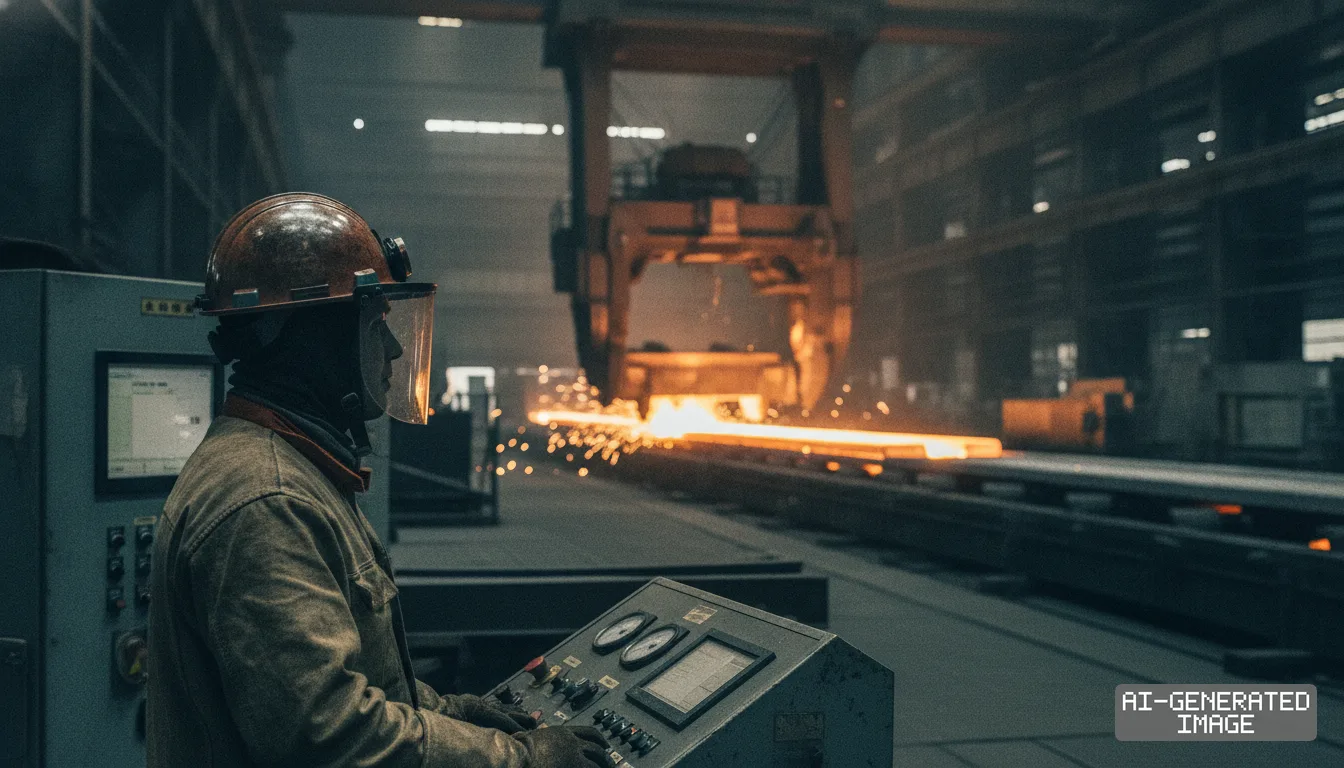
The U.S. Department of Commerce finalized countervailing subsidy duties on South Korean steelmakers Oct. 9, 2026, intensifying regulatory pressure on Seoul’s industrial alloy shipments into American manufacturing supply chains.
The final determination fixed net countervailable subsidy rates at 1.28% for Hyundai Steel Company and 3.68% for POSCO. The ruling concluded an administrative review of hot-rolled steel flat products imported during calendar 2023.
The tariff decision arrives alongside a petition submitted Sept. 28, 2026, by American steel industry associations demanding formal scrutiny of Korean import volumes. The groups alleged Korean mills surged shipments through category reclassifications to bypass absolute quota constraints.
South Korean long product exports reached 145,300 metric tons in July 2026, according to customs data cited in the trade filing. That total marked a sixfold increase from 22,100 metric tons recorded in July 2024.
South Korea exports steel to the United States under an absolute quota agreed upon in 2018. The bilateral framework exempts Seoul from Section 232 national security tariffs but caps annual volume at 70% of its average export tonnage between 2015 and 2017.
The quota system divides allowable volumes across 54 discrete product categories. Once an annual or quarterly quota cap fills, foreign shipments cannot enter American commerce until the next quota period opens unless importers obtain specific product exclusions.
POSCO saw its finalized subsidy rate trimmed slightly from a preliminary assessment of 3.71%. The resulting 3.68% cash deposit requirement applies immediately to all unliquidated entries of subject merchandise entering U.S. ports.
Hyundai Steel Company received a lower duty assessment of 1.28%. The company supplies flat-rolled sheet and specialty automotive grades to assembly operations and tier-one component stampers in Alabama and Georgia.
The joint petition from the American Iron and Steel Institute and the Steel Manufacturers Association urged Commerce Secretary Howard Lutnick and U.S. Trade Representative Jamieson Greer to audit Korean shipments. The groups cited sudden volume spikes in pipe, tube and structural long product lines.
Domestic producers contend that foreign substrate, melted and poured outside South Korea, undergoes conversion in Korean rolling mills before export. U.S. trade statutes require substantial transformation and verified country-of-origin certification to qualify for national quota allotments.
Stricter verification rules require importers to submit mill test certificates proving where raw steel was originally melted and poured. Shipments lacking traceable provenance risk detention at ports of entry by U.S. Customs and Border Protection.
Automotive stampers rely on imported Korean high-strength alloy sheets for vehicle body structures and chassis assemblies. Sudden quota exhaustion forces manufacturing plants to scramble for alternative domestic supply or pay duty penalties.
Energy equipment fabricators face comparable delivery friction for line pipe and structural tube grades. Specialty alloys used in high-pressure gathering networks depend heavily on qualified import channels with established chemical specifications.
The administrative determination leaves existing countervailing duty deposit instructions in place for all other South Korean producers at the assigned company rates. Importers must post cash deposits at customs clearance reflecting the newly finalized margins.
U.S. manufacturing buyers frequently apply for Section 232 product exclusions when domestic mills cannot provide required metallurgical properties or delivery schedules. Tighter regulatory review lengthens the processing window for those waiver requests.
Domestic steelmakers argue that surging Korean volumes displace domestic melt capacity during an industrial slowdown. Industry associations contend that administrative enforcement must close loopholes that permit foreign alloy processors to exceed historical shipment baselines.
Trade regulators evaluate whether Korean producers benefited from preferential government loan terms, regional utility discounts and research subsidies. The Commerce Department found those financial contributions constituted countervailable assistance under federal trade remedy statutes.
South Korean mill operators maintain that export volumes conform strictly to the quarterly category sub-limits administered by the Korea Iron and Steel Association. Seoul’s export monitoring body distributes quota allocations to domestic mills based on historical production records.
Importers and domestic industrial consumers have until Oct. 31, 2026, to request subsequent administrative reviews for the 2024 calendar period. If requested, those filings will trigger a new twelve-month audit of Korean export pricing and government support programs.
The Department of Commerce notice does not state whether regulators will initiate an autonomous Section 232 quota investigation, and officials have not published specific audit targets for specialty alloy grades.
U.S. Customs and Border Protection administers remaining calendar 2026 steel quota tranches under standard Section 232 entry guidelines through Dec. 31, 2026.
Impact map
How this development propagates across the region and out to global buyers.
| Event | Korea | China | Japan | Global impact |
|---|---|---|---|---|
| Section 232 quota audit | POSCO faces 3.68% cash deposits, Hyundai Steel pays 1.28% on flat-rolled entries | Third-country substrate rerouted through Korean mills faces tighter melted-and-poured audits | Nippon Steel and JFE absorb selective spillover demand for specialty automotive alloy | U.S. auto and energy supply chains face longer customs clearance for structural tube and flat products |
In this story
- Companies
- POSCOHyundai Steel Company
- Tickers
- 005490.KS004020.KS
- Exposed
- American Iron and Steel InstituteSteel Manufacturers Association
- Policy
- TariffsEconomic Security
- Impact
- Supply ChainCost StructureCompliance
Track every Tariffs development → Track every Economic Security development →
Related briefings
- Hyundai Steel and POSCO build US plant to bypass Section 232 Also on POSCO, Tariffs
- Japan shipyards agree long-term thick plate supply terms with Nippon Steel Also on POSCO, Cost Structure
- Mazagon Dock drops Thoothukudi yard as HD Hyundai wins site Also on POSCO
- HD Hyundai inspects Thoothukudi site for greenfield shipyard in India Also on POSCO
Sources
Primary documents
Reporting
Confidence: high — how we grade this
The documents behind this briefing are linked above. East Asia Brief produces its English text with AI assistance under human editorial review, and does not translate or republish other outlets' articles. See our methodology and AI policy. Spotted an error? Tell us.
The Morning Brief
What changed in Korean, Chinese and Japanese industry overnight — and what it means for your supply chain. One email, weekday mornings, US time. Free.
The Morning Brief is in preparation. Leave your address and we will write to you once — when the first issue is ready. Nothing before that.