China restricts tunnel boring machine exports, hitting India projects
Beijing's licensing rule targets heavy excavation gear and critical drive components, threatening construction timelines across urban metro lines and Himalayan border transit routes.
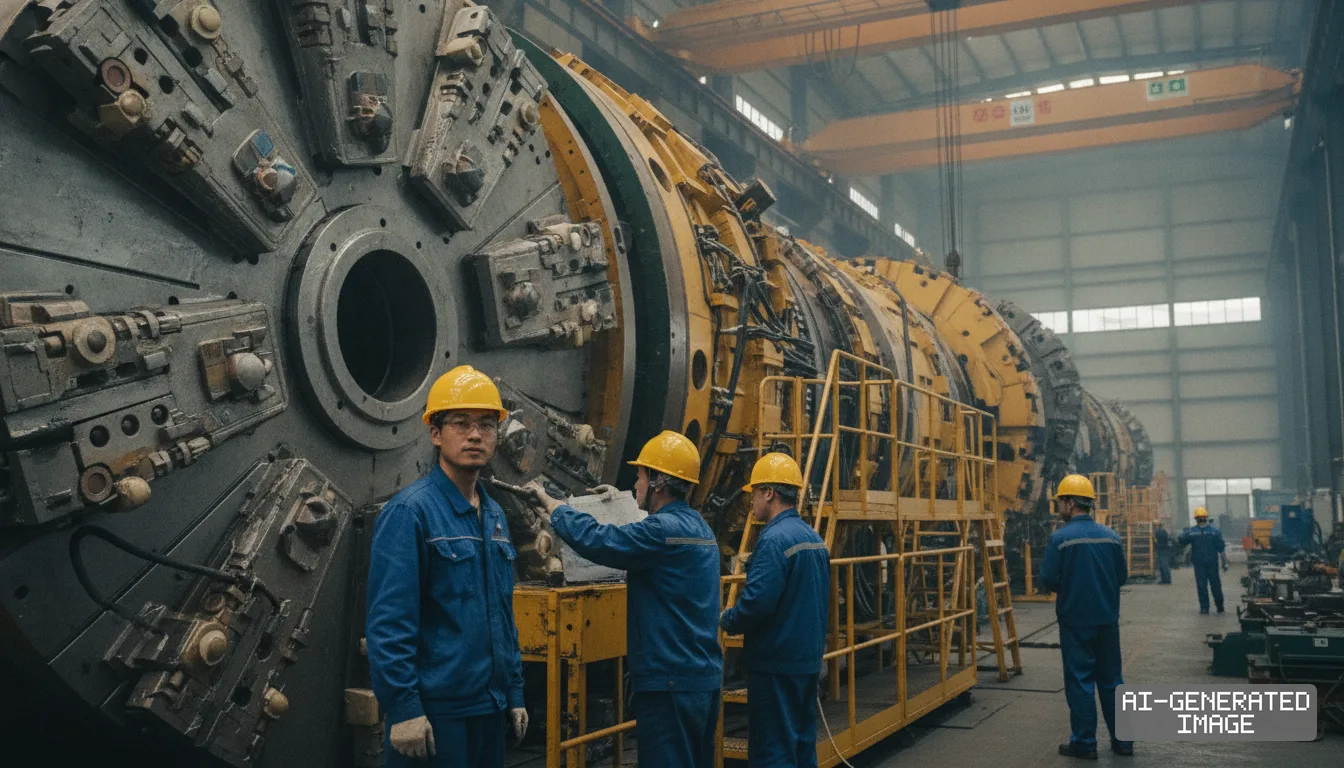
China's Ministry of Commerce advanced export controls on tunnel-boring machines on Nov. 2, 2026, threatening severe project delays for Indian metro networks reliant on Chinese industrial machinery.
The ministry published Announcement No. 50 jointly with the General Administration of Customs, placing mechanized tunneling equipment and specialized drive components under strategic dual-use export licensing regimes.
UN Comtrade data showed China exported $793 million of rock-cutting and tunneling machinery in 2025. That volume represents roughly 70% of the entire global market for mechanized tunneling gear.
The regulation restricts shipments of full-face tunnel-boring machines, earth pressure balance shields, slurry shields and open-type rock machines. It also covers cutterhead tools, main drive systems and screw conveyors.
The order restricts walking excavators engineered for rough terrain alongside high-altitude wet-shotcrete equipment designed to operate above 3,000 meters. Such gear stabilizes fractured cavern walls during deep mountain tunneling works.
Exporters must obtain individual government licenses before dispatching controlled machinery to sensitive countries involved in territorial disputes with Beijing. Ministry officials will review each application on national security and non-proliferation grounds.
Shipments to other global destinations require a registered export certificate and formal end-user declarations. Importers must pledge not to divert the machinery to disputed territories or unapproved third-party infrastructure operators.
The decree explicitly bans foreign companies and overseas individuals from transferring Chinese-origin controlled tunneling equipment to disputed jurisdictions. The provision prevents international engineering contractors from reallocating idle excavators to Indian sites.
The licensing mandate creates immediate operational bottlenecks across India. The country ranks among the largest global buyers of heavy tunneling equipment for urban transit expansions and strategic frontier logistics roads.
German equipment manufacturer Herrenknecht AG operates a major tunneling machinery manufacturing facility in Guangzhou, China. The firm also maintains an assembly and reconditioning plant in Chennai, India, to service domestic clients.
Herrenknecht secured contracts to deliver two 15.6-meter Mixshield machines for packages C and D of the Versova-Dahisar link road in Mumbai. The company manufactures core subassemblies and cutting structures in southern China.
German diplomatic representatives revealed in late 2025 that Chinese customs authorities had held up three Herrenknecht tunneling shields destined for Indian projects. The shipments faced prolonged inspection holds at Chinese ports.
Tunneling shields experience rapid mechanical wear during subterranean excavation, requiring fresh cutterhead disc cutters and high-pressure hydraulic seals every few weeks. Withholding replacement parts can paralyze active boring heads within days.
Indian engineering giant Larsen & Toubro Ltd. executes major underground rail contracts across Delhi and Mumbai. The contractor relies on imported tunneling gear to drill subterranean station caverns and multi-kilometer transit tubes.
State-owned builder China Railway Engineering Equipment Group Co. Ltd. commands roughly 70% of Chinese domestic production. The state enterprise has delivered excavation machinery to public infrastructure initiatives across 36 countries.
The Indian Ministry of Defence has prioritized bored road tunnels in Ladakh and Arunachal Pradesh to maintain year-round troop mobility. Strategic installations such as the Sela and Shinkun La tunnels demand mechanized boring methods.
The export ban on plateau-grade wet-shotcrete equipment strikes directly at Himalayan border construction methods. Specialized pumping rigs prevent structural collapses in sub-zero alpine conditions where traditional concrete mixes freeze before setting.
Alternative shield manufacturers in Germany, Japan and the United States offer substitute machinery. However, switching suppliers requires Indian contractors to redesign tunnel linings and absorb up to 40% higher capital procurement costs.
Tunnel-boring machines are engineered for unique geological rock strata and soil water pressures. Ordering a customized replacement machine from European or Japanese factories requires 12 to 18 months of manufacturing lead time.
Herrenknecht continues evaluating manufacturing capacity additions at its Chennai facility to cushion geopolitical supply shocks. However, Indian industrial supply chains cannot yet cast large main drive housings or grind precision cutterhead bearings.
The regulation establishes a structural precedent by weaponizing heavy industrial equipment rather than raw minerals. Global engineering consortia now face political screening when sourcing standard excavation plants from Chinese sub-tier suppliers.
The ministry notice does not state whether Indian state entities or contractors appear on a formal restriction roster. Chinese trade regulators have not published a public schedule defining sensitive disputed countries.
Export licensing controls under Announcement No. 50 become legally binding on Nov. 18, 2026. Chinese customs authorities will begin enforcing mandatory permit inspections on all outgoing tunneling shipments starting that morning.
Impact map
How this development propagates across the region and out to global buyers.
| Event | Korea | China | Japan | Global impact |
|---|---|---|---|---|
| TBM export controls | no direct domestic TBM exposure, civil contractors monitor Southeast Asian bids | CREG and domestic makers restricted from supplying disputed border projects | Komatsu and underground equipment makers see increased replacement inquiries | European manufacturers including Herrenknecht face factory component bottlenecks |
In this story
- Companies
- Herrenknecht AGChina Railway Engineering Equipment GroupLarsen & Toubro
- Tickers
- LT.NS
- Policy
- Export Controls
- Impact
- Supply ChainOrder Book
Track every Export Controls development →
Related briefings
- China curbs tunnel boring machine exports ahead of Nov. 18 Also on Herrenknecht AG, Larsen & Toubro, Export Controls
- China curbs tunnel boring machine exports under dual-use law Also on China Railway Engineering Equipment Group, Export Controls
- India pushes local tunnel boring machines under China curbs Also on Larsen & Toubro, Export Controls
- India pushes rare earth magnet output to counter China curbs Also on Larsen & Toubro, Export Controls
Sources
Primary documents
Reporting
Confidence: high — how we grade this
The documents behind this briefing are linked above. East Asia Brief produces its English text with AI assistance under human editorial review, and does not translate or republish other outlets' articles. See our methodology and AI policy. Spotted an error? Tell us.
The Morning Brief
What changed in Korean, Chinese and Japanese industry overnight — and what it means for your supply chain. One email, weekday mornings, US time. Free.
The Morning Brief is in preparation. Leave your address and we will write to you once — when the first issue is ready. Nothing before that.