China MOFCOM tightens drone motor and autopilot export rules
The joint regulatory order mandates export licenses from Nov. 18 for engines over 16 kilowatts and high-torque motors, squeezing Western defense startups that rely on commercial Chinese hardware.
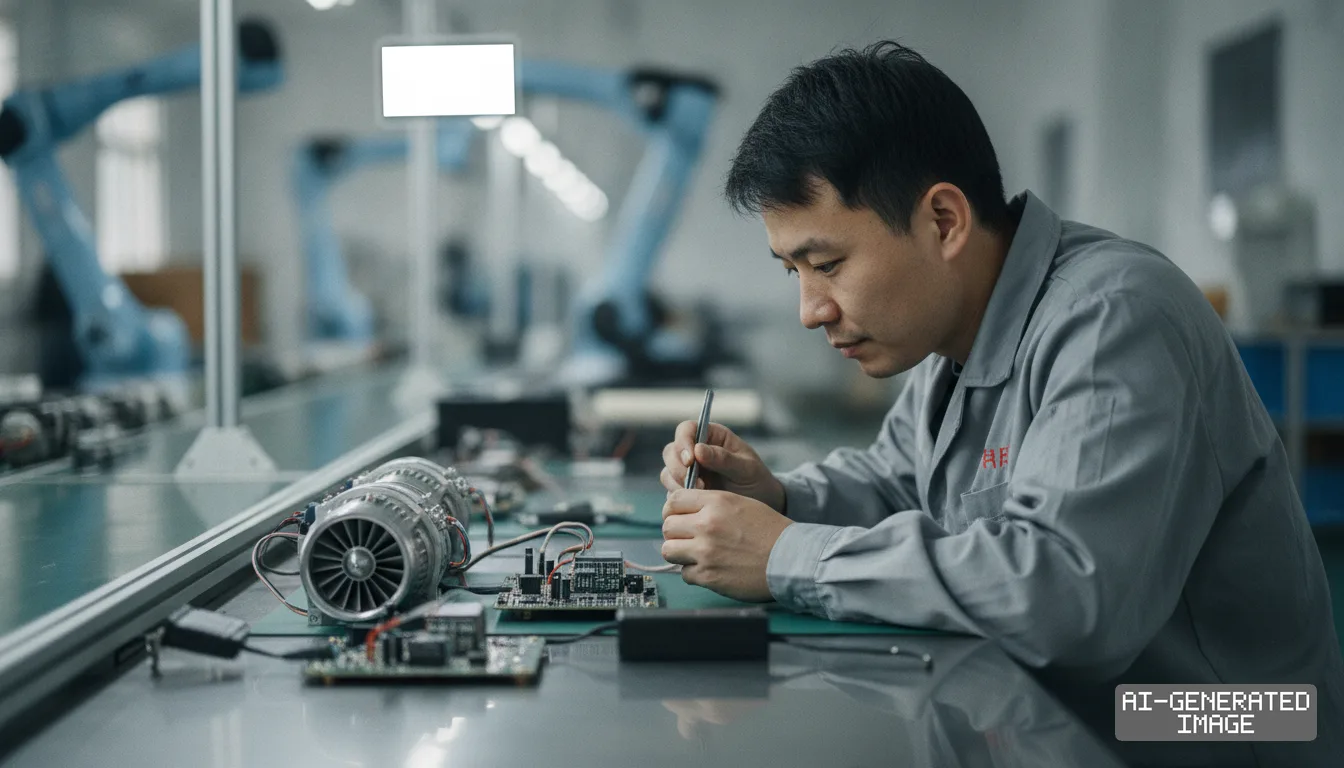
China's Ministry of Commerce reinforced export restrictions on Oct. 27, 2026, mandating individual government licenses for specialized drone engines, flight-control autopilots and tactical radio transmission systems shipped overseas.
The ministry published the technical standards jointly with the General Administration of Customs and the Central Military Commission. The decree applies across all international export destinations starting next month.
The measure restricts aviation piston engines exceeding 16 kilowatts of continuous power. It also controls turbojet engines delivering 400 newtons of thrust, which propel high-altitude target and strike airframes.
The engine curbs cover internal combustion units designed to operate above 15,420 meters, or 50,000 feet. Such propulsion hardware accounts for the core flight envelope of medium-altitude uncrewed systems.
Electric propulsion hardware faces four simultaneous technical hurdles. Exporters must obtain permits for brushless motors rated at 48 volts or more and 3 kilowatts or higher, the ministry notice said.
The motor rules apply to units with power density of at least 3 kilowatts per kilogram and speeds below 3,000 revolutions per minute. Matching electronic speed controllers face identical licensing rules.
Those motor parameters define heavy-lift platforms rather than consumer camera drones. High torque at low rotational speeds allows uncrewed craft to spin oversized propellers and lift heavy tactical payloads.
The regulation extends controls to specialized carbon-fiber propellers. Fixed-pitch blades measuring 762 millimeters from hub center to tip and folding blades of 648 millimeters require formal export approval, the ministry said.
Autopilot systems built specifically for unmanned aircraft require individual export permits under control code 7A103.b. The restriction covers source code for autonomous navigation, waypoint steering and formation swarm control.
Camera stabilization systems that use gimbal technology under classification 7E103.a are also restricted. Exporters must declare technical documentation proving the payload software cannot be modified for battlefield target tracking.
The rules restrict onboard radio communication equipment with equivalent isotropically radiated power of 30 dBmW or higher. Ground stations that command 10 or more uncrewed aircraft simultaneously face the same license hurdle.
Exporters must state on customs declarations whether shipments contain items listed on dual-use control registers. Customs officers will halt shipments if technical specifications closely match restricted thresholds without an export permit.
Under companion customs rules, freight forwarders must submit technical contracts and schematics within seven working days of an inquiry. Port inspectors may detain questioned hardware for 15 working days during technical reviews.
The ministry preserved an expedited export track for lower-tier civilian platforms. Manufacturers exporting basic consumer quadcopters can secure streamlined export certificates through pre-shipment online registry filings rather than individual licensing.
The controls land directly on Western defense startups and battlefield procurement networks. Many European and American drone builders rely on commercial off-the-shelf Chinese hardware to assemble tactical reconnaissance and strike fleets.
Assembly workshops in Ukraine consume thousands of commercial brushless motors and flight controllers each week. Direct export licensing from Chinese ports threatens to cut off the subcomponents that keep small strike drones flying.
Shenzhen-based Hobbywing Technology manufactures brushless motors and electronic speed controllers widely used across commercial and defense airframes. The company faces mandatory license reviews on its heavy-lift commercial propulsion lines.
Hobbywing has not published the dollar value or export volume of foreign supply contracts subject to the new restrictions. The manufacturer did not state whether overseas commercial distributors have begun canceling component orders.
American drone manufacturers already face tightening supply links. MOFCOM placed Utah-based Teal Drones and its parent company Red Cat Holdings on an export control watch list in June, barring direct component deliveries.
Western defense aggregators that previously sourced Chinese drone electronics through third-party intermediaries in Southeast Asia face tighter scrutiny. Chinese customs authorities now hold the authority to track end-user documentation across intermediate jurisdictions.
Alternative industrial capacity outside China remains constrained. Western motor manufacturers produce military-grade actuators at unit prices five to 10 times higher than commercial Chinese equivalents, according to procurement specialists.
The ministry has not published expected processing timelines for dual-use license applications. Government notices also do not specify historical approval rates for export requests submitted by commercial distributors outside Asia.
The licensing mandate takes effect on Nov. 18, 2026, without an expiration date. Freight moving through Chinese seaports and air hubs after that date without explicit license documentation will be detained at customs.
Impact map
How this development propagates across the region and out to global buyers.
| Event | Korea | China | Japan | Global impact |
|---|---|---|---|---|
| Drone component export controls | drone makers face tighter motor supply checks on dual-use assemblies | MOFCOM controls drone propulsion and autopilot exports from Nov. 18 | industrial drone assemblers review sub-tier motor sourcing in Shenzhen | Western defense startups face delays and higher procurement costs on COTS parts |
In this story
- Companies
- Hobbywing TechnologyRed Cat HoldingsTeal Drones
- Tickers
- RCAT
- Policy
- Export Controls
- Impact
- Supply ChainComplianceCost Structure
Track every Export Controls development →
Related briefings
- China curbs drone tech exports to US defense contractors in 2026 Also on Teal Drones, Red Cat Holdings, Export Controls
- China bans dual-use sales to MP Materials and US refiners Also on Red Cat Holdings, Export Controls, Compliance
- China blocks rare earth sales to US firms under export rules Also on Red Cat Holdings, Export Controls, Compliance
- China curbs tunnel boring machine exports ahead of Nov. 18 Also on Export Controls, Compliance, Cost Structure
Sources
Primary documents
Reporting
Confidence: high — how we grade this
The documents behind this briefing are linked above. East Asia Brief produces its English text with AI assistance under human editorial review, and does not translate or republish other outlets' articles. See our methodology and AI policy. Spotted an error? Tell us.
The Morning Brief
What changed in Korean, Chinese and Japanese industry overnight — and what it means for your supply chain. One email, weekday mornings, US time. Free.
The Morning Brief is in preparation. Leave your address and we will write to you once — when the first issue is ready. Nothing before that.