China bans dual-use sales to MP Materials and US refiners
The Ministry of Commerce export blacklist targets MP Materials and USA Rare Earth, cutting off specialized processing feedstocks needed for Western permanent magnets.
China's Ministry of Commerce reinforced export restrictions on Oct. 3, leaving American processors barred from dual-use equipment and chemical reagents under rules designed to slow Western rare earth magnet manufacturing.
China controls roughly 90% of global rare earth permanent magnet manufacturing and over 70% of extraction capacity. The trade curbs isolate companies building non-Chinese supply chains for electric vehicles and defense systems.
The measures target the two primary American producers, led by MP Materials Corp., which accounts for about 15% of global rare earth mining. MP Materials produced 840 metric tons of separated neodymium-praseodymium in the second quarter.
The underlying export restrictions stem from Announcement No. 23, issued by the Ministry of Commerce on June 22. That ruling placed 10 American entities onto Beijing's export control management list, effective immediately.
The order bars Chinese exporters from transferring dual-use items to the listed companies. It also forbids overseas organizations from shipping goods containing China-origin dual-use components to any of the 10 named corporate entities.
All ongoing transactions and contracted shipments involving the listed firms were ordered halted. Exporters requiring emergency exemptions must submit formal license applications directly to the commerce ministry for case-by-case review.
Beijing enacted the export curbs in direct retaliation for Washington's trade actions. The Pentagon on June 8 added prominent Chinese technology companies, including Alibaba Group, BYD and CXMT, to its Section 1260H military blacklist.
MP Materials operates the Mountain Pass open-pit mine in California, the only active commercial rare earth mining site in the United States. The company generated $108.5 million in revenue during the second quarter of 2026.
The miner historically relied on Chinese refiners to process its bastnasite concentrate into separated oxides. China's Shenghe Resources Holding Co. retains a 7.7% equity stake in MP Materials under an existing offtake agreement.
MP Materials halted commercial shipments of unrefined concentrate to China after bilateral tariff escalations. The company now refines roughly half of its mined material on site in California, directing finished oxides to allied markets.
The second critical mineral target is USA Rare Earth, Inc., which is developing the Round Top heavy rare earth deposit in Texas. The company is constructing a permanent magnet manufacturing facility in Stillwater, Oklahoma.
The Oklahoma plant is designed to produce an initial 1,200 metric tons of sintered neodymium-iron-boron magnets each year. USA Rare Earth aims to expand that volume to 4,800 metric tons annually as domestic assembly scales.
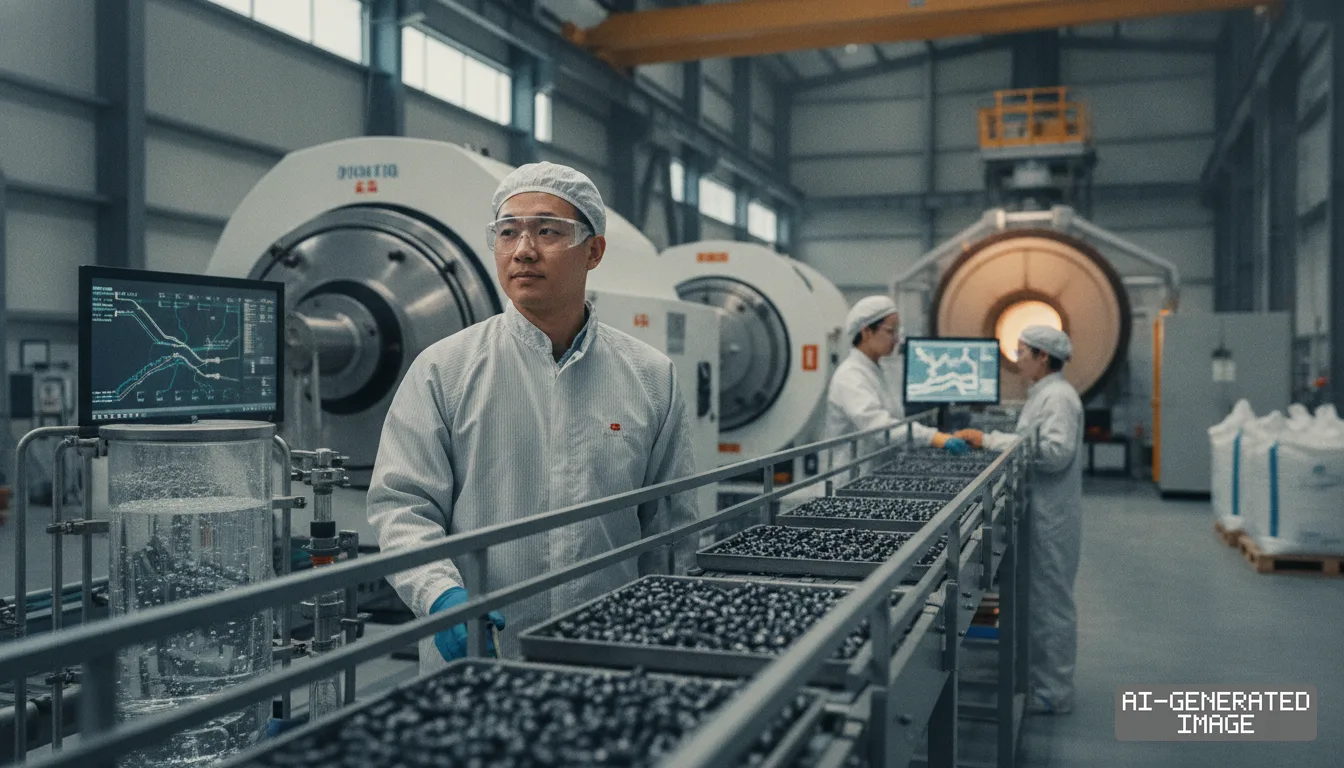
The dual-use export ban strikes at specialized extraction technology rather than raw ore. Chinese suppliers dominate the manufacturing of solvent extraction equipment, centrifugal contactors and specialized organic extractants used in commercial rare earth separation.
Permanent magnets for electric vehicle drivetrains and guided missiles require heavy rare earth additives, particularly dysprosium and terbium. China controls virtually 100% of global commercial refining capacity for these two heavy elements.
Eight defense and aerospace suppliers were included alongside the two mineral producers. The list names Aveox, Red Cat Holdings, Teal Drones, IMSAR, Jaia Robotics, Ball Aerospace, Oshkosh Defense and L3Harris Maritime Services.
Teal Drones and parent company Red Cat Holdings build tactical reconnaissance systems for the U.S. Army. The export embargo prevents them from procuring Chinese magnet assemblies, flight controllers and optical tracking components.
Oshkosh Defense manufactures tactical wheeled vehicles and holds major Pentagon contracts for hybrid-drive combat trucks. Those platforms depend on high-flux electric motors that use heavy rare earth permanent magnets.
The transfer ban on China-origin dual-use materials also restricts allied subcontractors in Japan and South Korea. Foreign magnet manufacturers cannot blend Chinese-separated heavy rare earths into components destined for the blacklisted American plants.
The Ministry of Commerce published Announcement No. 44 on Oct. 3 regarding an antidumping investigation into European chemical imports, but it has not published any separate rare earth docket on that date.
The notice does not state whether individual parts suppliers selling standard off-the-shelf magnet grades will face third-party enforcement audits. Beijing has not released detailed classification thresholds for dual-use rare earth tooling.
Procurement deadlines in Washington will soon accelerate the pressure on Western manufacturers. Beginning Jan. 1, 2027, the Pentagon will enforce a strict ban on defense hardware containing Chinese-origin sintered neodymium-iron-boron magnets.
MP Materials continues customer qualification deliveries from its magnet production facility in Fort Worth, Texas. Regulatory filings confirm commercial shipments to automotive buyers remain scheduled to begin before the end of the fourth quarter.
Impact map
How this development propagates across the region and out to global buyers.
| Event | Korea | China | Japan | Global impact |
|---|---|---|---|---|
| China dual-use rare earth export ban | no direct entity ban, refiners face supply bottlenecks for non-China dysprosium blends | domestic producers consolidate 90% magnet market, blocking critical extraction tooling exports | magnet assemblers prohibited from re-exporting China-origin separated minerals to listed US plants | Western EV and defense motor supply chains face delay in bypassing Chinese NdFeB magnets |
In this story
- Companies
- MP Materials Corp.USA Rare EarthInc.
- Tickers
- MP
- Exposed
- Shenghe ResourcesRed Cat HoldingsOshkosh Defense
- Policy
- Export Controls
- Impact
- Supply ChainComplianceCost Structure
Track every Export Controls development →
Related briefings
- China rare earth suppliers halt US shipments ahead of Washington summit talks Also on Oshkosh Defense, USA Rare Earth, Export Controls
- China Rare Earth Group seeks control of Shenghe Resources Also on Shenghe Resources, Export Controls, Compliance
- China scales dysprosium recovery from spent magnets as primary mining quotas tighten Also on Shenghe Resources, Export Controls, Compliance
- China bars dual-use exports to Japan citing military end-use Also on USA Rare Earth, Export Controls, Compliance
Sources
Primary documents
Reporting
Confidence: high — how we grade this
The documents behind this briefing are linked above. East Asia Brief produces its English text with AI assistance under human editorial review, and does not translate or republish other outlets' articles. See our methodology and AI policy. Spotted an error? Tell us.
The Morning Brief
What changed in Korean, Chinese and Japanese industry overnight — and what it means for your supply chain. One email, weekday mornings, US time. Free.
The Morning Brief is in preparation. Leave your address and we will write to you once — when the first issue is ready. Nothing before that.