China curbs drone tech exports to US defense contractors in 2026
Beijing maintains dual-use restrictions on rare earth magnets and flight hardware as Washington penalizes unnotified artificial intelligence capital flows under new outbound rules.
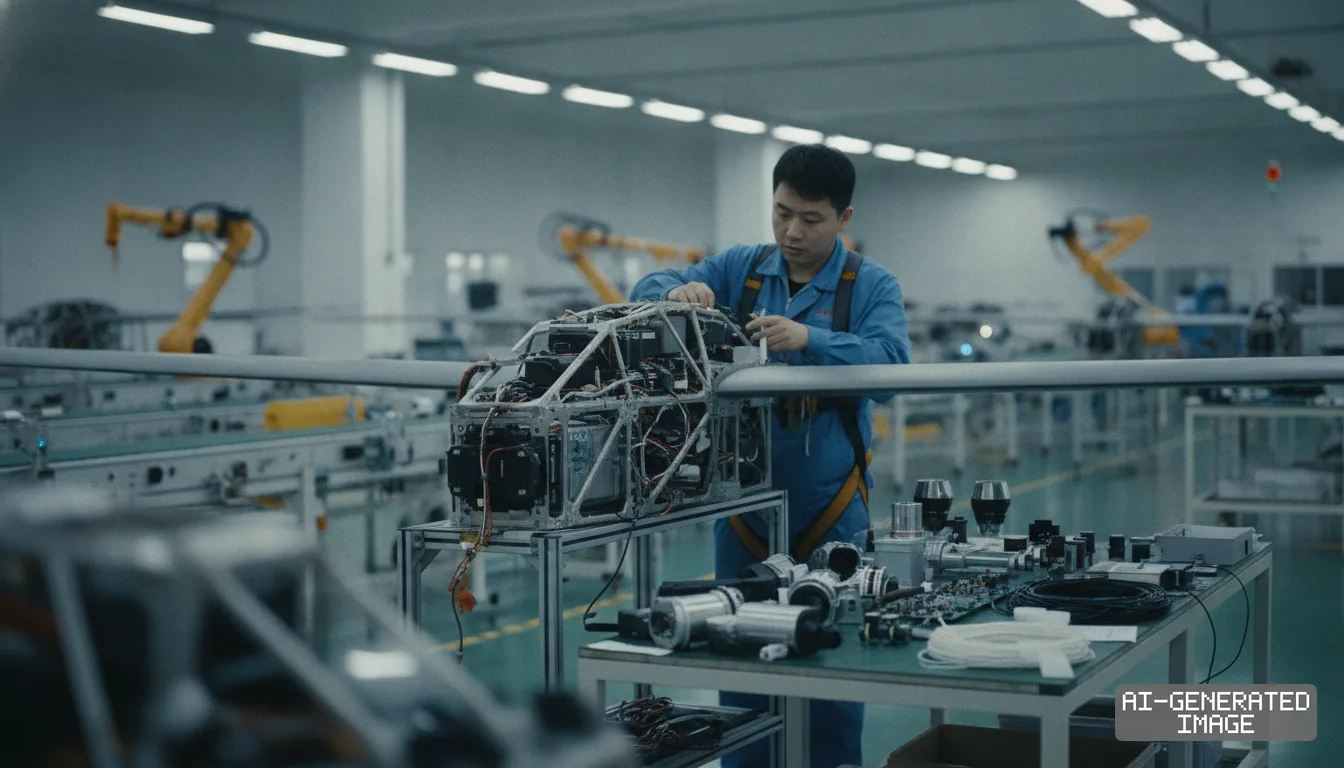
China's Ministry of Commerce published no regulatory sanctions against American defense firms on Oct. 7, 2026, leaving military drone supply chains bound to preexisting dual-use export curbs.
Market speculation that Beijing had designated six defense contractors followed tighter scrutiny over drone components. The ministry maintains strict case-by-case licensing for unmanned aerial vehicle hardware destined for the United States, trade officials said.
China manufactures roughly 90% of the world's rare earth permanent magnets. Those components feed high-torque brushless motors and precision guidance actuators across commercial and defense platforms, according to customs data.
The supply exposure became acute after earlier export curbs severed component pipelines. American drone makers remain vulnerable at motor assemblies and high-energy battery packs where domestic alternatives require months to qualify.
Beijing demonstrated that supply leverage in October 2024 by cutting off cell shipments to Skydio Inc. The sanction forced the largest American drone builder to ration customers to one battery per aircraft for six months.
On June 22, 2026, China expanded that pressure by placing 10 American defense, drone and rare earth companies on its dual-use export control list. Teal Drones and parent company Red Cat Holdings lost direct access to Chinese subsystem vendors.
That same notice restricted component deliveries to motor supplier Aveox and radar developer IMSAR. Concurrently, China's Ministry of Finance barred 46 American defense contractors from participating in Chinese government procurement tenders.
On Aug. 5, 2026, China's Ministry of Commerce issued Announcement No. 34 to tighten dual-use controls further. The rule rescinded licensing facilitation measures for drone hardware and key components bound for American buyers.
Under Announcement No. 34, Chinese exporters must submit individualized applications for drone items listed in the national control catalog. MOFCOM evaluates each cross-border shipment under national security and nonproliferation criteria, the ministry said.
Concurrently, MOFCOM Order No. 2 designated six American supply-chain diligence and auditing organizations under the Anti-Foreign Sanctions Law. Those targets included Applied DNA Sciences Inc., Stratum Reservoir LLC and Altana Technologies Inc.
The Aug. 5 designations also barred Verité Group Inc., the Responsible Business Alliance and Human Rights in China. A companion order added Compliance Testing LLC for assisting American telecommunications restrictions, the ministry said.
None of the seven entities penalized in August manufacture defense hardware or uncrewed aircraft. Confusion among trade observers over that corporate roster drove incorrect reports of a fresh October defense blacklist, industry analysts said.
Earlier measures had directly struck drone programs. In July 2024, the Ministry of Foreign Affairs sanctioned six defense companies, including Anduril Industries and AEVEX Aerospace, over loitering munition deliveries to Taiwan under Decree No. 7.
In October 2024, Decree No. 13 added Skydio, Edge Autonomy Operations LLC and Huntington Ingalls Industries Inc. Those designations froze local assets and barred Chinese industrial organizations from conducting commercial transactions with the firms.
Western aerospace builders face persistent bottlenecks in replacing Chinese neodymium-iron-boron magnets. Chinese refiners control over 70% of global rare earth extraction and nearly all commercial heavy rare earth separation capacity.
Dysprosium and terbium additives grant permanent magnets high thermal resistance inside defense avionics and missile actuators. Alternative magnet fabrication plants in North America and Japan face qualification delays extending past 12 months.
Regulatory pressure on cross-border technology flows unfolded from the American side as well. On Oct. 7, 2026, the U.S. Department of the Treasury announced its first civil penalty under the Outbound Investment Security Program.
Treasury levied a $200,000 fine on Amidi LLC, the parent company of startup accelerator Plug and Play Tech Center. The penalty penalized an unnotified $92,478 investment made by Amidi's Chinese fund in April 2025.
The target firm, Shanghai Qiongche Intelligent Technology Company Limited, develops artificial intelligence and embodied robotics systems. Treasury identified the transaction through routine market monitoring rather than voluntary disclosure, the department said.
Treasury Secretary Scott Bessent said the penalty enforces compliance rules designed to protect sensitive American technologies. The program requires American investors to submit formal notifications regarding controlled investments in Chinese artificial intelligence startups.
Bilateral friction over unmanned systems and dual-use aerospace goods continues to compress commercial operating room. Chinese customs authorities inspect outbound avionics and magnet consignments against an expanded 2026 dual-use catalog containing 846 controlled items.
China's Ministry of Commerce and Ministry of Foreign Affairs have not published any decree or notice penalizing six American defense contractors on Oct. 7, 2026.
China's dual-use export licensing catalogue operates under regulatory terms that run through March 31, 2027, requiring exporters to submit annual documentation updates before the spring deadline.
Impact map
How this development propagates across the region and out to global buyers.
| Event | Korea | China | Japan | Global impact |
|---|---|---|---|---|
| Drone dual-use export curbs | Defense drone subcontractors secure non-Chinese magnet supply lines | MOFCOM subjects all U.S.-bound UAV parts to individual review | Magnet makers expand domestic dysprosium-free sintered NdFeB capacity | Defense UAS bill of materials rises 15-20% on Western component qualification |
In this story
- Companies
- SkydioRed Cat HoldingsTeal DronesAmidi LLC
- Tickers
- RCAT
- Exposed
- AveoxIMSARAnduril Industries
- Policy
- Export ControlsEconomic SecuritySanctions
- Impact
- Supply ChainComplianceCost Structure
Track every Export Controls development → Track every Economic Security development →
Related briefings
- China bans dual-use sales to MP Materials and US refiners Also on Red Cat Holdings, Export Controls, Compliance
- EU puts China rare earth curbs on trade docket to cut deficit Also on Export Controls, Compliance, Cost Structure
- China Delays Rare Earth Export Controls in U.S. Trade Truce Also on Export Controls, Compliance, Cost Structure
- Chalmers maps automotive gallium recovery under China curbs Also on Export Controls, Compliance, Cost Structure
Sources
Primary documents
Reporting
Confidence: high — how we grade this
The documents behind this briefing are linked above. East Asia Brief produces its English text with AI assistance under human editorial review, and does not translate or republish other outlets' articles. See our methodology and AI policy. Spotted an error? Tell us.
The Morning Brief
What changed in Korean, Chinese and Japanese industry overnight — and what it means for your supply chain. One email, weekday mornings, US time. Free.
The Morning Brief is in preparation. Leave your address and we will write to you once — when the first issue is ready. Nothing before that.