ASML and tool makers see China sales share plunge in third quarter
Shipments redirected to South Korea and Taiwan as ASML's revenue share from Chinese fabricators dropped from 42% to 23% year on year.
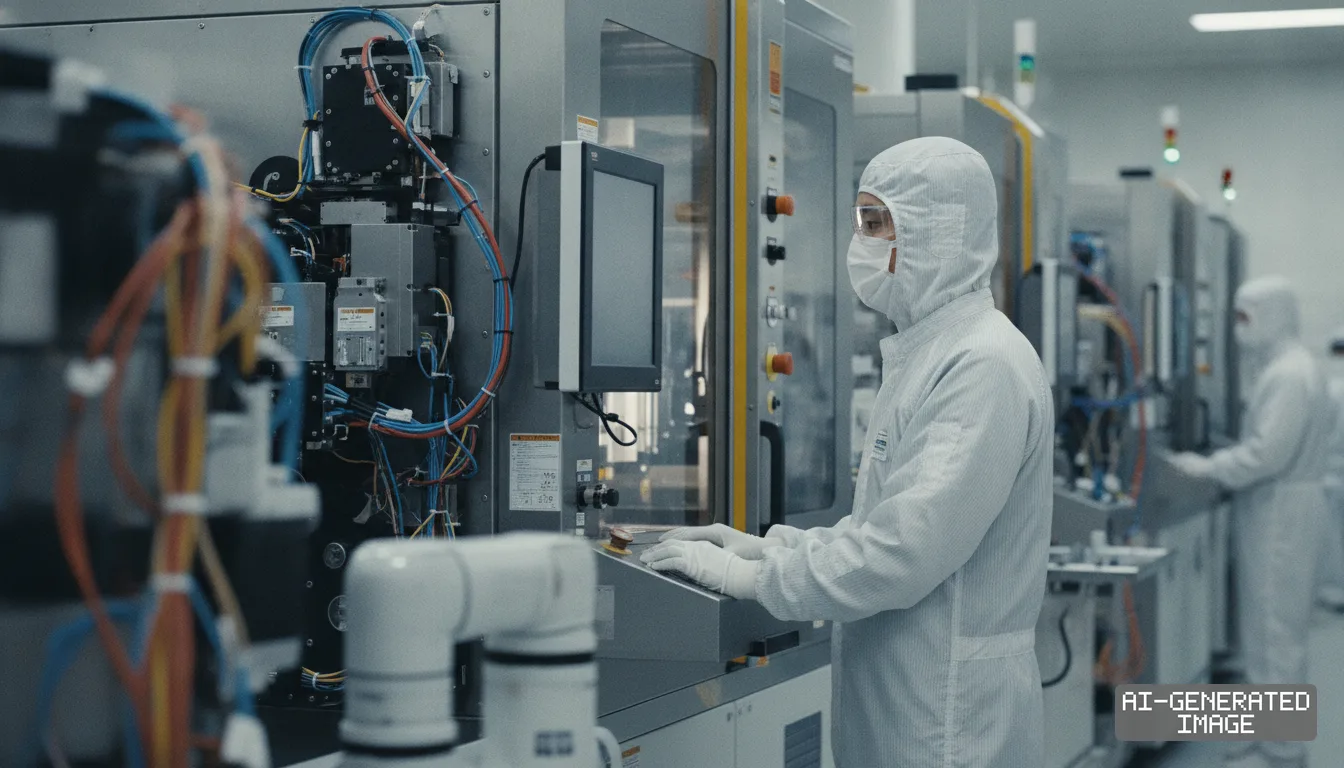
The world's four largest semiconductor equipment manufacturers saw their revenue exposure to China fall sharply on Nov. 9, 2026, as quarterly filings showed tool shipments shifting to South Korea and Taiwan.
The contraction marks a decisive shift from 2025, when Chinese chipmakers stockpiled mature-node machinery ahead of trade barriers. Surging artificial intelligence capital expenditure elsewhere in East Asia is now absorbing tool deliveries.
ASML reported that China accounted for 23% of its net system sales in the third quarter of 2026, down 19 percentage points from 42% a year earlier. Total quarterly system shipments reached €8.4 billion ($9.1 billion).
Purchases by fabricators in Taiwan and South Korea surpassed Chinese volume for the first time in six quarters. Taiwan represented 32% of ASML tool sales, while South Korean memory producers took 31%.
American tool vendors registered corresponding declines in Chinese exposure. Lam Research reported that China generated 35% of its revenue in the third quarter of 2026, down eight percentage points from 43% in the prior-year quarter.
Revenue at Lam Research from South Korea more than doubled over the same timeframe. The increase tracked expanded tool installations at memory lines operated by Samsung Electronics and SK hynix.
Those South Korean memory makers are expanding capacity for high-bandwidth memory — stacks of dynamic random-access memory linked by microscopic vertical channels — to support artificial intelligence processors. Tool deliveries followed that capital reallocation.
Process inspection specialist KLA Corporation reported a five percentage point decrease in Chinese revenue weighting. Sales into China represented 34.5% of total revenue in the third quarter of 2026, down from 39.5% a year earlier.
Shipments to advanced packaging and logic lines in Taiwan offset the deceleration in Chinese tool uptake. Increased inspection requirements for sub-three-nanometer nodes at Taiwan Semiconductor Manufacturing Co. supported total equipment billings across the region.
Tokyo Electron posted a parallel reduction in Chinese sales exposure. The Japanese manufacturer said sales to China accounted for 36.4% of total revenue in the quarter ended Sept. 30, 2026, down from 40.3% a year earlier.
Consolidated net sales at Tokyo Electron reached 935.1 billion yen ($6.1 billion) for the quarter, with operating income of 295.4 billion yen. Management raised its full-year revenue outlook to 3.7 trillion yen on strong logic demand.
Applied Materials recorded a comparable trend in its third fiscal quarter, with China generating 28% of total net sales of $9.12 billion. That weighting fell from more than 30% during the previous fiscal year.
The shift reflects the tightening of multilateral trade controls imposed by the United States, Japan and the Netherlands. Licensing rules restrict the export of tools capable of producing advanced logic below 14 nanometers.
Restrictions also prohibit the transfer of manufacturing gear for high-density flash memory and advanced dynamic random-access memory. Those controls eliminated sales of high-end equipment to state-backed Chinese fabrication projects.
Concurrently, Chinese chipmakers have accelerated the substitution of foreign machinery with domestic alternatives. State-backed fabricators Semiconductor Manufacturing International Corp. and Yangtze Memory Technologies are installing domestic tools to secure their production lines.
Naura Technology Group and Advanced Micro-Fabrication Equipment Inc. have captured increasing market share across mainland fabs. Domestic tools now handle a larger portion of mature-node plasma etching and chemical vapor deposition.
Local tool deployment has curtailed Chinese demand for foreign legacy systems. Having completed major stockpiling programs during late 2024 and 2025, Chinese operators are slowing purchase orders for imported mid-tier machinery.
The realignment occurred alongside record global semiconductor expansion. Worldwide chip sales reached $517.7 billion in the third quarter of 2026, up 24.1% from the second quarter, according to the Semiconductor Industry Association.
Third-quarter global sales were compiled by the World Semiconductor Trade Statistics organization. The data showed September sales rising 146.8% year-over-year to $172.6 billion, driven by cloud computing investments in the Americas and East Asia.
For international equipment makers, the rebalancing has reduced geographic concentration risks. Revenue growth is increasingly tethered to artificial intelligence infrastructure rather than Chinese mature-node capacity expansions.
Operating profit margins have expanded across the sector as high-margin tools replace discounted legacy packages. Equipment makers report strong order backlogs for leading-edge tools running through the end of 2027.
The quarterly filings do not state the exact dollar value of legacy tool orders that Chinese buyers diverted to domestic suppliers. Equipment makers have not published order cancellations broken down by individual Chinese customer.
Applied Materials reports its fourth-quarter earnings on Nov. 12, while the U.S. Department of Commerce concludes its annual export control policy review on Dec. 15.
Tool manufacturers maintain delivery slots for extreme ultraviolet lithography systems and advanced packaging tools in Pyeongtaek and Tainan through the third quarter of 2027.
Impact map
How this development propagates across the region and out to global buyers.
| Event | Korea | China | Japan | Global impact |
|---|---|---|---|---|
| China tool revenue decline | Samsung and SK hynix absorb memory tools, boosting Lam Korea sales | SMIC and YMTC accelerate tool purchases from Naura and AMEC | Tokyo Electron drops China share to 36.4% while logic orders rise | Tool billings rebalance toward AI packaging and sub-three-nanometer nodes |
In this story
- Companies
- ASMLTokyo ElectronLam ResearchKLA CorporationApplied Materials
- Tickers
- ASML8035.TLRCXKLACAMAT
- Exposed
- Semiconductor Manufacturing International CorpYangtze Memory TechnologiesNaura Technology GroupAdvanced Micro-Fabrication Equipment IncSamsung ElectronicsSK hynix
- Policy
- Export Controls
- Impact
- Supply ChainOrder BookCost Structure
Track every Export Controls development →
Related briefings
- Naura and SMEE Accelerate Domestic Tool Shipments to Chinese Fabs Also on Yangtze Memory Technologies, Naura Technology Group, Lam Research
- TSMC revenue rises 53% on AI demand to record NT$514 billion Also on Semiconductor Manufacturing International Corp., Tokyo Electron, Samsung Electronics
- Kioxia and Sandisk split roadmaps for 3D NAND hybrid bonding in Japan Also on KLA Corporation, SK hynix, Samsung Electronics
- Japan Linear Guide Makers Expand Ultra-Clean Units for 2nm Fab Robotics Also on Lam Research, Applied Materials, ASML
Sources
Primary documents
Reporting
Confidence: high — how we grade this
The documents behind this briefing are linked above. East Asia Brief produces its English text with AI assistance under human editorial review, and does not translate or republish other outlets' articles. See our methodology and AI policy. Spotted an error? Tell us.
The Morning Brief
What changed in Korean, Chinese and Japanese industry overnight — and what it means for your supply chain. One email, weekday mornings, US time. Free.
The Morning Brief is in preparation. Leave your address and we will write to you once — when the first issue is ready. Nothing before that.