SK hynix opens 874 billion won Trinity Fab testbed in Yongin
The shared validation line tests domestic materials and equipment, anchoring a 1.4 trillion won supplier program backed by SK Group and public funding.
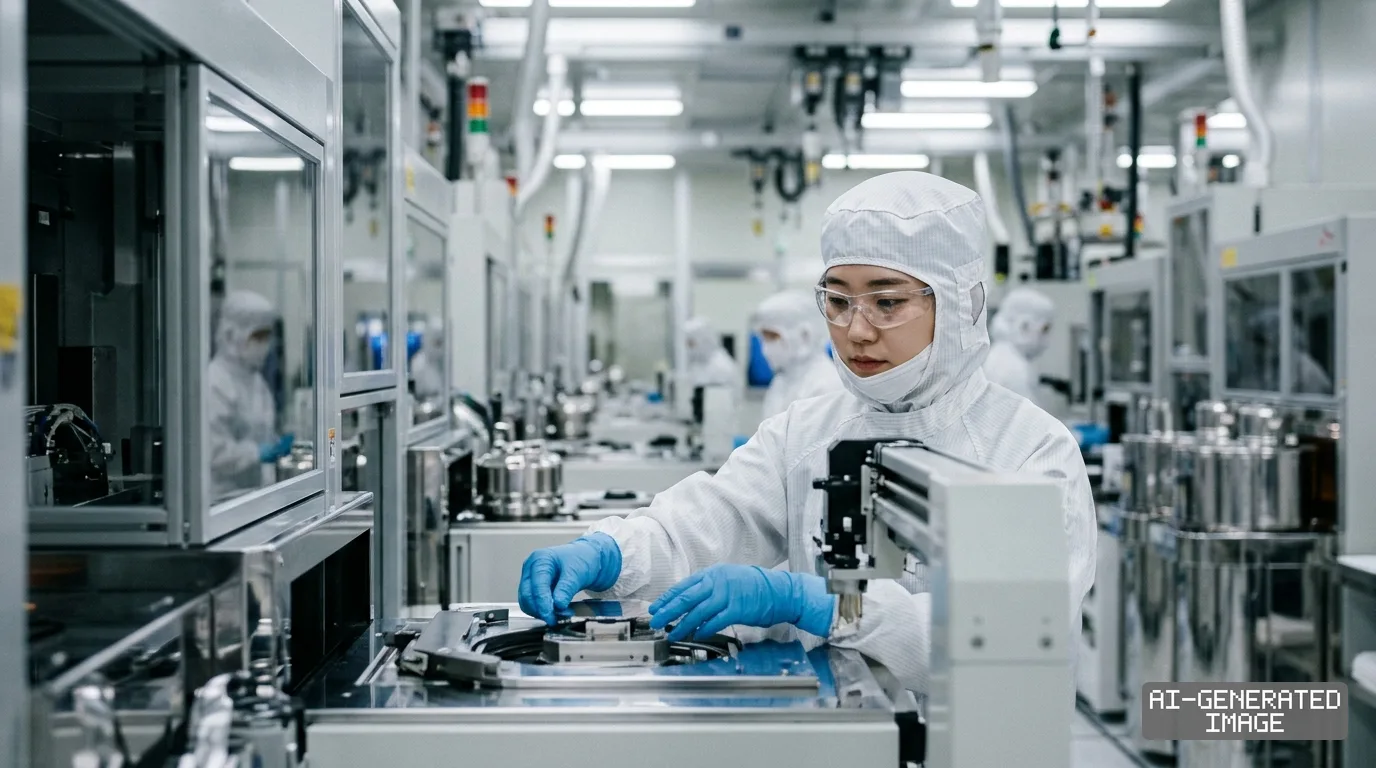
SK hynix opened its Trinity Fab verification facility to media on Nov. 16, detailing plans to validate domestic semiconductor materials, parts and equipment inside its Yongin mega-cluster.
The shared testing installation carries an investment of 874.6 billion won ($625 million). SK hynix is contributing 443.2 billion won, representing 50.7% of total facility funding, alongside 373.6 billion won from South Korea's central government and 57.7 billion won from provincial authorities.
The pilot line anchors a 1.4 trillion won ($1.0 billion) supplier assistance program spanning five years. SK Group established that financial facility in July to stabilize upstream suppliers producing high-bandwidth memory and advanced dynamic random-access memory components.
The verification fab occupies 3,305 square meters on the third floor of the Y1 manufacturing building in Yongin. Overall construction on the multi-story Y1 fabrication plant has reached an 89% completion rate, the company said.
About 2,640 square meters of the facility will house 51 mass-production tools across primary wafer processing steps. The equipment lineup includes 26 wafer processing tools, 11 metrology and inspection systems, and 14 auxiliary support units.
The equipment suite spans photolithography, plasma etching, thin-film chemical vapor deposition, chemical mechanical polishing and wet wafer cleaning. All machinery processes 12-inch wafers under production specifications identical to commercial memory lines.
The remaining 660 square meters will hold 15 partitioned cleanroom suites measuring approximately 45 square meters each. Domestic equipment and materials suppliers will lease these individual spaces at subsidized rates to conduct proprietary testing.
An independent non-profit entity named the Trinity Fab Foundation will operate the installation. The non-profit structure is designed to safeguard corporate trade secrets and intellectual property when competing vendors run trial batches, the foundation said.
Representatives from government ministries, municipal agencies, academic institutions and supplier associations will occupy a majority of seats on the foundation board. SK hynix will supply engineering personnel, cleanroom maintenance and chemical management without charging operational fees.
Plasma deposition toolmaker TES is among the suppliers preparing to test machinery on the shared line. Single metrology and diagnostic tools cost between 1 billion won and 5 billion won ($715,000 to $3.6 million), TES said.
Those capital costs have previously prevented mid-tier equipment makers from conducting full wafer diagnostics internally. Access to shared production-grade tools allows suppliers to verify machinery performance while reducing internal capital expenditure, TES executives said.
Specialty gas producer TEMC faces a similar technical hurdle when qualifying process chemicals. Securing trial runs on active commercial lines has previously taken one to two years because semiconductor manufacturers rarely halt revenue-generating production lines for experimental testing, TEMC said.
The foundation plans to assist roughly 300 domestic materials, parts and equipment suppliers through 2027. Early access to commercial-grade infrastructure will allow suppliers to generate reliable yield data before pitching components to global chipmakers, foundation officials said.
The broader 1.4 trillion won assistance package also introduces an experimental research risk-sharing mechanism. SK hynix will reimburse up to 50% of initial research expenses if an approved joint development project fails to achieve commercial readiness.
The financing framework provides three-year interest-free research loans and expands low-interest operating credit for secondary and tertiary contractors. SK hynix processes supplier payments four times per month, settling cash disbursements within 10 days of invoice receipt.
The initiative reflects South Korea's strategy to insulate advanced packaging supply chains from geopolitical disruptions. Sourcing critical etching chemicals, chemical slurries and vacuum chambers locally protects domestic memory fabs against foreign export restrictions and logistical chokepoints, trade officials said.
Unlike research facilities operated by institutions such as Belgium's imec or Taiwan's Industrial Technology Research Institute, Trinity Fab sits directly inside an operational manufacturing shell. The shared cleanroom connects to the identical automated chemical feeds and air filtration shafts supporting commercial lines.
The testbed draws electricity, ultra-pure water and bulk industrial gases directly from the central utility building serving the Y1 plant. That integrated utility connection ensures experimental test runs encounter the exact pressure tolerances, exhaust dynamics and vibration levels found in full-scale fabrication.
Cleanroom fit-out inside Trinity Fab is scheduled for completion in May 2027, with formal verification services beginning in the fourth quarter of 2027. SK hynix plans to open the first primary production cleanroom in the Y1 building in February 2027.
The foundation has not published the rental fee schedule for the 15 supplier suites or the finalized selection criteria for the 300 target vendors.
SK hynix plans to construct four semiconductor fabrication plants across the 4.15-million-square-meter Yongin cluster through 2033 to anchor its long-term artificial intelligence memory production.
Impact map
How this development propagates across the region and out to global buyers.
| Event | Korea | China | Japan | Global impact |
|---|---|---|---|---|
| Trinity Fab open testbed deployment | TES and TEMC cut validation cycles; 300 suppliers access 12-inch line | Domestic Korean tool validation widens memory technology gap | Japanese equipment suppliers face rising localization from Korean toolmakers | Memory supply chain cushions export control risks for AI hardware BOM |
In this story
Track every Subsidies development →
Related briefings
- Samsung starts recycling 80% of neon gas at Pyeongtaek fab Also on TEMC, SK hynix, Subsidies
- Samsung begins $104B regional push with Onyang packaging fab Also on SK hynix, Subsidies
- Samsung breaks ground on $33B advanced packaging fab in Asan Also on SK hynix, Subsidies
- SK hynix expands US engineering team for custom Nvidia memory Also on SK hynix, Subsidies
Sources
Reporting
Confidence: medium — how we grade this
The documents behind this briefing are linked above. East Asia Brief produces its English text with AI assistance under human editorial review, and does not translate or republish other outlets' articles. See our methodology and AI policy. Spotted an error? Tell us.
The Morning Brief
What changed in Korean, Chinese and Japanese industry overnight — and what it means for your supply chain. One email, weekday mornings, US time. Free.
The Morning Brief is in preparation. Leave your address and we will write to you once — when the first issue is ready. Nothing before that.