POSCO Future M anchors $260M Vietnam anode site to bypass China
Backed by LG Energy Solution and Hyundai, the 357 billion won Thai Nguyen facility counters China's 92.4% share of South Korea's synthetic graphite anode imports.
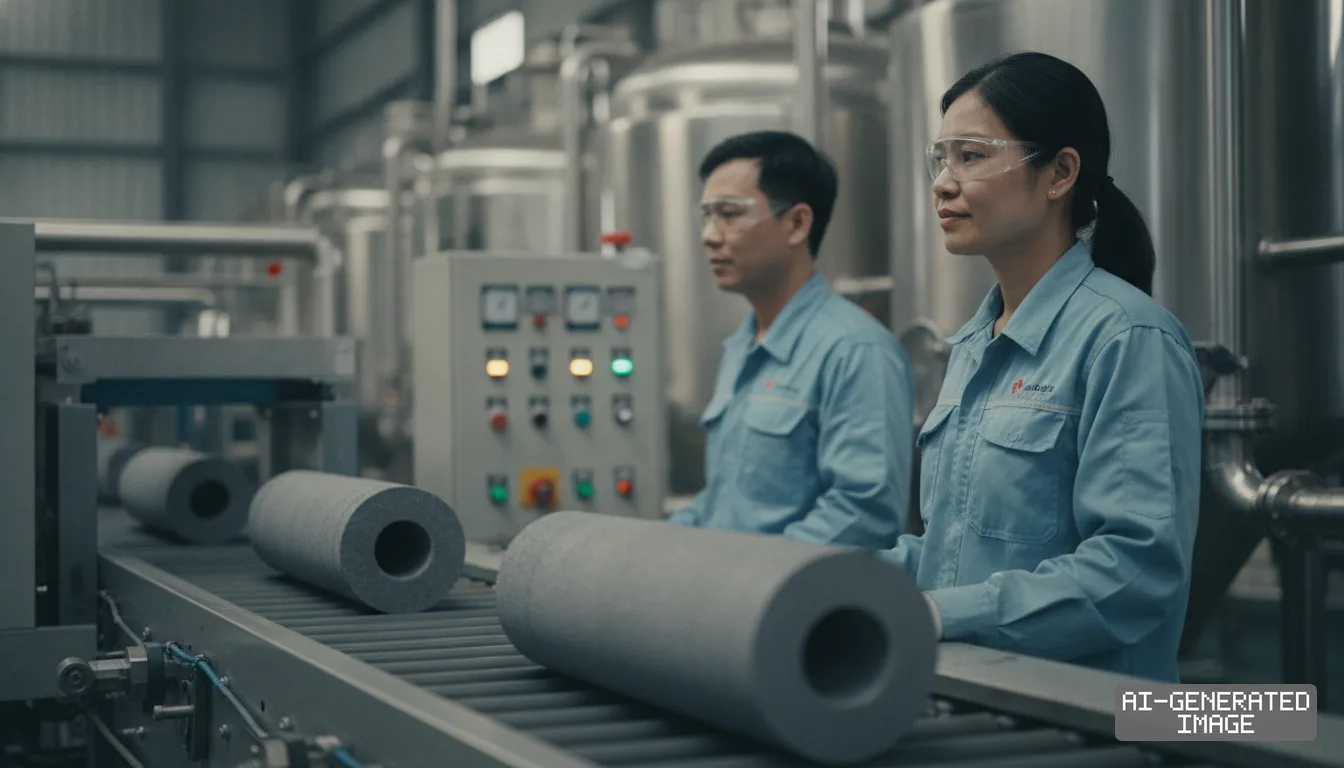
POSCO Future M advanced an ex-China supply network for synthetic graphite battery anodes on Nov. 6, 2026, aligning Korean cell manufacturers and vehicle assemblers behind Southeast Asian processing lines to counter trade restrictions.
The coordinated supply corridor anchors POSCO Future M's 357 billion won ($260 million) synthetic graphite manufacturing complex in Thai Nguyen, Vietnam, securing non-Chinese anode active materials for Western automotive platforms.
China supplied 92.4% of South Korea's battery-grade synthetic graphite imports through May 2026, according to Korea Customs Service records, while Chinese chemical processors control roughly 95% of global commercial refining capacity.
The materials producer established commercial off-take commitments on Oct. 30 through a seven-year memorandum of understanding with LG Energy Solution covering 720,000 metric tons of cathode and anode active materials from 2027 through 2033.
The volume commitment encompasses synthetic graphite anode material sourced from manufacturing lines in Pohang, South Korea, and Thai Nguyen, alongside lithium iron phosphate and high-nickel ternary cathodes, POSCO Future M said.
Hyundai Motor Group reinforced the manufacturing axis on Nov. 3 by signing a letter of intent to evaluate a 100 billion won ($73 million) equity stake in the Thai Nguyen facility.
The proposed equity investment gives Hyundai Motor Group preferential purchase rights for artificial graphite anodes produced in Vietnam, reserving feedstock for battery installations across North American and European electric vehicle assembly lines.
Synthetic graphite is produced by heating petroleum needle coke past 2,800 degrees Celsius to reorganize carbon atoms into planar crystalline lattices, offering higher structural consistency than natural flake graphite.
The crystalline structure improves lithium-ion intercalation speeds during vehicle charging cycles and curbs electrode volumetric expansion, extending the operational lifespan of high-density electric vehicle battery cells.
POSCO Future M currently operates 8,000 metric tons of annual synthetic graphite capacity at its domestic processing plant in Pohang, North Gyeongsang Province, serving domestic cell assembly facilities.
The Thai Nguyen facility will add 23,000 metric tons of annual capacity during its initial operational phase, with infrastructure designed to scale up to 55,000 metric tons through subsequent investment tranches.
Company operating plans designate the domestic Pohang facility for high-performance artificial graphite using secondary particle synthesis, while the Vietnamese installation will focus on standardized mid-tier formulations.
Lower industrial electricity tariffs and regional operating overhead in northern Vietnam allow POSCO Future M to narrow the price spread against state-subsidized graphite processors in mainland China.
Building industrial scale outside mainland China addresses compliance thresholds enacted under the United States Inflation Reduction Act and European Union critical raw material directives.
United States Treasury guidelines governing Section 30D clean vehicle tax credits disqualify electric vehicles containing battery components or critical minerals extracted, processed or recycled by foreign entities of concern.
Under Section 45X advanced manufacturing rules, battery manufacturers must source at least 60% of component direct material costs from qualified trading partners to secure full production subsidies.
The European Union's Critical Raw Materials Act similarly establishes that no single non-member state may supply more than 65% of any strategic raw material consumed within the bloc by 2030.
POSCO Future M moved to dismantle legacy equity ties in China earlier this year, completing the divestment of its remaining 8.3% stake in Inner Mongolia Sinosteel New Materials in May.
The group is securing domestic precursor inputs through affiliate POSCO MC Materials, which refines petroleum needle coke to feed carbonization furnaces without relying on Chinese intermediate vendors.
POSCO Future M filed debt securities registration statements on Nov. 6 to finalize bond pricing conditions, raising operational capital to fund ongoing battery material production facility expansions.
The group secured long-term commercial commitments in March through a 1.01 trillion won ($740 million) supply contract with an undisclosed global automotive manufacturer, allocating phase-one Thai Nguyen synthetic graphite output through 2032.
That contract, alongside a 700 billion won ($510 million) natural graphite agreement finalized late last year, lifted POSCO Future M's booked anode order backlog with Western automotive manufacturers to roughly 1.7 trillion won ($1.2 billion).
POSCO Future M and LG Energy Solution plan to execute a binding supply agreement before Dec. 31, 2026, establishing delivery allocations and commodity pricing mechanisms across product lines.
Commercial mass production at the Thai Nguyen synthetic graphite plant is scheduled to begin in the first half of 2028, according to construction execution plans released by the company.
The regulatory filings do not confirm whether Hyundai Motor Group has completed negotiations to convert the 100 billion won preliminary investment intent into a binding equity transaction.
The companies have not published the volume breakdown separating cathode materials from synthetic graphite anodes within the 720,000-ton LG Energy Solution supply framework.
POSCO Future M remains South Korea's sole industrial manufacturer operating commercial production across both cathode active materials and battery-grade anode active materials.
Impact map
How this development propagates across the region and out to global buyers.
| Event | Korea | China | Japan | Global impact |
|---|---|---|---|---|
| Ex-China synthetic graphite supply alliance | POSCO Future M commits 720,000 tons of active materials across domestic battery supply chains | Chinese refiners face demand erosion as Korean buyers replace 92.4% import dependency | Cell manufacturers gain non-PFE artificial graphite supply alternatives | Automakers de-risk IRA clean vehicle tax credit eligibility through 2033 |
In this story
- Companies
- POSCO Future MLG Energy SolutionHyundai Motor Group
- Tickers
- 003670.KS373220.KS005380.KS
- Exposed
- POSCO MC Materials
- Policy
- Tax CreditsLocal Content Rules
- Impact
- Supply ChainCapexCompliance
Track every Tax Credits development → Track every Local Content Rules development →
Related briefings
- Hyundai Motor pursues $75M anode stake with POSCO Future M Also on POSCO MC Materials, Hyundai Motor Group, POSCO Future M
- LG Energy Solution beats profit views on grid battery orders Also on Hyundai Motor Group, LG Energy Solution
- SK On assumes $1.5 billion debt from US battery subsidiary Also on Hyundai Motor Group, Compliance
- LG hires Hyundai robotics lead to direct physical AI push Also on Hyundai Motor Group
Sources
Primary documents
Reporting
Confidence: high — how we grade this
The documents behind this briefing are linked above. East Asia Brief produces its English text with AI assistance under human editorial review, and does not translate or republish other outlets' articles. See our methodology and AI policy. Spotted an error? Tell us.
The Morning Brief
What changed in Korean, Chinese and Japanese industry overnight — and what it means for your supply chain. One email, weekday mornings, US time. Free.
The Morning Brief is in preparation. Leave your address and we will write to you once — when the first issue is ready. Nothing before that.