Korea and Canada link battery supply chains to bypass China minerals
Bilateral working channels connect Canadian mines directly to Ontario and Quebec plants as Seoul faces a 99.7% import reliance on minerals.
South Korea and Canada advanced bilateral critical mineral procurement channels on Nov. 19, 2026, seeking to anchor battery supply chains in North America amid widening Chinese export controls.
The initiative operationalizes resource linkages evaluated during bilateral supply-chain sessions in Vancouver. Both governments are pushing to connect Canadian extraction directly to Korean manufacturing footprints across Ontario and Quebec.
South Korea contends with acute supply exposure, recording a 99.7% net import reliance across strategic industrial minerals. Beijing now classifies 30 of South Korea's 33 designated critical minerals as export-controlled items, the Asia Pacific Foundation of Canada said.
Korean industrial buyers have targeted 9.03 billion Canadian dollars ($6.6 billion) in procurement plans for Canadian lithium, nickel and rare earths. Those commitments represent approximately 8% of Seoul's annual overseas mineral procurement budget.
Corporate groups also outlined C$130 million in initial direct investment intentions targeting Canadian graphite extraction assets. Graphite remains essential for electric vehicle anodes, where Chinese refiners control more than 90% of global spherical graphite processing.
Direct procurement agreements have already begun taking shape among major battery cell producers. LG Energy Solution contracted 240,000 dry metric tonnes of spodumene concentrate over four years from Elevra Lithium's North American Lithium mine in Quebec.
That volume yields roughly 30,000 tonnes of battery-grade lithium hydroxide. The total quantity provides sufficient material to manufacture energy storage systems and traction packs for approximately 700,000 electric vehicles, LG Energy Solution said.
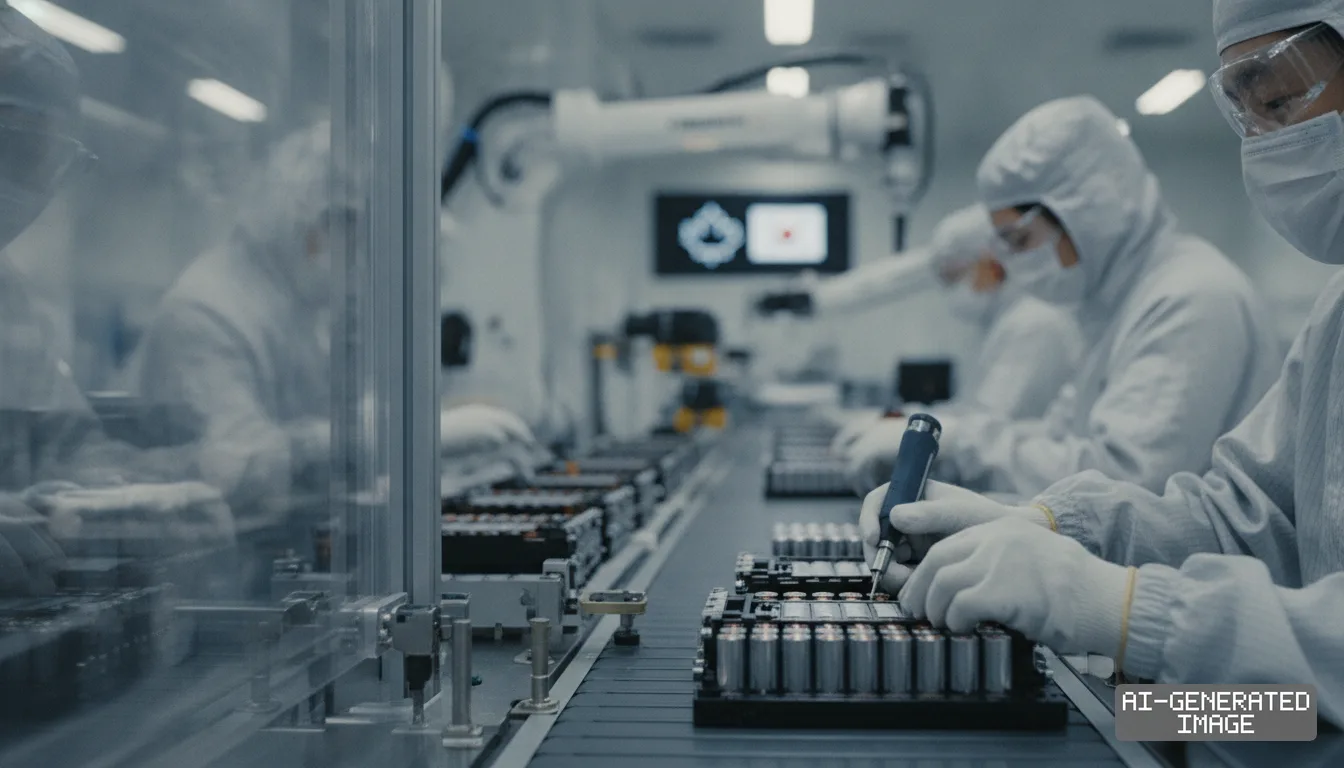
LG Energy Solution absorbed full operational control of its NextStar Energy facility in Windsor, Ontario, after buying out former partner Stellantis. Total capital expenditure at the site exceeds C$5 billion, supporting more than 1,300 active manufacturing jobs.
The Windsor plant began manufacturing utility-scale energy storage system battery packs in June 2026. Sourcing spodumene directly within Quebec allows the producer to insulate its assembly cells against external licensing disruptions.
Cathode processing investments face more complex execution schedules elsewhere in Canada. POSCO Future M owns an 85% equity interest in Ultium CAM, a joint-venture processing facility built in Bécancour, Quebec, with General Motors holding 15%.
Federal and provincial authorities awarded the Bécancour venture C$300 million in combined capital grants in 2023. The project's first phase targets 30,000 tonnes of annual cathode material, which began pre-production testing during late 2025.
Commercial operations at Bécancour remain delayed by two to three years relative to original project projections. A planned second phase, designed to add 33,000 tonnes of cathode capacity and 45,000 tonnes of precursor synthesis, remains suspended.
Upstream bottlenecks deepened after mining group Vale dropped a proposed regional nickel sulphate refinery. Without localized precursor synthesis, Canadian cathode lines must import intermediate chemical salts, sustaining exposure to Asian processing hubs.
Institutional coordination between Seoul and Ottawa has accelerated to resolve these midstream processing bottlenecks. Bilateral oversight operates under the Canada–Korea Industrial Cooperation Committee, established through a ministerial future mobility memorandum in January 2026.
Diplomatic engagement expanded in June 2026 when ministerial envoys agreed to align national emergency reserves. Both governments committed to completing a joint critical minerals stockpiling plan before the conclusion of 2026.
Multilateral alignment also supports the bilateral initiative. South Korea joined Canada's Critical Minerals Resilience and Production Alliance during the G7 Summit in Évian, establishing collective financing mechanisms for extraction and refining corridors.
Provincial agencies in British Columbia have concurrently prioritized regional mineral deposits matching South Korea's supply priorities. State-backed Korea Mine Rehabilitation and Mineral Resources Corporation signed exploratory cooperation frameworks with provincial authorities targeting nickel, manganese and rare earths.
British Columbia's Critical Minerals Office added three advanced mining projects to its fast-track review process in February 2026. The pipeline includes Northisle's North Island copper site, Surge Copper's Berg deposit and Defense Metals' Wicheeda rare earth project.
The province aims to institute statutory time limits for mineral exploration permits before mid-2027. Predictable permitting windows offer Korean battery conglomerates greater timing certainty when allocating long-term exploration capital to Western Canadian mines.
Government delegates face a Dec. 31 deadline to finalize the terms of the joint critical minerals stockpiling plan agreed in June. The completed framework will establish bilateral reserve sharing protocols during sudden export licensing suspensions.
Official documentation published through Nov. 19 does not state whether South Korea's Ministry of Trade, Industry and Energy or Natural Resources Canada concluded a binding intergovernmental treaty during the Vancouver meetings. Bilateral integration continues to proceed under existing commercial contracts and working-level committee structures.
Impact map
How this development propagates across the region and out to global buyers.
| Event | Korea | China | Japan | Global impact |
|---|---|---|---|---|
| Korea-Canada mineral integration | LG Energy Solution contracts 240,000 tonnes spodumene; POSCO freezes C$300m Bécancour Phase 2 | Loses captive refining margin on 30 export-restricted battery feedstocks bound for North America | Automakers in Ontario secure IRA-compliant cells without Chinese precursor exposure | Spodumene and synthetic graphite contracts shift North American battery BOM from spot to fixed offtake |
In this story
- Companies
- LG Energy SolutionPOSCO Future MElevra Lithium
- Tickers
- 373220.KS003670.KSELVR
- Exposed
- General MotorsStellantis
- Policy
- Export ControlsSubsidies
- Impact
- Supply ChainCapex
Track every Export Controls development → Track every Subsidies development →
Related briefings
- LG Energy Solution secures 240,000 tons of Canadian lithium from Elevra Also on Elevra Lithium, Stellantis, General Motors
- LG Energy Solution beats profit views on grid battery orders Also on Elevra Lithium, General Motors, LG Energy Solution
- LG Energy Solution expands Michigan workforce to 3,300 at $5B hub Also on Elevra Lithium, General Motors, LG Energy Solution
- Posco Holdings starts direct lithium extraction test runs for Korean cathode lines Also on Stellantis, General Motors, Posco Future M
Sources
Reporting
Confidence: medium — how we grade this
The documents behind this briefing are linked above. East Asia Brief produces its English text with AI assistance under human editorial review, and does not translate or republish other outlets' articles. See our methodology and AI policy. Spotted an error? Tell us.
The Morning Brief
What changed in Korean, Chinese and Japanese industry overnight — and what it means for your supply chain. One email, weekday mornings, US time. Free.
The Morning Brief is in preparation. Leave your address and we will write to you once — when the first issue is ready. Nothing before that.