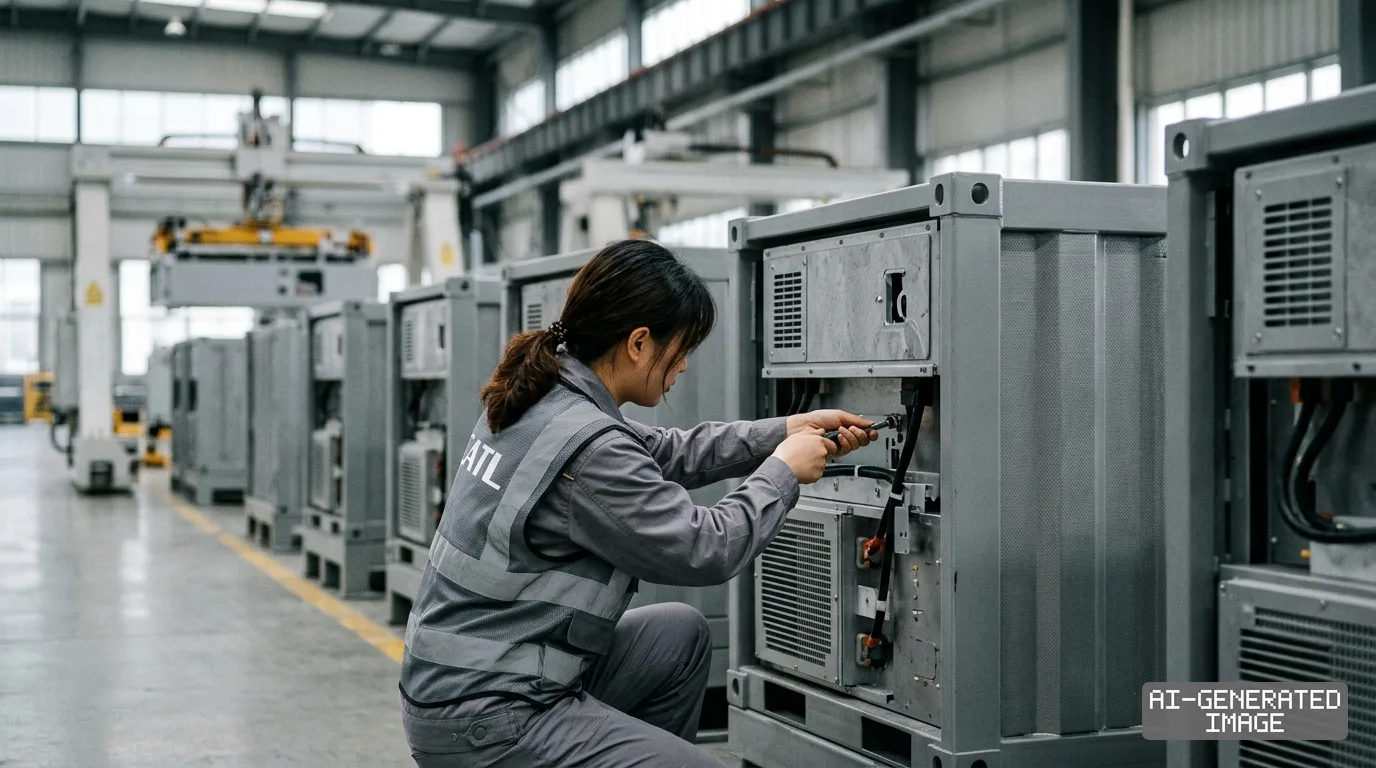
CATL and GCL open Ningde microgrid for heavy-duty truck battery swaps
The Fujian facility connects 94 kilowatts of wind and solar capacity to a 930-kilowatt-hour storage unit, replacing 120,000 kilowatt-hours of grid draw yearly.
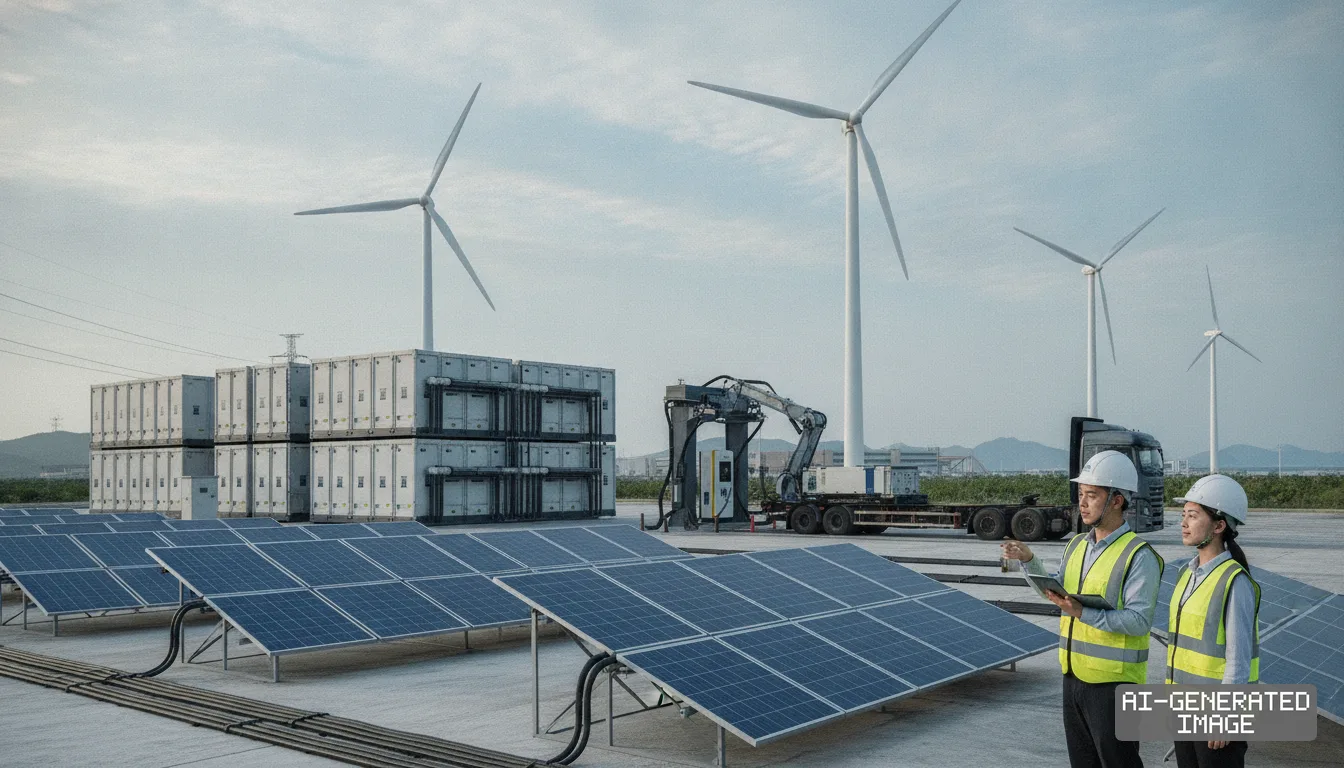
GCL Energy Technology and Contemporary Amperex Technology unit Qiji Battery Swap commissioned an integrated wind, solar and battery storage microgrid in Ningde, Fujian province, on Nov. 13, 2026.
The demonstration facility pairs 94 kW of wind and solar capacity with a 930 kWh battery energy storage system. The installation supports five-minute battery swaps for heavy commercial vehicles and megawatt-scale ultra-fast charging.
The complex will consume 120,000 kWh of renewable power annually, GCL Energy Technology said. That clean energy consumption will cut local carbon dioxide emissions by about 72 metric tons each year.
The station operates at the Ningde North Port Access Road facility near the G15 Shenhai Expressway. The transport corridor carries dense commercial freight between maritime terminals and manufacturing centers across southeastern China.
The facility features perovskite tandem photovoltaic modules deployed across its structural canopy, marking the first commercial application of the technology for heavy-truck swapping infrastructure in China. The modules increase generation yield within space-constrained freight staging depots.
Operational systems connect directly to Juxing AIVP, the proprietary virtual power plant software run by GCL Energy Technology. Machine-learning algorithms automatically coordinate photovoltaic generation, stationary battery storage reserves and vehicle battery swapping loads.
The digital control platform adjusts station power draws to shave peak demand from the municipal utility distribution network. The automated dispatch setup also allows the facility to trade ancillary frequency-regulation services in provincial wholesale electricity markets.
The deployment reflects a broader commercial transition for Contemporary Amperex Technology, known as CATL. The battery maker is moving beyond selling bare energy storage cells toward supplying complete distributed power architectures.
CATL established the Qiji brand to build standardized battery swapping corridors for long-haul freight lines. The truck packs rely on third-generation lithium iron phosphate chemistry designed to eliminate stationary charging downtime for fleet operators.
CATL supplies roughly 37% of global electric vehicle battery capacity. Building integrated microgrids allows the battery manufacturer to bundle its hardware with generation assets for utility-scale commercial fleet tenders worldwide.
GCL Energy Technology, a clean power unit listed on the Shenzhen Stock Exchange under ticker 002015, manages the power balance and virtual grid interface. The company operates more than four gigawatts of distributed energy assets across China.
The project fulfills a strategic cooperation agreement signed between the two companies in Ningde in September 2022. That agreement established joint development plans for solar generation, grid-tied battery storage and commercial vehicle electrification networks.
Direct integration of on-site renewables addresses growing utility concerns over transmission bottlenecks. Megawatt-scale vehicle charging depots impose sharp power spikes on regional distribution circuits, prompting utilities to demand localized battery buffers.
Heavy diesel trucks generate a disproportionate volume of transport emissions and consume substantial fleet capital. Swapping pre-charged battery blocks in five minutes provides transport firms with operating schedules identical to conventional diesel refueling.
The project provides operational data for Chinese energy firms preparing bids for decentralized microgrid projects in Southeast Asia and Europe. Multinational fleet operators face stringent local emission mandates while confronting lengthy wait times for high-voltage grid interconnections.
On-site storage units capture surplus solar energy during morning output peaks and discharge stored power during midday truck arrivals. That automated buffering minimizes expensive power purchases from local utilities during peak daytime tariff periods.
Commercial transport operators along the Fujian industrial corridor will run test fleets through the station under multi-month service trials. Performance records from those freight runs will establish baseline operating metrics for planned coastal highway networks.
GCL Energy Technology plans to review dispatch logs from the Ningde demonstration facility on Dec. 15, 2026. The technical assessment will determine whether the joint venture approves replication across 10 additional coastal logistics hubs along the G15 expressway.
The disclosure does not state the total capital expenditure allocated for the Ningde facility. The municipal power bureau has also not published the wholesale tariff schedule applied to the station's off-peak grid power injections.
Impact map
How this development propagates across the region and out to global buyers.
| Event | Korea | China | Japan | Global impact |
|---|---|---|---|---|
| Fujian renewable microgrid launch | Cell makers face integrated Chinese competition combining storage, generation and fleet services | CATL and GCL ET secure operational benchmarks for electrified freight along high-density coastal transit corridors | Fleet builders face standardisation pressure from proprietary Chinese battery swap architectures | Industrial logistics hubs evaluate decentralized microgrids to bypass utility distribution grid interconnection queues |
In this story
- Companies
- Contemporary Amperex TechnologyGCL Energy Technology
- Tickers
- 300750.SZ002015.SZ
- Policy
- Standards
- Impact
- Supply ChainCapexCost Structure
Track every Standards development →
Related briefings
- Utilities test semi-solid grid batteries despite 15% capex premium Also on Standards, Contemporary Amperex Technology, Cost Structure
- CATL adds sodium-ion batteries to swap stations across 200 cities Also on Standards, Contemporary Amperex Technology, Cost Structure
- CATL and BAIC Sign Battery-Swap Pact to Target 1 Million EVs Also on Standards, Contemporary Amperex Technology, Cost Structure
- CATL and IM Motors deploy active battery fire safety systems Also on Standards, Contemporary Amperex Technology, Cost Structure
Sources
Reporting
Confidence: medium — how we grade this
The documents behind this briefing are linked above. East Asia Brief produces its English text with AI assistance under human editorial review, and does not translate or republish other outlets' articles. See our methodology and AI policy. Spotted an error? Tell us.
The Morning Brief
What changed in Korean, Chinese and Japanese industry overnight — and what it means for your supply chain. One email, weekday mornings, US time. Free.
The Morning Brief is in preparation. Leave your address and we will write to you once — when the first issue is ready. Nothing before that.