Utilities test semi-solid grid batteries despite 15% capex premium
Grid operators weigh $130 per kilowatt-hour cell costs and container compression gear against a 20% longer cycle life and lower flammability.
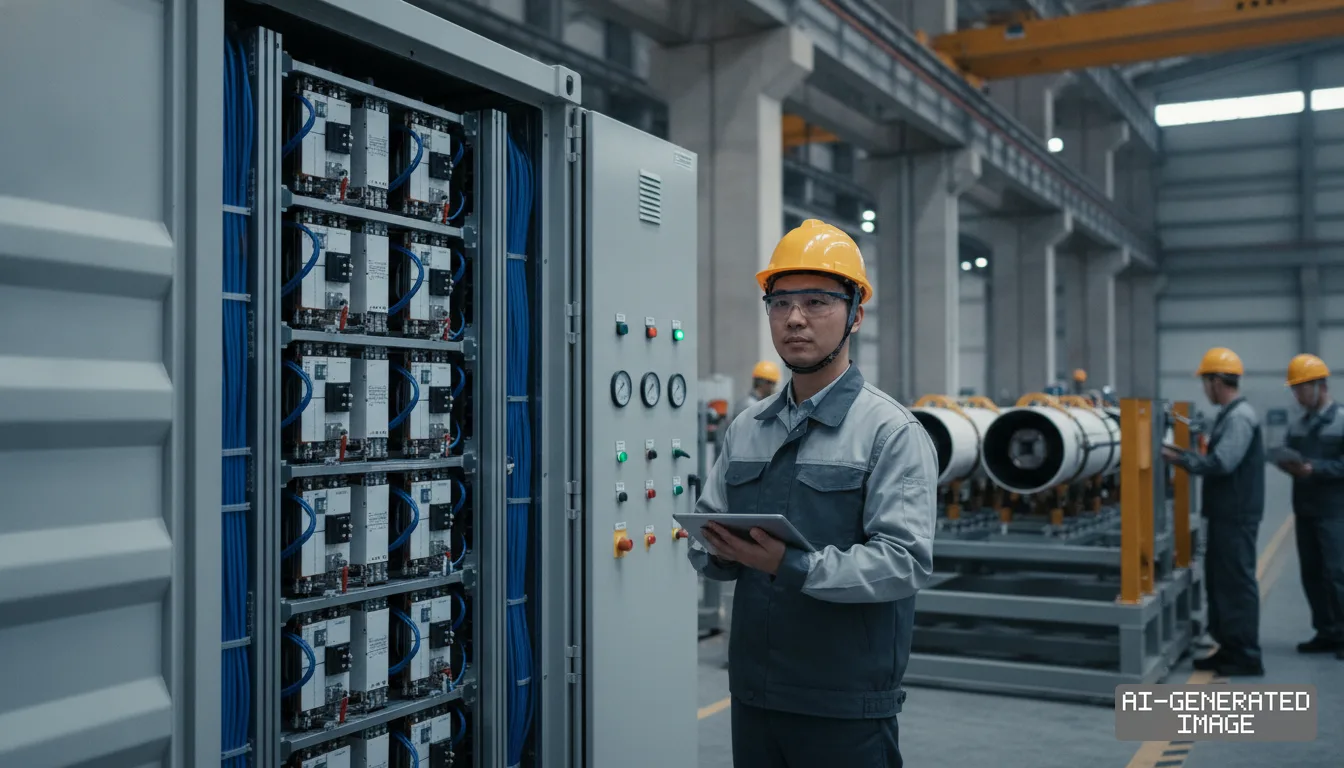
Power grid developers tested semi-solid battery energy storage systems on Nov. 11, evaluating whether reduced electrolyte flammability justifies higher equipment costs and container hardware constraints.
Semi-solid cells trade at $130 to $160 per kilowatt-hour, lifting upfront capital expenditure by 10% to 15% above liquid-electrolyte packs that sell between $80 and $100 per kilowatt-hour.
The chemistry delivers roughly 20% longer cycle life than traditional cells. Utility planners weigh that operational benefit against the initial capital outlay during high-voltage grid dispatch.
Semi-solid batteries replace most liquid electrolyte with a gel or solid conductive medium. The design curtails combustible vapor formation when cells suffer mechanical puncture or electrical overload.
Thermal runaway remains the primary operational hazard for utility-scale storage. A single cell short circuit can ignite adjoining modules inside sealed 20-foot steel shipping enclosures.
Conventional lithium iron phosphate installations rely on external deluge sprinklers, aerosol extinguishers and exhaust deflagration panels. Those safety mechanisms add balance-of-plant costs without stopping internal chemical fires.
The semi-solid format aims to eliminate thermal propagation at the electrode level. Cell prototypes maintain structural stability under thermal abuse temperatures exceeding 150 degrees Celsius.
Physical integration poses unforeseen engineering hurdles inside shipping containers. Cells require constant mechanical compression to keep electrodes in contact with solid electrolyte layers during repeated cycling.
CRU Group said mechanical pressurisation rigs occupy usable rack volume. That compression equipment reduces the effective energy density of a standard 20-foot container by several percentage points.
Lithium dendrites — microscopic metal filaments that form during fast charging — also puncture thin solid separators without steady mechanical pressure, CRU Group energy storage lead Edward Rackley said.
Engineering teams must install rigid steel clamping plates and tension rods around each module stack. Those structural additions increase overall container weight and complicate module replacement.
The added weight reduces transport margins for modular field units. Road freight regulations limit shipping weights for pre-integrated 5-megawatt-hour storage enclosures hauled on standard chassis trailers.
Parasitic loads from thermal management systems present another operating obstacle. Gel and solid matrices display lower ionic conductivity at sub-zero temperatures than conventional organic solvents.
Containers deployed in cold climates require active internal heating mats to maintain operating temperatures above 15 degrees Celsius. That continuous heating draws auxiliary power directly from station transformers.
Higher internal resistance also curbs charge and discharge efficiency. Round-trip energy efficiency drops to 84% in unconditioned semi-solid pilot packs, compared to 89% in liquid-electrolyte units.
Suppliers pitch semi-solid chemistry as an interim bridge. Full all-solid-state commercial systems face mass-production delays until at least 2030 due to difficult dry-room manufacturing limits.
WeLion supplies semi-solid cells for transportation and stationary projects. The firm competes against Contemporary Amperex Technology, which markets liquid-electrolyte containers with chemical fire inhibitors.
South Korean cell manufacturers monitor deployment data before modifying manufacturing lines. LG Energy Solution and Samsung SDI concentrate capital on low-cost lithium iron phosphate container platforms.
Both manufacturers maintain dedicated research lines for solid-state chemistry. Neither company plans volume deliveries of semi-solid stationary containers before certifying cell reliability under field conditions.
Certification authorities evaluate whether current battery standards reflect semi-solid properties. The UL 9540A test evaluates fire propagation, while IEC 62619 governs general electrical and mechanical safety.
The Korean Agency for Technology and Standards set Dec. 15 for a working group session reviewing UL 9540A and IEC 62619 test standards.
The documents do not state whether any national grid operator has issued binding procurement specifications for semi-solid containers, and tender agencies have not published formal pilot terms.
Inspecting authorities continue to apply liquid-battery testing protocols to semi-solid systems, requiring full container burn evaluations before issuing local utility interconnect permits.
Impact map
How this development propagates across the region and out to global buyers.
| Event | Korea | China | Japan | Global impact |
|---|---|---|---|---|
| Semi-solid BESS adoption | LG Energy Solution and Samsung SDI prioritize standard LFP containers over unproven pressurised racks | WeLion and CATL pitch high-safety stationary packs but face container density penalties | Utilities postpone semi-solid procurement pending revised fire service cabinet guidelines | Grid storage developers balance a 10% to 15% CAPEX premium against lower site insurance costs |
| Semi-solid BESS adoption | LG Energy Solution and Samsung SDI prioritize standard LFP containers over unproven pressurised racks | WeLion and CATL pitch high-safety stationary packs but face container density penalties | Utilities postpone semi-solid procurement pending revised fire service cabinet guidelines | Grid storage developers balance a 10% to 15% CAPEX premium against lower site insurance costs |
| Semi-solid BESS adoption | LG Energy Solution and Samsung SDI prioritize standard LFP containers over unproven pressurised racks | WeLion and CATL pitch high-safety stationary packs but face container density penalties | Utilities postpone semi-solid procurement pending revised fire service cabinet guidelines | Grid storage developers balance a 10% to 15% CAPEX premium against lower site insurance costs |
In this story
- Companies
- Contemporary Amperex TechnologyWeLion
- Tickers
- 300750.SZ
- Exposed
- LG Energy SolutionSamsung SDI
- Policy
- Standards
- Impact
- CapexCost StructureSupply Chain
Track every Standards development →
Related briefings
- CATL and IM Motors deploy active battery fire safety systems Also on Standards, Contemporary Amperex Technology, Samsung SDI
- LG and Samsung SDI schedule 2027 launch for data center LFP cells Also on Standards, Contemporary Amperex Technology, Samsung SDI
- CATL launches 9 MWh TENER+ battery with 25-year design life Also on Standards, Contemporary Amperex Technology, Samsung SDI
- CATL confirms 2027 solid-state battery pilot for premium EVs Also on Standards, Contemporary Amperex Technology, Samsung SDI
Sources
Primary documents
Reporting
Confidence: high — how we grade this
The documents behind this briefing are linked above. East Asia Brief produces its English text with AI assistance under human editorial review, and does not translate or republish other outlets' articles. See our methodology and AI policy. Spotted an error? Tell us.
The Morning Brief
What changed in Korean, Chinese and Japanese industry overnight — and what it means for your supply chain. One email, weekday mornings, US time. Free.
The Morning Brief is in preparation. Leave your address and we will write to you once — when the first issue is ready. Nothing before that.