APF Canada urges joint mineral refining to curb Seoul supply risks
A Vancouver policy review calls for shared stockpiles and processing infrastructure as South Korea faces a 99.7% foreign import reliance for battery minerals.
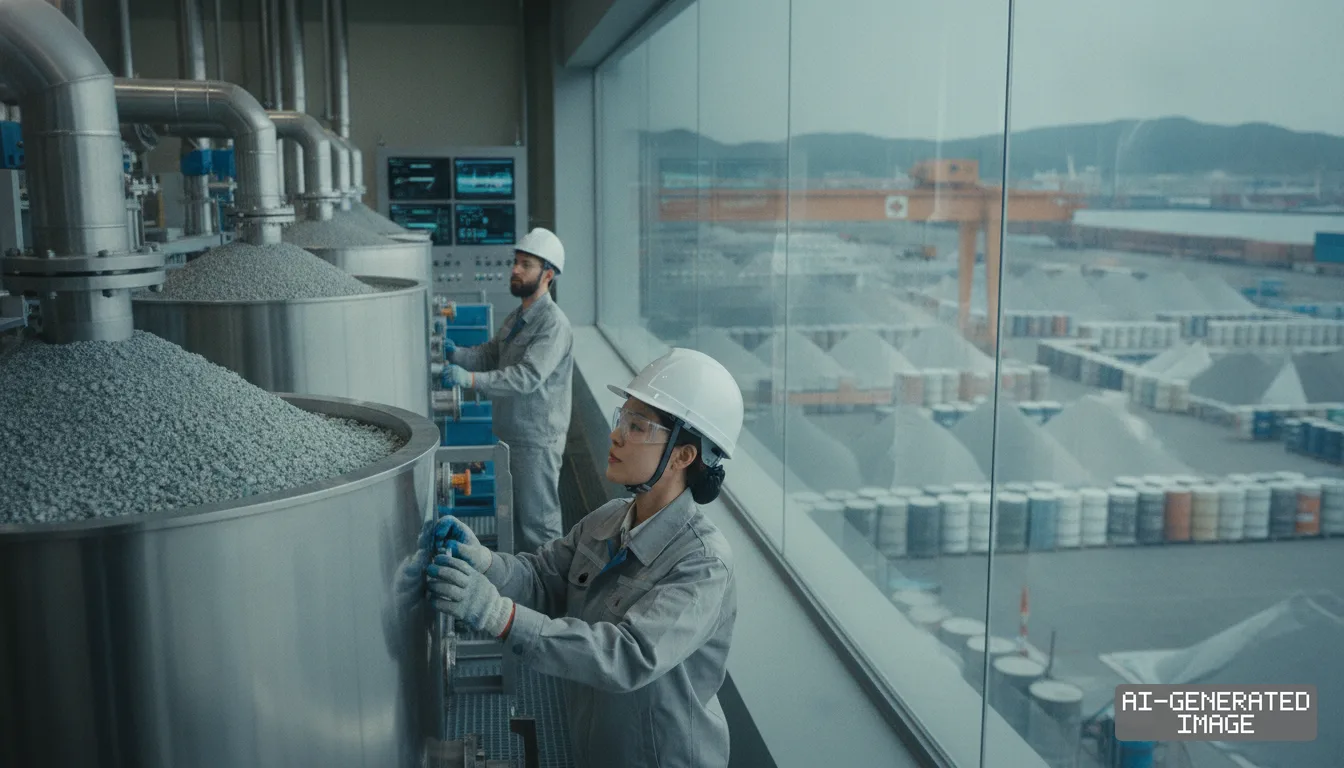
The Asia Pacific Foundation of Canada published a report on Nov. 26, 2026, urging South Korea and Canada to build joint mineral processing capacity and shared strategic stockpiles.
The policy review synthesizes findings from a bilateral supply chain roundtable held Nov. 18 in Vancouver. The session was co-hosted by the foundation and South Korea's consulate general.
South Korea passed $1 trillion in annual exports in November, becoming the fourth country to hit that mark. Memory chips and logic devices accounted for over 40% of outbound shipments.
That export expansion masks extreme upstream vulnerability, according to the report. South Korea relies on foreign imports for 99.7% of its critical mineral supplies, leaving domestic manufacturing exposed to disruption.
Chinese export controls represent the primary pressure point for South Korean industry. Beijing classifies 30 of South Korea's 33 designated critical minerals as strategic materials subject to strict state licensing.
South Korea's dependence on Chinese gallium supplies reached 98% in 2024, up from 43% in 2020. Gallium functions as a critical input for advanced radio frequency chips and power electronics.
China introduced export licensing on gallium and germanium in July 2023, followed by graphite in October 2023. Beijing added antimony in August 2024, before targeting tungsten and tellurium in February 2025.
Commercial trade between Ottawa and Seoul provides an established baseline for cooperation. Canadian energy exports to South Korea reached C$2.2 billion ($1.6 billion) in 2025, according to foundation figures.
Canadian shipments of metal ores and non-metallic minerals added another C$1.5 billion during the same year. Bilateral trade remains concentrated in unrefined mineral resources rather than processed chemicals.
South Korean battery component manufacturers have initiated midstream capital investments in Canada. Solus Advanced Materials committed C$750 million ($550 million) through its subsidiary Volta Energy Solutions to build a copper foil factory in Quebec.
The Quebec plant manufactures thin copper foil used as the negative electrode collector in lithium-ion battery cells. The operation relies on local hydroelectric power to lower the carbon footprint of production.
Canadian junior exploration companies are seeking Asian industrial buyers to advance early-stage extraction assets. Northisle Copper and Gold is permitting deposits in British Columbia, while Defense Metals Corp is evaluating rare-earth projects.
Raw ore extraction cannot insulate manufacturing supply chains without local chemical refining, the foundation said. Canadian mine output frequently travels to East Asian processing hubs before returning to North American automotive assembly plants.
South Korean battery suppliers possess chemical separation and hydrometallurgical processing capabilities. Combining Canadian ore extraction with South Korean processing expertise could build an integrated allied supply corridor, the report said.
Roundtable delegates warned that remote mine locations and volatile commodity prices hinder project financing. High capital expenditure requirements in northern mining districts continue to delay commercial mine development across Canada.
Canadian federal and provincial authorities must provide clear tax credits and transportation infrastructure to support midstream refining, the report said. Without public co-funding, private refiners face prohibitive construction and logistics costs.
The foundation proposed establishing a joint strategic mineral stockpile between the two nations. The mechanism would let South Korean manufacturers tap emergency mineral reserves maintained in Canadian storage during maritime supply interruptions.
South Korea demonstrated its capacity for rapid supplier diversification during previous supply shocks. Following China's 2023 export curbs on germanium, South Korea reorganized procurement channels, turning Canada into its primary overseas supplier.
United States regulatory rules under the Inflation Reduction Act also drive bilateral integration. To secure electric vehicle tax credits, battery manufacturers must source active materials from countries with bilateral free-trade pacts.
Allied industrial planners face immediate calendar deadlines in managing supply risks. Beijing suspended its expanded rare-earth export controls until Jan. 10, 2027, temporarily freezing trade retaliation while negotiations continue with Washington.
The foundation report does not state when Ottawa and Seoul plan to sign a formal government pact, and neither ministry has published an execution deadline for establishing the joint stockpile.
South Korea and Canada signed their preliminary critical mineral cooperation memorandum in 2023, leaving binding procurement contracts and midstream plant construction as the subsequent test for both governments.
Impact map
How this development propagates across the region and out to global buyers.
| Event | Korea | China | Japan | Global impact |
|---|---|---|---|---|
| Critical mineral refining push | Solus Advanced Materials commits C$750 million in Quebec; chip makers face 98% gallium import reliance | MOFCOM controls 30 of Korea's 33 critical minerals; pause runs to Jan. 10, 2027 | Tokyo faces identical rare-earth exposure, relies on non-Chinese refining pacts | Allied EV battery supply chains require North American downstream processing to clear IRA rules |
In this story
- Companies
- Solus Advanced Materials
- Tickers
- 336370.KS
- Exposed
- Northisle Copper and GoldDefense Metals Corp
- Policy
- Export ControlsSubsidies
- Impact
- Supply ChainCapexCost Structure
Track every Export Controls development → Track every Subsidies development →
Related briefings
- Lotte Energy Materials secures national quality mark for EV foil Also on Solus Advanced Materials, Cost Structure
- Lotte Energy Materials secures ISO 27001 for AI copper foil Also on Solus Advanced Materials
- Japan revives rare earth refining to counter China curbs Also on Export Controls, Subsidies, Cost Structure
- Quad ministers advance mineral refining network to bypass China Also on Export Controls, Subsidies, Cost Structure
Sources
Reporting
Confidence: medium — how we grade this
The documents behind this briefing are linked above. East Asia Brief produces its English text with AI assistance under human editorial review, and does not translate or republish other outlets' articles. See our methodology and AI policy. Spotted an error? Tell us.
The Morning Brief
What changed in Korean, Chinese and Japanese industry overnight — and what it means for your supply chain. One email, weekday mornings, US time. Free.
The Morning Brief is in preparation. Leave your address and we will write to you once — when the first issue is ready. Nothing before that.