Lotte Energy Materials secures national quality mark for EV foil
South Korea's industry ministry recognized the supplier's ultra-thin copper foil controls under IATF 16949 automotive standards in Seoul on Nov. 27.
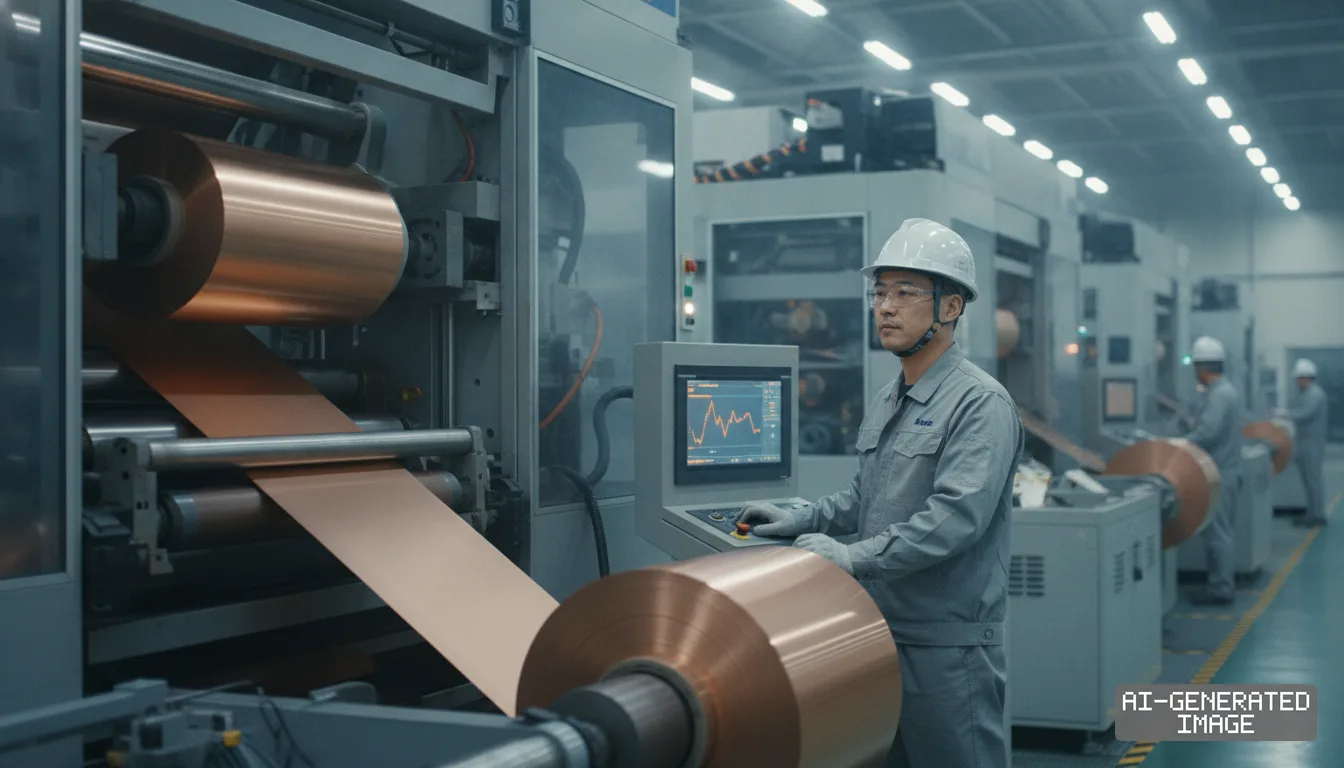
Lotte Energy Materials said Nov. 27 it received a national quality competitiveness award from South Korea's industry ministry, validating its manufacturing controls for high-end battery copper foil.
The Korean Agency for Technology and Standards selected the company among 65 honored enterprises at the 52nd National Quality Management Convention in Seoul. The agency granted 477 total state awards during the event.
The award recognizes production control under ISO 9001 and IATF 16949 automotive standards. Global demand is shifting from standard electrodeposited sheets toward ultra-thin copper foils measuring four to six micrometers in thickness.
Electric vehicle makers require thinner copper current collectors to pack higher volumes of active material into individual battery cells. Reducing foil thickness cuts cell weight and increases overall energy density in long-range vehicle packs.
Next-generation cells increasingly incorporate more than 10% silicon into graphite anodes. Silicon expands substantially during lithiation, requiring collector foils with high tensile strength and high elongation to prevent tearing under repeated mechanical stress.
Lotte Energy Materials developed its proprietary HiSTEP hybrid high-end copper foil to counter this physical degradation. The material combines high tensile resilience with elongation properties to withstand physical expansion without fracturing during high-rate charging cycles.
The company also announced Nov. 27 that its plant circle won a Silver Award in safety and quality. That honor followed competitive evaluations at the 52nd National Quality Innovation Competition held in late August.
South Korean foil manufacturers face intense price competition from Chinese rivals across standard electric vehicle lines. Chinese state-backed competitors added extensive electrodeposited copper foil capacity, driving down pricing and compressing operating margins across commoditized thickness categories.
To counter that commoditization, Korean producers are focusing on premium battery foils and North American supply chains. Trade rules and content requirements in the United States penalize Chinese anode components, favoring compliant Asian material producers.
Lotte Energy Materials concentrates mass battery foil manufacturing at its smart factory in Kuching, Malaysia. The Malaysian site operates an annual capacity of 60,000 tons, representing roughly 75% of the company's total copper foil production.
The Southeast Asian plant uses local hydroelectric power to lower electricity expenses. Electrical energy forms a major portion of operating costs in the continuous electroplating baths used to deposit copper ions onto rotating titanium drums.
The domestic plant in Iksan, North Jeolla Province, is converting battery lines into artificial intelligence circuit foil facilities. The retooling plan repurposes domestic footprint toward hyper very low profile foils for high-speed graphics accelerator substrates.
The company raised annual circuit foil capacity at Iksan from 3,700 tons to 6,700 tons this year. It plans to expand that capacity to 16,000 tons per year by 2027 through a 49 billion won ($35 million) investment.
Surging orders for grid-scale energy storage systems in North America have created an additional product stream. The company produces heavy gauge copper foil measuring 20 micrometers or thicker for specialized energy storage battery cells.
Lotte Energy Materials is also developing nickel-plated copper collectors for all-solid-state lithium batteries. Nickel surface coatings resist heat and corrosive sulfide degradation inside next-generation solid electrolyte matrices during extended cell operation.
Downstream battery clients enforce stringent surface uniformity specifications to prevent micro-short circuits in high-voltage packs. Lotte Energy Materials controls foil roughness to under 0.8 micrometers to ensure stable adhesion with advanced cathode and anode slurries.
The company is running a pilot facility for sulfide solid electrolytes to gather commercial scale-up data. It targets commercialization of one gigawatt-hour of solid-state battery materials by 2028, management said.
The official award notice does not state plant-level audit scores for Lotte Energy Materials, and the agency has not published individual factory evaluation scorecards for Iksan or Malaysia.
Domestic competitors are executing parallel manufacturing realignments across their copper foil footprints. SK nexilis shifted bulk production toward its Malaysian lines while Solus Advanced Materials expanded its European and North American manufacturing hubs.
The manufacturer posted consolidated revenue of 677.5 billion won ($487 million) in 2025 as the global electric vehicle market slowed. Management expects its Malaysian operations and consolidated balance sheet to return to profitability by the second quarter of 2027.
Lotte Energy Materials completed the sale of a 90% stake in its non-core construction subsidiary for 170.8 billion won ($123 million) to fund its advanced foil capital expenditures.
Impact map
How this development propagates across the region and out to global buyers.
| Event | Korea | China | Japan | Global impact |
|---|---|---|---|---|
| Premium battery foil certification | Lotte Energy Materials converts Iksan lines to 16,000 tons of AI foil | Standard copper foil mills face margin erosion from overcapacity | Mitsui Mining faces competition in ultra-low profile carrier foils | Tier-1 EV pack builders accelerate adoption of 4-6 micrometer collector sheets |
In this story
- Companies
- Lotte Energy Materials
- Tickers
- 020150.KS
- Exposed
- SK nexilisSolus Advanced Materials
- Policy
- Standards
- Impact
- Supply ChainCost Structure
Track every Standards development →
Related briefings
- Lotte Energy Materials secures ISO 27001 for AI copper foil Also on SK nexilis, Solus Advanced Materials, Lotte Energy Materials
- Lotte names materials veteran Hwang to helm battery foil business Also on Lotte Energy Materials, Cost Structure
- Samsung SDI explores Chinese suppliers for solid-state cells Also on Lotte Energy Materials, Cost Structure
- Lotte Energy Materials shifts capex to AI circuit copper foil Also on Lotte Energy Materials
Sources
Primary documents
Reporting
Confidence: high — how we grade this
The documents behind this briefing are linked above. East Asia Brief produces its English text with AI assistance under human editorial review, and does not translate or republish other outlets' articles. See our methodology and AI policy. Spotted an error? Tell us.
The Morning Brief
What changed in Korean, Chinese and Japanese industry overnight — and what it means for your supply chain. One email, weekday mornings, US time. Free.
The Morning Brief is in preparation. Leave your address and we will write to you once — when the first issue is ready. Nothing before that.