Toyota deploys Yaskawa AI welding robots for vehicle frames
The autonomous MOTOMAN NEXT system adjusts torch paths in real time and inspects its own welds, cutting chassis fabrication time by 85% at Toyota's Gamagori racing kart facility.
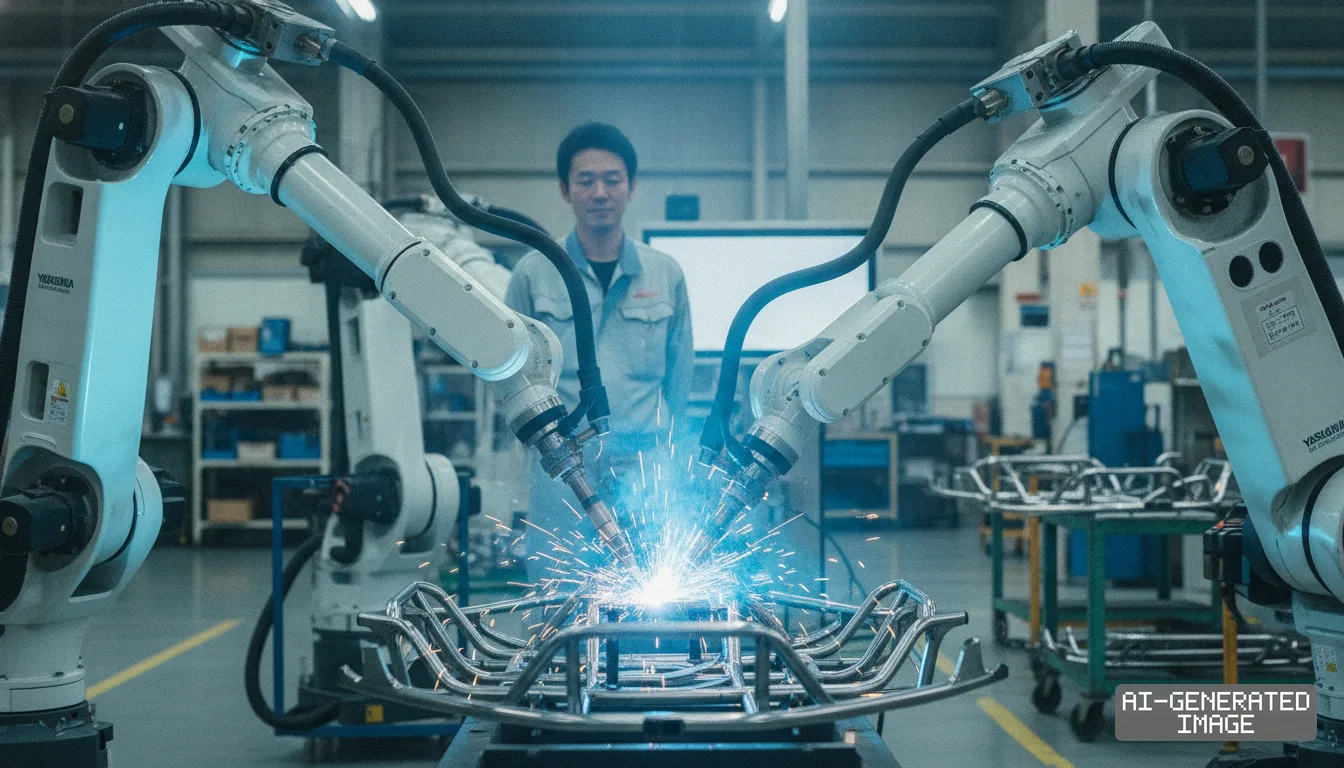
Toyota Motor deployed Yaskawa Electric AI welding robots into commercial chassis manufacturing on Oct. 30, 2026, automating high-precision tubular welding previously restricted to master artisans.
The equipment operates at the Gamagori GR Kart Workshop in Aichi Prefecture, which produces up to eight racing kart chassis per day. Each entry-level GR Kart sells for 385,000 yen ($2,510).
The deployment applies Sequence Freezing Arc welding, a technique developed in 2024 that cuts chassis fabrication from three weeks to three days. The method achieves an 85% reduction in cycle time.
The installation uses Yaskawa Electric's MOTOMAN NEXT robot, an industrial manipulator equipped with graphics processing units and onboard machine learning models. The unit processes sensory data directly at the machine.
The robot operates an autonomous control unit powered by Nvidia processors running Linux and ROS 2 software frameworks. The controller links classic industrial motion planning with real-time computer vision algorithms.
The robot recognizes fit-up gaps and steel pipe alignment before striking an arc. It measures thermal conditions across the joint and adjusts electrical current and torch travel speed in real time.
Sequence Freezing Arc welding cycles the welding torch to freeze the molten pool in rapid intervals. This thermal management prevents burn-through and minimizes heat warping on thin-walled tubular steel.
Optical cameras and acoustic sensors monitor the molten weld pool during operation. The system analyzes sound frequencies and visual arc stability to detect porosity or uneven penetration before the metal cools.
Once the seam is finished, the robotic arm inspects the joint geometry without human assistance. If the seam deviates from design tolerances, the manipulator applies an autonomous corrective weld immediately.
Standard industrial robots follow rigid preprogrammed paths and cannot adapt to physical variations in unmachined tubing. As a result, automotive plants have historically depended on skilled human welders for tubular frames.
The initiative originated in August 2023 when Toyota Motor Chairman Akio Toyoda visited the Gazoo Racing World Rally Team facility in Finland. Toyoda identified roll-cage fabrication as a severe manufacturing bottleneck.
Fabricating race-car safety cages required two to three weeks of manual torch work by certified craftsmen. The manual process restricted production volume and tied up skilled labor on repetitive structural joints.
Toyota Gazoo Racing partnered with Yaskawa Electric in late 2023 to digitize the manual techniques. The resulting arc welding method controlled heat input to prevent pipe distortion and eliminate structural weight.
Toyota tested the automated process on race vehicles in Japan's Super Taikyu endurance series throughout 2025. The field trials proved that autonomous welds withstood high torsional stress during competitive racing conditions.
The Gamagori facility represents the first commercial application of the technology on a continuous assembly line. Toyota completed construction of the dedicated kart workshop in June 2026.
Yaskawa Electric generates approximately 40% of its revenue from robotics, where automotive assembly lines form its largest customer group. The company designed the MOTOMAN NEXT series to expand beyond repetitive stamping and spot-welding.
Japanese robot builders including Fanuc and Kawasaki Heavy Industries are also racing to commercialize vision-guided welding systems. Yaskawa Electric aims to gain share by targeting labor-intensive structural assembly where manual teaching is uneconomical.
Japan faces a severe shortage of certified welders as older manufacturing specialists retire without sufficient replacements. More than 30% of skilled welding technicians in Japan are over 55 years old, according to industry census data.
The labor crunch has hit motorsports fabrication and specialty chassis assembly especially hard. Those operations require small-batch flexibility rather than the uniform stamping runs common in mass-market passenger car plants.
By executing both arc deposition and non-destructive quality testing in a single work cell, the robot removes separate inspection stations. That integration lowers floor space requirements by roughly a third.
Toyota describes the system as an evolution of jidoka, its traditional production philosophy of automation with a human touch. The robot stops itself upon detecting structural anomalies, preventing defective parts from advancing downstream.
The deployment comes as global automakers seek flexible manufacturing systems capable of assembling multiple chassis variants on shared lines. Rigid welding jigs typically require costly retooling whenever vehicle designs change.
Autonomous vision guidance allows the robotic arm to locate joint coordinates without precision clamping fixtures. That capability enables fabricators to switch between tube diameters and chassis profiles through software adjustments alone.
The companies scheduled a formal technical review of the Gamagori welding cells for December 2026, ahead of potential deployments to larger commercial sports car assemblies in 2027.
The joint release does not state whether Toyota plans to transfer the robotic welding system to high-volume assembly lines, and neither company disclosed the capital investment committed to the Gamagori facility.
Impact map
How this development propagates across the region and out to global buyers.
| Event | Korea | China | Japan | Global impact |
|---|---|---|---|---|
| Autonomous chassis welding deployment | Hyundai Motor assesses self-correcting arc welding cells to counter domestic skilled artisan shortages | Geely and BYD deploy vision-guided edge AI arms to reduce custom chassis tooling costs | Toyota and Yaskawa cut frame lead time 85% while insulating assembly from an aging welding workforce | Specialty vehicle makers shift from hard-tooled jigs to adaptive multi-sensor welding cells |
In this story
- Companies
- Toyota MotorYaskawa Electric
- Tickers
- 7203.T6506.T
- Exposed
- FanucNvidia
- Impact
- CapexSupply ChainCost Structure
Related briefings
- Inbolt raises $12.5 million for robot vision in auto plants Also on Toyota Motor, Yaskawa Electric, FANUC
- Kawasaki Heavy advances 2030 target for AI humanoid robots Also on Yaskawa Electric, Fanuc, Nvidia
- Yaskawa and Toyota deploy AI welding robots for race frames Also on Toyota Motor, Yaskawa Electric, Cost Structure
- FANUC India links industrial robots to Niral Networks private 5G Also on Yaskawa Electric, FANUC, Cost Structure
Sources
Primary documents
Reporting
Confidence: high — how we grade this
The documents behind this briefing are linked above. East Asia Brief produces its English text with AI assistance under human editorial review, and does not translate or republish other outlets' articles. See our methodology and AI policy. Spotted an error? Tell us.
The Morning Brief
What changed in Korean, Chinese and Japanese industry overnight — and what it means for your supply chain. One email, weekday mornings, US time. Free.
The Morning Brief is in preparation. Leave your address and we will write to you once — when the first issue is ready. Nothing before that.