Yaskawa and Toyota deploy AI welding robots for race frames
The autonomous MOTOMAN NEXT system cuts roll-cage fabrication from three weeks to three days, transferring race-tested arc welding to assembly lines.
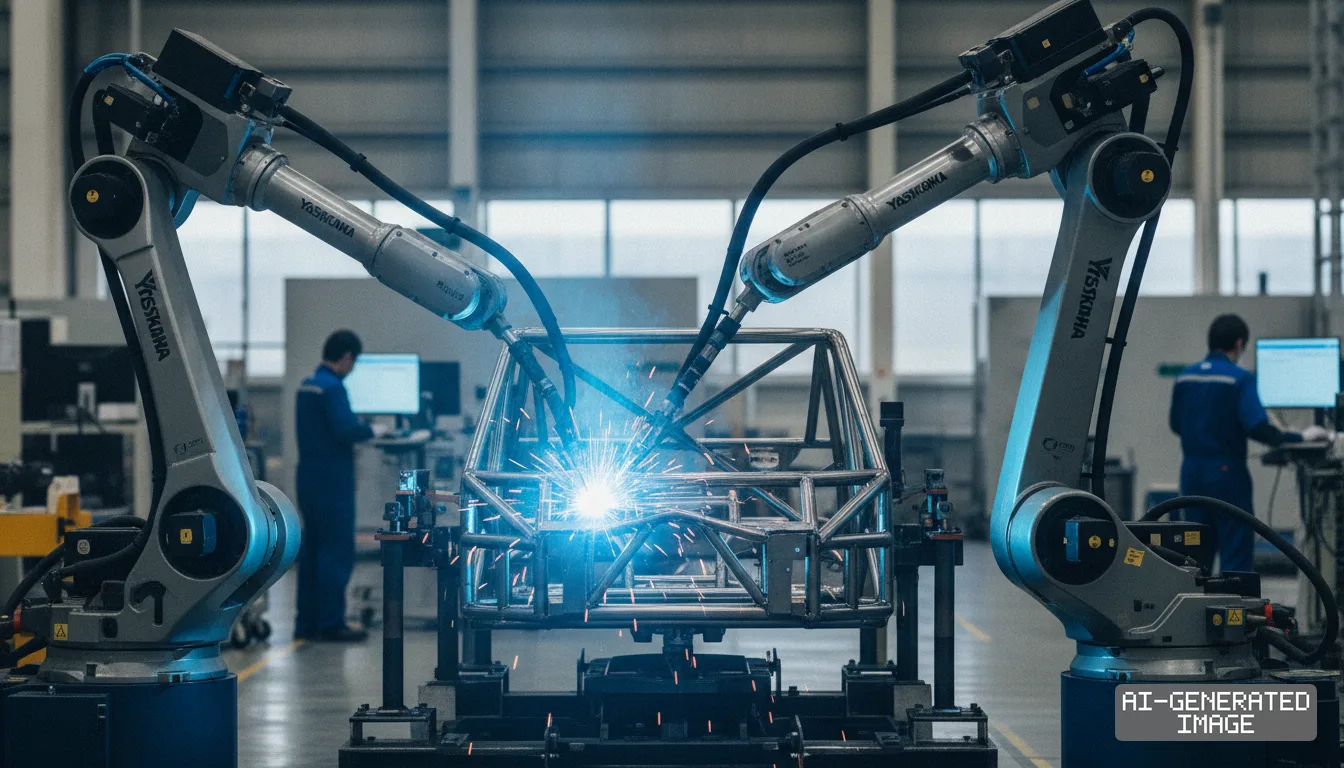
Yaskawa Electric Corporation and Toyota Motor Corporation's Gazoo Racing unit unveiled an autonomous arc welding system on Oct. 28, 2026, putting AI-controlled industrial arms into commercial vehicle fabrication.
The technology cuts roll-cage assembly from three weeks to three days, an 85% drop in manufacturing time. It adapts high-precision motorsport welding for commercial vehicle assembly.
The partners installed the robotic cell at the Gamagori GR Kart Workshop in Aichi Prefecture in September 2026. The facility builds tubular chassis frames for the entry-level GR Kart racer.
The system uses Yaskawa's MOTOMAN NEXT robot, an industrial manipulator equipped with graphics processing units and artificial intelligence. The hardware handles heavy-duty arc welding across irregular joint geometries.
The robot recognizes pipe assembly gaps and ambient temperatures before striking an arc. It alters voltage, current and torch trajectory autonomously while welding tubular steel joints.
Visual cameras and acoustic sensors monitor the molten weld pool during the joining process. The onboard AI processes sound frequencies and optical images to detect defects before they solidify.
The robotic arm inspects the finished seam immediately after completing the arc pass. It performs targeted corrective welds if it identifies dimensional variance or incomplete penetration.
Automating the inspection and rework stages eliminates manual intervention. Factory technicians previously examined every tubular seam by hand before clearing chassis assemblies for downstream paint lines.
The automated work cell replaces tasks long restricted to elite manual artisans, known in Japanese industry as takumi. Skilled human welders have become increasingly scarce across Japan's automotive sector.
Joint development started in 2023 after Toyota Motor Chairman Akio Toyoda visited the Gazoo Racing World Rally Team in Finland. Toyoda identified roll-cage fabrication bottlenecks that stalled vehicle turnaround times.
Manual roll-cage assembly required up to three weeks of labor per competition chassis. The structural tubes demand exact tolerances to protect drivers during high-speed rally crashes.
Yaskawa and Toyota engineers spent 2024 developing Sequence Freezing Arc Welding, an arc process that regulates heat input to rapidly freeze molten metal. The technique increases tensile strength while reducing weld mass.
Gazoo Racing tested SFA welds on sports cars competing in Japan's Super Taikyu endurance racing series. The racing series subjected the automated joints to extreme mechanical vibration and track stress.
Engineers transferred metallurgical data from the racing series into the MOTOMAN NEXT platform throughout 2025. That data trained the neural networks to identify optimal weld puddle formation across varied angles.
Applying the autonomous robot to GR Kart frames reduced unit production costs, Toyota Gazoo Racing said. The chassis requires multiple curved tube intersections that challenge conventional robotic welding torches.
Yaskawa books the system within its robotics division, which generated 118.4 billion yen ($770 million) in revenue in the first half of fiscal 2026. Robotics accounts for roughly 44% of group sales.
Automotive manufacturing represents the largest end market for Yaskawa's industrial manipulators. Sluggish capital spending by legacy carmakers in Japan and Europe has weighed on robot order backlogs throughout 2026.
Toyota operates the Gamagori facility to supply grass-roots racing karts launched in September 2026. Lowering frame manufacturing overhead supports broader adoption of entry-level motorsports among younger drivers.
The deployment supports Toyota's manufacturing principle of jidoka, defined as automation with a human touch. The philosophy requires automated lines to halt immediately when anomalies occur and correct defects in-line.
Industrial robot suppliers in East Asia are shifting toward perception-guided autonomy. Fixed-trajectory welding robots struggle with thermal distortion, requiring costly manual re-teaching by factory programmers.
Autonomous sensing allows the MOTOMAN NEXT arm to adjust to millimeter-level parts variations. The capability reduces tooling fixture requirements and cuts factory changeover times for short production runs.
Yaskawa plans to broaden commercial deployment of the MOTOMAN NEXT platform across external manufacturing clients heading into 2027. The company is targeting tier-one automotive parts suppliers and heavy equipment builders.
The partners did not disclose contract values, capital investment totals or delivered robot counts for the Gamagori installation. Neither company revealed unit production targets for the GR Kart chassis line.
Toyota Gazoo Racing plans to test additional autonomous joining applications during the 2027 motorsport season. Production at the Gamagori workshop continues under the autonomous robotic process, the companies said.
Impact map
How this development propagates across the region and out to global buyers.
| Event | Korea | China | Japan | Global impact |
|---|---|---|---|---|
| AI welding robot deployment | Hyundai Motor and Doosan Robotics face competition in adaptive auto welding | BYD and domestic robot suppliers accelerate vision-guided arc automation | Yaskawa and Toyota automate skilled welding to counter welder shortages | Automotive frame cycle times fall as AI vision replaces post-weld rework |
In this story
- Companies
- Yaskawa ElectricToyota Motor
- Tickers
- 6506.T7203.T
- Impact
- Supply ChainCapexCost Structure
Related briefings
- Inbolt raises $12.5 million for robot vision in auto plants Also on Toyota Motor, Yaskawa Electric, Cost Structure
- Japan seeks $2.6B for Rapidus after pledging $21B to US fabs Also on Toyota Motor, Cost Structure
- Hyundai, Toyota and BYD advance in-house solid-state battery lines Also on Toyota Motor, Cost Structure
- BYD readies solid-state battery road trial as rivals advance Also on Toyota Motor, Cost Structure
Sources
Reporting
Confidence: medium — how we grade this
The documents behind this briefing are linked above. East Asia Brief produces its English text with AI assistance under human editorial review, and does not translate or republish other outlets' articles. See our methodology and AI policy. Spotted an error? Tell us.
The Morning Brief
What changed in Korean, Chinese and Japanese industry overnight — and what it means for your supply chain. One email, weekday mornings, US time. Free.
The Morning Brief is in preparation. Leave your address and we will write to you once — when the first issue is ready. Nothing before that.