Korea tests quadruped robots for $247 million state rollout
Nine ministries review 11 domestic manufacturers to deploy 1,700 autonomous units across defense, police and disaster sites ahead of formal 2027 procurement tenders.
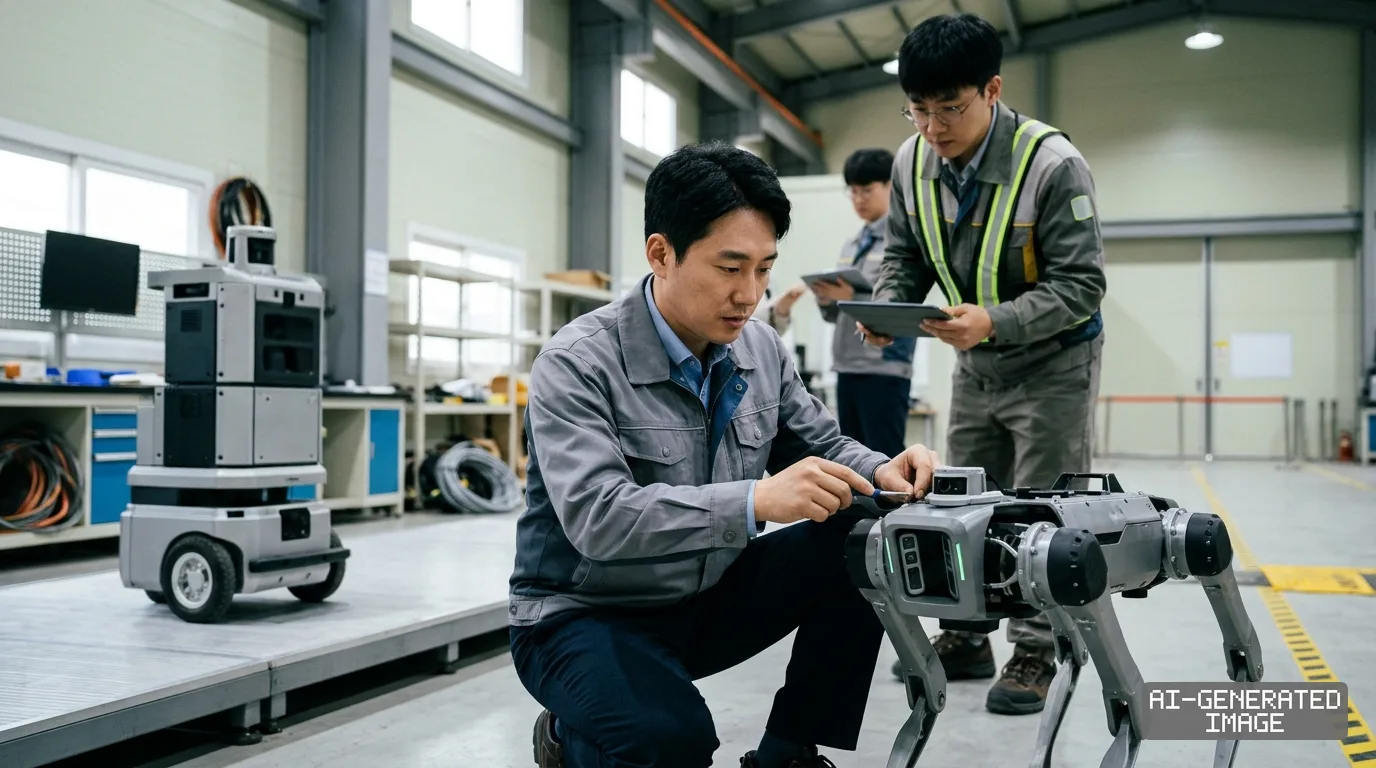
South Korea's industry ministry concluded competitive trials on Oct. 30 for quadrupedal and wheeled service robots seeking entry into a 340 billion won ($247 million) state procurement program.
The allocation funds 1,700 artificial intelligence robots in 2027 across eight central government ministries. That initial procurement represents roughly 11% of Seoul's broader target to deploy 15,000 public sector robots by 2030.
South Korea also aims to reach 200,000 total service robots across the private and public sectors combined by 2030, according to the National Advanced Strategic Industry Committee roadmap.
The Ministry of Trade, Industry and Energy organized the trials with the Korea Institute for Robot Industry Advancement to match commercial hardware with state demand. Nine government bodies attended the evaluations, including the Ministry of National Defense, Army Headquarters, the National Fire Agency and the Korean National Police Agency.
The Ministry of Agriculture, Food and Rural Affairs and the Korea Industrial Complex Corporation also evaluated platforms for perimeter inspection and facility monitoring.
Eleven domestic robotics makers demonstrated four-wheeled and four-legged machines across obstacle courses configured with stairs, steep ramps and unpaved terrain. The evaluations included technical presentations, autonomous navigation demonstrations and direct consultations with agency procurement officials.
Public procurement offers robotics manufacturers a route to commercial scale. Service robot builders have struggled to lower production costs because commercial orders remain confined to small trial batches.
Securing large initial government orders allows hardware makers to spread tooling and design expenses across longer production runs. Longer runs lower the unit cost of actuators, machining and onboard sensors.
Rainbow Robotics fielded its RBQ series quadruped platforms during the trials. The company, backed by Samsung Electronics, generated 15.3 billion won ($11.1 million) in full-year revenue, where low commercial run rates have limited component volume discounts.
Rainbow Robotics designs its own actuators, which combine the electric motor, reducer and drive controller into a single sealed joint. Winning a fraction of the 1,700-unit state batch would represent its largest commercial manufacturing run to date.
Robotis demonstrated autonomous delivery and surveillance platforms that rely on its proprietary Dynamixel smart actuators. Actuators generate more than 85% of the company's 38.9 billion won ($28.2 million) in annual sales.
Robotis is expanding its manufacturing footprint to produce up to 1 million actuators annually. Supplying standardized drive modules for state robot fleets provides volume support for that expanded assembly capacity.
The showcase included Lion Robotics, Aidin Robotics, OpenPath Robotics, LIG D&A, Hyundai Motor Company and Neubility. Hyundai Motor demonstrated mobile platforms built to navigate factory floors and secure facilities.
Defense and policing agencies represent the largest initial volume buyers. Conscription declines and tighter labor regulations have forced South Korea's armed forces and police units to automate perimeter patrols and hazardous reconnaissance.
State agencies had previously hesitated to buy emerging robotics hardware because civil servants risked administrative penalties if experimental machines broke down or sat unused in storage.
The industry ministry plans to address those concerns by creating a legal indemnity clause for purchasing officers. The measure shields officials from disciplinary audits if they procure qualified robots following established standard operating procedures.
The state will also require robot manufacturers to provide mandatory warranty servicing and liability insurance coverage. Operating agencies will submit periodic utilization audits to ensure machines remain operational in field conditions.
The ministry is also designing procurement filters to prevent low-cost Chinese quadruped models from capturing state budgets. Similar concerns arose when imported Chinese electric buses captured large shares of municipal transit subsidies.
Chinese manufacturers such as Unitree Robotics have cut prices by building extensive domestic supply chains. South Korea aims to counter that pricing edge by mandating strict cybersecurity checks, localized maintenance networks and verified hardware origins.
Data collected during field deployment will flow back to participating domestic manufacturers. That real-world operational data allows robotics engineers to refine physical artificial intelligence models and terrain-adaptation algorithms.
The ministry will establish the formal Public Robot Deployment Guidelines by Dec. 31, 2026, setting baseline standards before parliamentary passage of the budget. Hardware makers will also display their production platforms at the RoboWorld exhibition opening Nov. 4, 2026 at KINTEX in Goyang.
The ministry has not published the unit price ceilings for each robot category, and official notices do not state the quota reserved for quadrupedal systems versus wheeled platforms.
The National Assembly continues its committee review of the 340 billion won budget request ahead of the 2027 fiscal year.
Impact map
How this development propagates across the region and out to global buyers.
| Event | Korea | China | Japan | Global impact |
|---|---|---|---|---|
| Public robot procurement program | Rainbow Robotics and Robotis contest 1,700-unit state batch to lower commercial bills of materials | Unitree and Deep Robotics face procurement bars as Korea introduces domestic indemnity and cybersecurity rules | Actuator and component makers like Harmonic Drive Systems see orders supported by Korean robot manufacturing runs | State anchor contracts accelerate volume cost reduction for quadruped and wheeled patrol platforms |
In this story
- Companies
- Rainbow RoboticsRobotis
- Tickers
- 277810.KQ108490.KQ
- Exposed
- Hyundai Motor Company
- Policy
- Procurement RulesStandards
- Impact
- Order BookCapexCost Structure
Track every Procurement Rules development → Track every Standards development →
Related briefings
- Korea begins 1,700 public robot rollout to back local makers by 2027 Also on Robotis, Rainbow Robotics, Procurement Rules
- Korean robot makers surge as Nvidia expands physical AI ties Also on Robotis, Rainbow Robotics
- UBS maps 87 humanoid robot suppliers across hardware tiers Also on ROBOTIS, Cost Structure
- Korea tightens export licensing rules on robotics actuator technology Also on Robotis
Sources
Primary documents
Reporting
Confidence: high — how we grade this
The documents behind this briefing are linked above. East Asia Brief produces its English text with AI assistance under human editorial review, and does not translate or republish other outlets' articles. See our methodology and AI policy. Spotted an error? Tell us.
The Morning Brief
What changed in Korean, Chinese and Japanese industry overnight — and what it means for your supply chain. One email, weekday mornings, US time. Free.
The Morning Brief is in preparation. Leave your address and we will write to you once — when the first issue is ready. Nothing before that.