Samsung readies direct-drive robot hand for CES showcase
The design embeds miniature electric motors directly inside finger joints, supporting a 60 trillion won manufacturing investment push in Gumi.
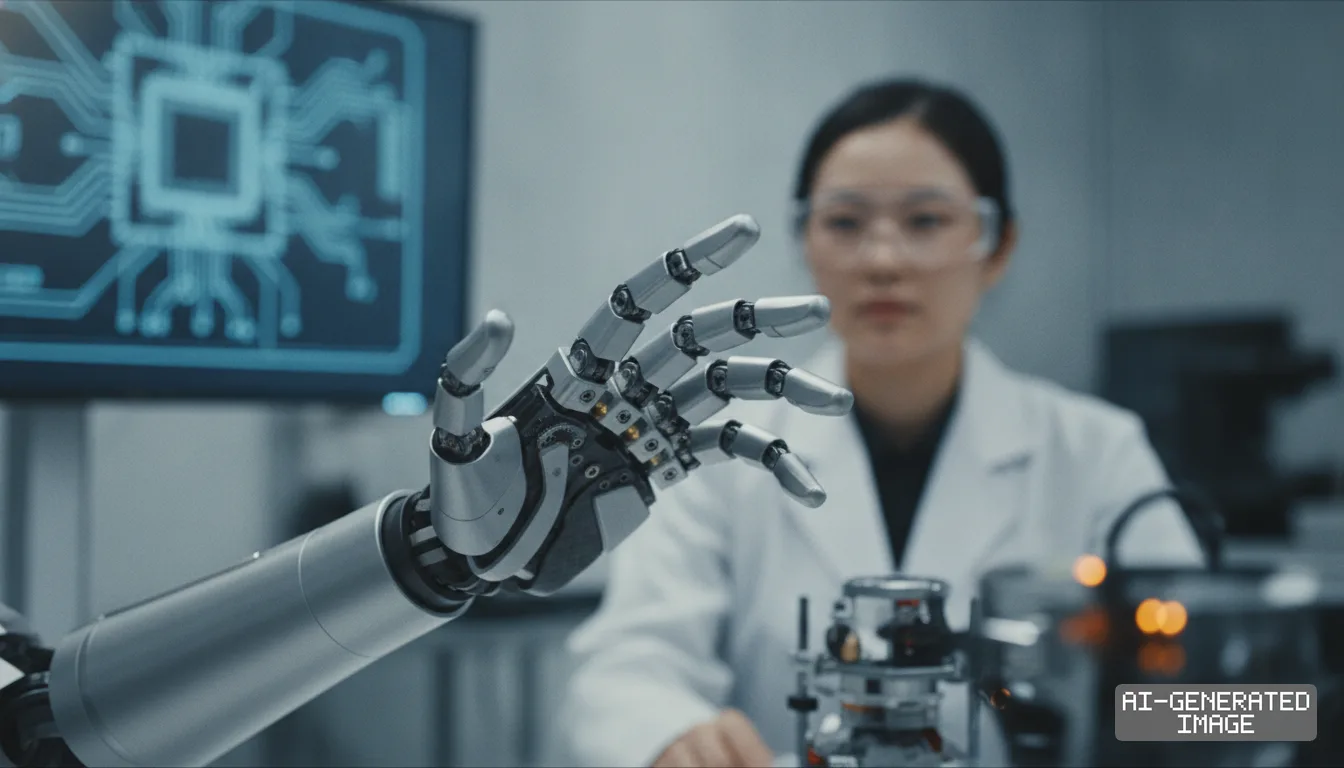
Samsung Electronics prepared on Nov. 16 to demonstrate its first humanoid robot featuring direct-drive five-finger hands at the CES consumer technology exhibition in Las Vegas.
The hardware forms the mechanical flagship of the group's 60 trillion won ($43 billion) multi-year investment program across South Korea's Yeongnam industrial region. The capital expenditure plan finances physical AI research hubs and mass-production facilities in Gumi.
The robotic hand architecture positions miniature electric motors directly inside each individual finger joint. This direct-drive configuration eliminates conventional mechanical gear reducers and transmission linkages across the fingers.
By embedding actuation at each joint, the mechanism delivers instantaneous mechanical response during object manipulation. Direct drive removes the backlash and gear compliance that degrade positioning precision in motorized assemblies.
The design establishes a clear engineering departure from tendon-driven approaches used in rival humanoid projects. Tesla equipped its Optimus hand with 25 actuators mounted inside the forearm that pull fingers using routed cables.
Forearm cable systems reduce hand mass but introduce mechanical cable elasticity and friction over time. Cable stretch complicates repetitive grasping cycles in industrial assembly plants where micro-millimeter tolerance is required.
Direct motor integration increases distal weight across the fingers, creating distinct thermal and inertial constraints. Engineers must package miniaturized coreless motors and magnetic position sensors into narrow finger links without inducing thermal saturation.
Samsung consolidated humanoid hardware and manipulation research under the Robotics eXperience business division earlier this year. The unit operates directly under Device eXperience division chief executive Roh Tae-moon at the Umyeon R&D campus.
The division oversees a dedicated Physical AI Lab tasked with developing foundation models for real-world robotic interaction. Leadership hired former Boston Dynamics engineering executives and specialized university researchers in robotic manipulation to guide development.
Executive Chairman Lee Jae-yong visited the Umyeon campus on Oct. 27 to review dexterity tests firsthand. Lee inspected multi-finger gripping routines simulating delicate component assembly in cleanroom electronics facilities.
Samsung laid the industrial foundation for the humanoid program by securing a 35.0% controlling equity stake in Rainbow Robotics in December 2024. Rainbow Robotics supplies advanced kinematic algorithms, joint modules and mobile bipedal platforms.
Rainbow Robotics posted second-quarter revenue of 12.31 billion won ($8.7 million), up 97.9% from the prior year. The subsidiary anchors commercial production scaling while Samsung develops in-house manipulation hardware and artificial intelligence models.
The humanoid project directly feeds into Samsung's stated industrial timeline to achieve fully autonomous manufacturing by 2030. The operational roadmap designates humanoid units for cleanroom maintenance, pallet transport and circuit board component insertion.
Direct-drive actuation shifts component demand across the domestic robotics supply chain. Eliminating joint reducers reduces procurement from precision strain-wave gear manufacturers while elevating demand for ultra-compact servomotors and multi-axis torque controllers.
Finger-mounted actuation also requires dense arrays of high-resolution tactile sensors across each fingertip. Precision electronics suppliers are developing piezoresistive pressure matrices to provide closed-loop grip force regulation during assembly tasks.
The hardware runs edge AI computing architectures directly on the robot chassis rather than relying on external servers. Processing sensory data onboard minimizes communication latency, allowing fingers to adjust grasping pressure within milliseconds of contact.
Physical AI models require extensive empirical interaction data generated through specialized testing infrastructure. Samsung designated the Gumi manufacturing facility as a dedicated robot data factory to generate physical manipulation datasets at commercial scale.
The CES trade show convenes in Las Vegas in January 2027, marking the target industry window for public humanoid demonstrations. The event serves as the benchmark presentation for commercial robotics platforms targeting high-mix electronics manufacturing.
Samsung Electronics has not published regulatory filings or technical specification sheets detailing motor torque ratings or finger degrees of freedom. Supply contracts for custom micro-actuators and tactile sensors remain unconfirmed in public financial disclosures.
The company reiterated its longstanding policy that future commercial robotics hardware schedules remain subject to operational validation.
Impact map
How this development propagates across the region and out to global buyers.
| Event | Korea | China | Japan | Global impact |
|---|---|---|---|---|
| Direct-drive humanoid hand architecture | Rainbow Robotics coordinates kinematics; domestic micromotor and sensor vendors gain allocation over reducer makers | Component suppliers face heightened competition in high-torque dexterous hand modules | Precision harmonic reducer exporters see reduced demand if direct-drive joint designs scale | Humanoid developers split between forearm tendon cables and direct joint motors for assembly |
In this story
- Companies
- Samsung ElectronicsRainbow Robotics
- Tickers
- 005930.KS277810.KQ
- Exposed
- Tesla
- Impact
- Supply ChainCapexOrder Book
Related briefings
- SFA and Rainbow Robotics form pact on autonomous fab systems Also on Rainbow Robotics, Samsung Electronics, Order Book
- Samsung SDS develops robot orchestration platform for 2027 Also on Rainbow Robotics, Samsung Electronics, Order Book
- Samsung develops humanoid robot prototype before 2027 debut Also on Rainbow Robotics, Samsung Electronics, Order Book
- Qualcomm deploys edge AI robotics chips with South Korean partners Also on Rainbow Robotics, Samsung Electronics, Order Book
Sources
Primary documents
Reporting
Confidence: high — how we grade this
The documents behind this briefing are linked above. East Asia Brief produces its English text with AI assistance under human editorial review, and does not translate or republish other outlets' articles. See our methodology and AI policy. Spotted an error? Tell us.
The Morning Brief
What changed in Korean, Chinese and Japanese industry overnight — and what it means for your supply chain. One email, weekday mornings, US time. Free.
The Morning Brief is in preparation. Leave your address and we will write to you once — when the first issue is ready. Nothing before that.