BYD tests robotic 1,000 kW charger for automated vehicle refills
The automated multi-axis arm handles liquid-cooled megawatt cables to recharge passenger vehicle batteries to 70% in five minutes.
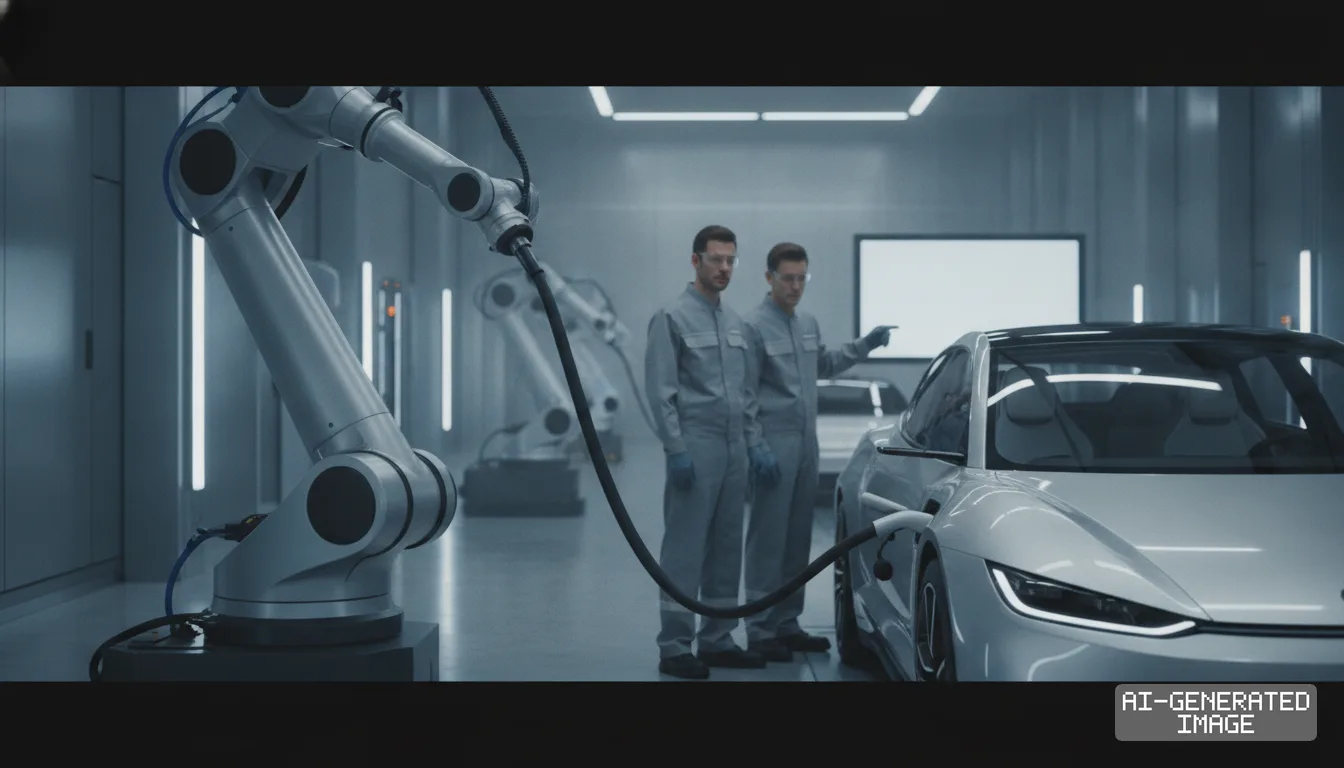
BYD demonstrated an automated robotic charging terminal capable of delivering 1,000 kilowatts on Nov. 15, 2026, coupling heavy liquid-cooled megawatt cables to electric vehicles without driver intervention.
The installation delivered 1,000 kilowatts to replenish a passenger car battery from 10% to 70% in five minutes, the company said. A full charge to 97% took eight minutes and 57 seconds.
The terminal hardware carries an engineering ceiling of 1,500 kilowatts through a single connector. That power rating requires thick liquid-cooled copper conductors that prove too heavy and stiff for routine manual handling by motorists.
BYD resolved the mechanical mass constraint by mounting the charging coupler on an industrial multi-axis robotic manipulator. The motorized arm articulates across multiple axes to maneuver the heavy terminal directly to the vehicle flank.
Optical cameras and machine-vision algorithms identify the vehicle position and open the charging port cover. Integrated force-feedback sensors monitor insertion resistance to seat the high-current pins cleanly into the socket without damaging body panels.
The sequence links with automated valet parking software developed by the Shenzhen automaker. A driver exits the vehicle at a designated staging point before onboard computers guide the car into the robotic stall.
The robotic arm supports multiple international charging coupler standards for foreign markets, BYD said in an operational briefing. The mechanical wrist swaps orientation to dock into distinct domestic and export vehicle charging sockets.
Conducting 1,000 amperes of electrical current generates intense resistive heat across the contact pins. Active liquid coolant flows through internal channels within the robotic head and umbilical sheath to hold terminal temperatures within operating thresholds.
BYD paired the charging station with on-site photovoltaic solar panels and stationary battery energy storage cabinets. The microgrid setup buffers power demand, preventing sudden megawatt spikes from pulling excessive current off municipal electricity grids.
The hardware emerged from field deployments in the Abu Dhabi desert, where ambient temperatures regularly exceed 45 degrees Celsius. The company first detailed the combined solar, storage and charging architecture in an operational filing on Nov. 8.
The system pairs with BYD's second-generation Blade Battery, a lithium iron phosphate pack using high-rate chemical pathways. The chemistry accepts high current without suffering thermal runaway during sustained megawatt delivery, according to company technical documentation.
Early vehicle integration focuses on luxury flagships, including the Yangwang U8 sport utility vehicle and the Denza Z9GT shooting brake. Both models feature the high-voltage electrical architectures required to receive megawatt-tier direct-current intake.
Autonomous charging eliminates the human labor overhead required to replenish commercial vehicle fleets. Automated freight yards and municipal electric bus depots require continuous turnaround cycles where manual plugging slows scheduled departures.
The mechanism also addresses the operational bottleneck facing driverless robotaxi networks. Fully autonomous fleets operating without safety drivers cannot refuel at conventional retail stalls without automated docking arms or inductive ground pads.
Rival technology supplier Huawei Technologies faces direct competitive pressure in the automated charging segment. Huawei holds an estimated 40% share of China's liquid-cooled ultra-fast terminal installations and demonstrated its own 600-kilowatt robotic dispenser in January 2025.
Middle Eastern retail conglomerate Al-Futtaim Group distributes BYD passenger cars across the United Arab Emirates. Al-Futtaim manages regional dealership networks and plans to test automated fleet charging infrastructure across commercial transport corridors.
Industrial articulated arms introduce moving joints and optical sensors that require regular mechanical calibration. Dust, airborne sand and ambient moisture in outdoor highway installations raise long-term maintenance costs relative to static charging pedestals.
Utilities in export destinations face delays when connecting megawatt-scale commercial installations to transmission lines. Even with stationary battery storage buffering the load, regional substation transformers require costly hardware upgrades to support multi-stall depots.
BYD announced plans to deploy 6,000 flash-charging stations across international markets by Dec. 31, 2027. The company operates manufacturing and distribution facilities across more than 100 countries and regions.
The company has not disclosed the commercial equipment price of the robotic arm or its planned deployment ratio across those 6,000 stations. The technical briefing does not confirm when serial production units will enter retail markets outside China.
BYD opened pre-orders for its Yangwang U8 and Denza Z9GT models across overseas markets ahead of scheduled commercial fleet trials.
Impact map
How this development propagates across the region and out to global buyers.
| Event | Korea | China | Japan | Global impact |
|---|---|---|---|---|
| Megawatt robotic charging deployment | Hyundai Motor monitors automated high-voltage standards for autonomous fleets | BYD challenges Huawei's 40% domestic share of liquid-cooled ultra-fast terminals | Fanuc and Yaskawa Electric evaluate industrial manipulator demand for depot automation | Fleet operators lower driver dwell time while capex rises for 1,000 kW microgrid depots |
In this story
- Companies
- BYDHuawei Technologies
- Tickers
- 002594.SZ
- Exposed
- Al-Futtaim Group
- Policy
- Standards
- Impact
- CapexSupply Chain
Track every Standards development →
Related briefings
- CATL plans 6,000 EV battery swap stations across 297 Chinese cities Also on Huawei Technologies, Standards
- BYD schedules Fangchengbao Tai 9 hybrid SUV debut for Nov. 19 Also on Huawei Technologies, BYD
- CATL expands Seres pact to add 12 GWh battery capacity in Chongqing Also on Huawei Technologies
- SMIC hits record $9.33B revenue as legacy nodes mask 7nm lag Also on Huawei Technologies
Sources
Primary documents
Reporting
Confidence: high — how we grade this
The documents behind this briefing are linked above. East Asia Brief produces its English text with AI assistance under human editorial review, and does not translate or republish other outlets' articles. See our methodology and AI policy. Spotted an error? Tell us.
The Morning Brief
What changed in Korean, Chinese and Japanese industry overnight — and what it means for your supply chain. One email, weekday mornings, US time. Free.
The Morning Brief is in preparation. Leave your address and we will write to you once — when the first issue is ready. Nothing before that.