Korean and Japanese Yards Deploy Welding Robots to Docks
Shipbuilders turn to automated vision-guided welding arms and mobile carriers to defend production schedules as Chinese yards capture 63% of commercial vessel orders.
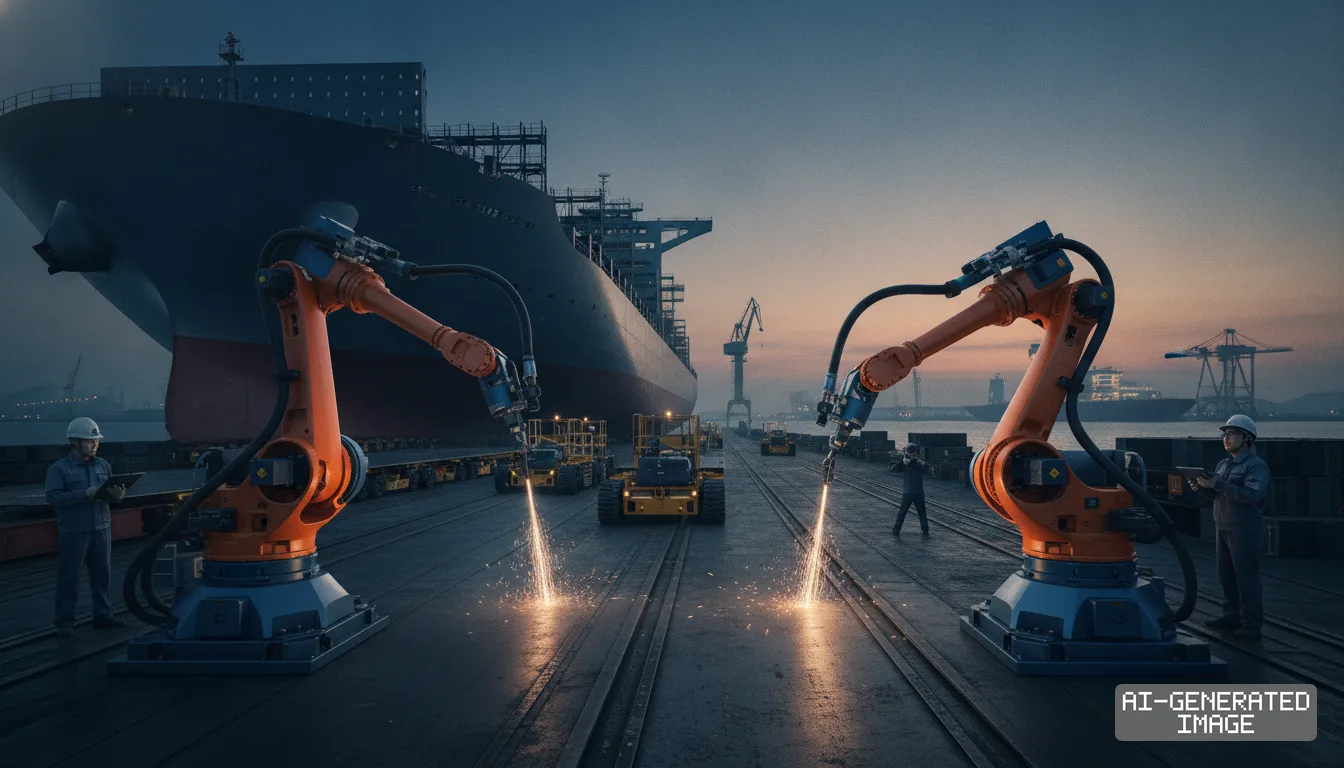
Shipbuilders in South Korea and Japan accelerated the deployment of collaborative welding robots and autonomous transport systems across commercial drydocks on Oct. 4, 2026, targeting chronic skilled-labor shortages.
The push comes as Northeast Asian yards face an acute generational turnover among certified pipe and hull welders. Foreign worker quotas have failed to close the persistent production deficit.
Clarkson Research data showed Chinese shipbuilders captured 35.37 million compensated gross tons, or 63% of the 56.43 million global order total, leaving South Korea with 21%.
The commercial gap forced yards in Ulsan and Imabari to rethink shop-floor mechanics. Ship construction has resisted assembly-line automation because curved hull plates require non-repetitive joins.
Heavy industrial yards previously relied on veteran tradespeople to compensate for plate distortion and dimensional variance. That manual pool has shrunk as regional demographics aged out of heavy manufacturing.
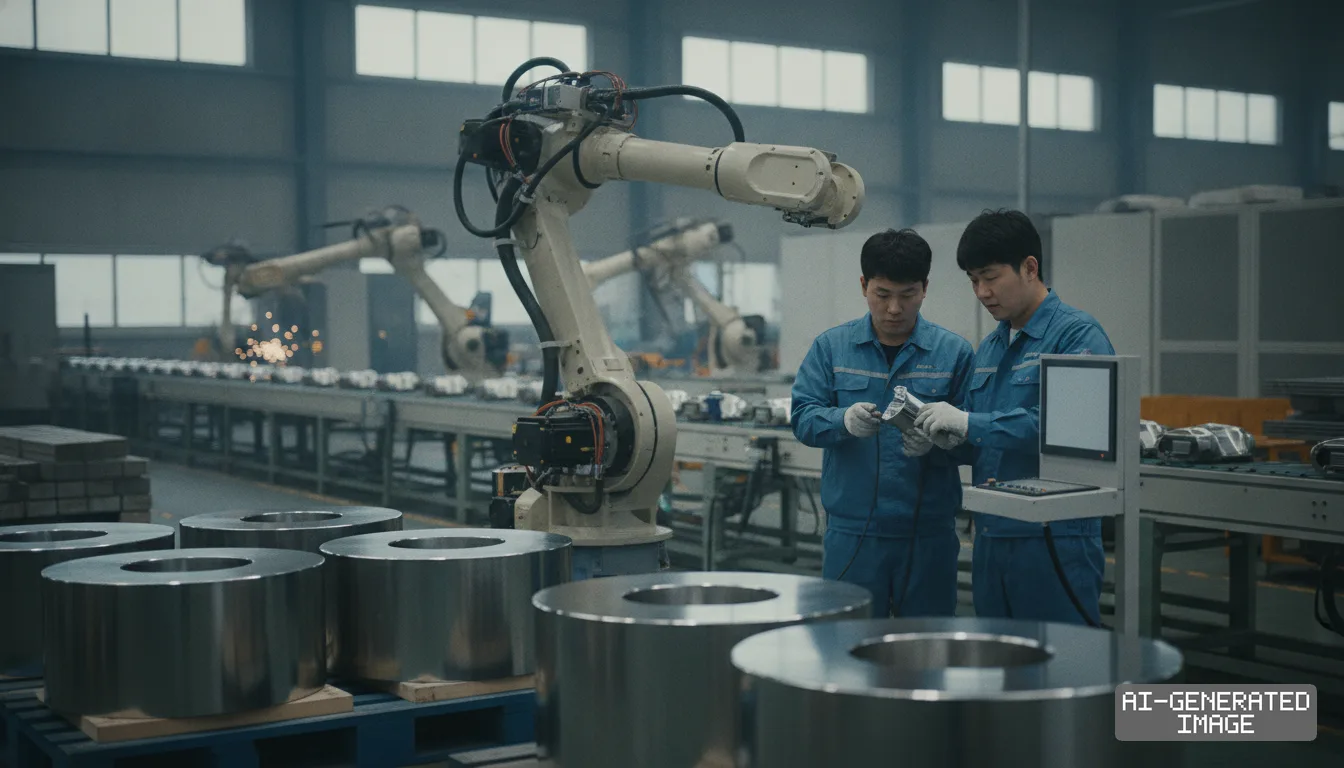
HD Hyundai Samho deployed robotic welding units capable of completing up to 50 seam passes per day. A veteran human welder averages roughly 30 passes over the same operational shift.
The 67% output increase allows the yard to defend delivery schedules on lucrative liquefied natural gas carriers. Those high-margin berths carry severe contractual penalties for late handovers.
Collaborative robots, known as cobots, operate beside human workers without bulky perimeter safety cages. Built-in force-torque sensors halt mechanical movement immediately upon contact with yard personnel.
Rainbow Robotics delivered 35 collaborative welding systems to HD Hyundai Heavy Industries under a dedicated automation supply contract. The deal placed 30 operational units and three spares in Ulsan.
The systems pair Rainbow Robotics arms with process-integration tooling developed by JCT. The hardware packages weigh 24 pounds, allowing two riggers to shift units between inner hull compartments.
HD Korea Shipbuilding & Offshore Engineering developed software that generates welding toolpaths straight from digital 3D hull drawings. The platform eliminates the need for manual teaching in cramped vessel spaces.
South Korea's Ministry of Trade, Industry and Energy backed the transition through its M.AX manufacturing project. The state initiative funded an autonomous sub-assembly cell at the Ulsan hull yard.
The test cell pairs eight industrial articulated arms with two autonomous mobile robots. A single technician monitors up to six automated welding stations through an industrial tablet interface.
In Japan, the Ministry of Land, Infrastructure, Transport and Tourism mapped a 350 billion yen ($2.23 billion) fund through 2035. The capital pool finances robotic upgrades across regional yards.
Tokyo's program tasks the National Maritime Research Institute with automating five production stages: steel bending, welding, painting, logistics and non-destructive joint inspection.
Imabari Shipbuilding, Japan's largest commercial shipbuilder, expanded joint automation studies with Japan Marine United. The yards seek to pool engineering resources against state-backed Chinese rivals.
Imabari President Yukito Higaki said deciding the scale and timing of shipyard capital expenditures remains exceptionally difficult during prolonged market volatility.
Industrial robot builder Fanuc reported that Asian shipyards have shifted from sporadic laboratory tests to line trials. Senior Executive Managing Director Kenichiro Abe said yards now treat automation as an operational imperative.
The automation race has also reached mainland Chinese competitors. Hengli Heavy Industries equipped its Dalian yard with 5G-linked automated cutting tables and robotic welding gantries to compress fabrication cycles.
The published project disclosures do not state the exact capital expenditure allocated to dockside sensor retrofits, and shipbuilders have not released commercial payback metrics for non-repetitive curved block welding.
HD Hyundai scheduled the rollout of its fully connected smart yard roadmap for 2030. The program aims to shorten total vessel construction lead times by 30% across all Korean facilities.
Japan's transport ministry will review initial yard automation bids in November. Selected drydocks will begin full-scale field verification of vision-guided welding equipment during the first half of 2027.
Impact map
How this development propagates across the region and out to global buyers.
| Event | Korea | China | Japan | Global impact |
|---|---|---|---|---|
| Shipyard welding cobot deployment | HD Hyundai raises seam output 67% and targets 30% lead-time cuts by 2030 | Hengli links 5G automated gantries to defend 63% global order share | Imabari and MLIT tap 350 billion yen fund to automate five yard processes | LNG carrier delivery slots stay secure as automation offsets Asian yard labor deficits |
In this story
- Companies
- HD HyundaiImabari ShipbuildingRainbow RoboticsFanuc
- Tickers
- 267250.KS277810.KS6954.T
- Exposed
- JCTHengli Heavy Industries
- Policy
- SubsidiesEconomic Security
- Impact
- Cost StructureCapexOrder Book
Track every Subsidies development → Track every Economic Security development →
Related briefings
- Fanuc previews 11-kg welding cobots for shipyards at Fabtech 2026 Also on JCT, Rainbow Robotics, Fanuc
- Bigwave Robotics partners with automation suppliers to scale US physical AI Also on Rainbow Robotics, FANUC, Order Book
- Imabari and JMU consolidate dry bulk engineering to standardize ammonia dual-fuel vessels Also on Imabari Shipbuilding, Cost Structure, Order Book
- Shipyard labor policies diverge as Korea, Japan, and China tackle yard manning gaps Also on Imabari Shipbuilding, Cost Structure, Order Book
Sources
Reporting
Confidence: medium — how we grade this
The documents behind this briefing are linked above. East Asia Brief produces its English text with AI assistance under human editorial review, and does not translate or republish other outlets' articles. See our methodology and AI policy. Spotted an error? Tell us.
The Morning Brief
What changed in Korean, Chinese and Japanese industry overnight — and what it means for your supply chain. One email, weekday mornings, US time. Free.
The Morning Brief is in preparation. Leave your address and we will write to you once — when the first issue is ready. Nothing before that.