Kawasaki Heavy unveils quadruped AI robot for shipyards in 2026
The four-legged machine navigates vertical hull plates using abdominal magnets to automate hazardous welding and inspection at the Sakaide yard ahead of commercial rollout in 2028.
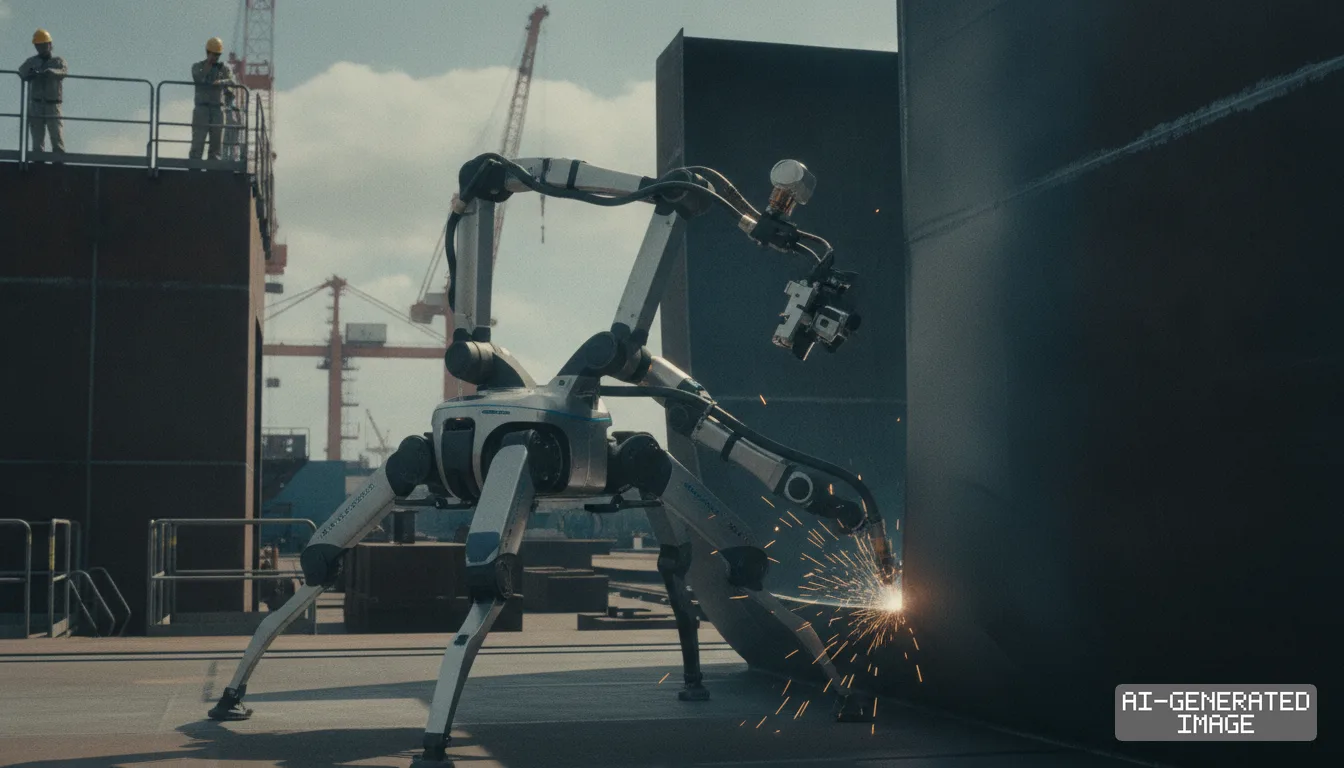
Kawasaki Heavy Industries unveiled a quadruped artificial intelligence shipyard robot on Oct. 6, 2026, designed to handle autonomous welding, painting and inspection across hazardous confined hull blocks.
The industrial group projected fiscal 2026 revenue of 2.56 trillion yen ($17.1 billion) at the briefing. It is directing investment toward robotics to offset chronic labor shortages across Japanese dry docks.
The four-legged machine carries abdominal magnets that grip vertical steel bulkheads and curved hull plates. This mechanism allows the robot to walk up sheer walls and navigate inverted overhead structures.
Onboard physical artificial intelligence generates real-time work plans directly on unstructured steel surfaces. The software calculates weld seams and coating coverage without requiring pre-programmed operator paths, the company said.
Shipbuilding blocks contain narrow voids where toxic paint fumes gather and manual access requires scaffolding. The robotic platform enters these confined cells to eliminate human fall risks.
The robot project forms part of an initiative sponsored by Japan's National Institute of Maritime, Port and Aviation Technology. The government program runs from March 2026 through March 2027.
Shin Kurushima Dock and Namura Shipbuilding participate alongside Kawasaki Heavy in the research consortium. The two shipbuilders operate five commercial yards in Japan that face identical aging workforce constraints in block assembly.
Kawasaki Heavy partnered with Nvidia on July 16, 2026, to build a digital shipyard platform. The project uses Nvidia Cosmos world models and Isaac robotics software to simulate yard environments.
The digital platform generates synthetic training data for physical AI models before hardware deployment. That process lets engineers test gait stability across wet and irregular steel plates virtually.
The Tokyo manufacturer selected its Sakaide Works in Kagawa Prefecture as the operational testbed. The commercial yard builds liquefied natural gas carriers and dry bulk vessels using large block assembly.
Japanese shipbuilders face an aging workforce as experienced hull welders reach retirement age. Traditional gantry automation cannot enter cramped inner double bottoms where the quadruped machine is built to operate.
The robot carries visual cameras, ultrasonic sensors and thermal imaging payloads across its frame. These instruments verify weld bead integrity and paint thickness during active work passes.
Specialized end-effectors mounted beneath the chassis deliver automated arc welding on flat and curved seams. The system records seam coordinates directly into yard management systems for quality auditing.
Rival shipbuilders in South Korea rely heavily on fixed rail-guided crawlers and overhead gantries. Those mechanized systems require manual rigging, while Kawasaki Heavy's legged unit moves autonomously across bare structural framing.
Company President Yasuhiko Hashimoto outlined the deployment during the Group Vision 2030 progress briefing. The executive identified physical AI as a core growth pillar across commercial marine and industrial machinery divisions.
Kawasaki Heavy plans to begin field trials at the Sakaide shipyard in 2027. The company aims to achieve full commercial implementation across active ship assembly lines in 2028.
The government-backed consortium led by the Maritime Bureau concludes its experimental development phase on March 31, 2027. Consortium partners will review field metrics before scheduling wider dock deployment.
The company has not disclosed unit production costs or target fleet volumes for the robotic system. Official documents also omit an individual commercial brand name for the unit.
Kawasaki Heavy continues baseline training runs for the quadruped unit at its Akashi development center. The company will transfer pre-series hardware to Sakaide during the coming fiscal cycle.
Impact map
How this development propagates across the region and out to global buyers.
| Event | Korea | China | Japan | Global impact |
|---|---|---|---|---|
| Shipyard quadruped robot rollout | Hanwha Ocean and HD Hyundai maintain rail crawler automation, watching Japanese legged mobility | Jiangnan Shipyard relies on gantry welding lines, shielded by larger labor force | Kawasaki Heavy tests units at Sakaide in 2027; Shin Kurushima and Namura gain consortium tech | Marine engineering Capex shifts toward autonomous physical AI systems by 2028 |
In this story
- Companies
- Kawasaki Heavy Industries
- Tickers
- 7012.T
- Exposed
- NvidiaShin Kurushima DockNamura Shipbuilding
- Policy
- Subsidies
- Impact
- Supply ChainCapexCost Structure
Track every Subsidies development →
Related briefings
- Japan Clears $635 Million in Subsidies to Modernize Shipyards by 2035 Also on Namura Shipbuilding, Kawasaki Heavy Industries
- Mitsubishi Heavy buys shipyard land in Shimonoseki buildout Also on Namura Shipbuilding
- Japan awards $1.4bn shipbuilding subsidies to Imabari and seven domestic yards Also on Namura Shipbuilding
- Kawasaki Heavy advances 2030 target for AI humanoid robots Also on Kawasaki Heavy Industries, Nvidia
Sources
Primary documents
Reporting
Confidence: high — how we grade this
The documents behind this briefing are linked above. East Asia Brief produces its English text with AI assistance under human editorial review, and does not translate or republish other outlets' articles. See our methodology and AI policy. Spotted an error? Tell us.
The Morning Brief
What changed in Korean, Chinese and Japanese industry overnight — and what it means for your supply chain. One email, weekday mornings, US time. Free.
The Morning Brief is in preparation. Leave your address and we will write to you once — when the first issue is ready. Nothing before that.