IndexBox reports 12% annual growth for dual-arm chip cobots
Turnkey bimanual systems handling semiconductor packaging and electronics assembly will double by 2035 as Asia-Pacific drives more than half of global procurement.
IndexBox reported Oct. 2 that global demand for collaborative dual-arm robots will expand at a 12.0% compound annual growth rate through 2035, driven by semiconductor packaging and electronics assembly.
The market research firm projected that the total market index will reach 280 to 320 by 2035, up from a baseline of 100 in 2025. That trajectory will double global market volume over the decade.
Asia-Pacific accounts for 50% to 55% of global procurement demand for these bimanual machines, IndexBox said. China alone represents 25% to 30% of total purchases, backed by concentrated consumer electronics assembly.
Turnkey systems that integrate vision sensors, custom end-effectors and safety cells generate 55% to 60% of industry revenue. Buyers increasingly demand fully integrated work cells to shorten line deployment schedules.
Semiconductor packaging facilities and precision electronics factories face rising technical barriers when automating delicate assembly steps. Single-arm robots struggle to execute tasks that require simultaneous holding and fastening.
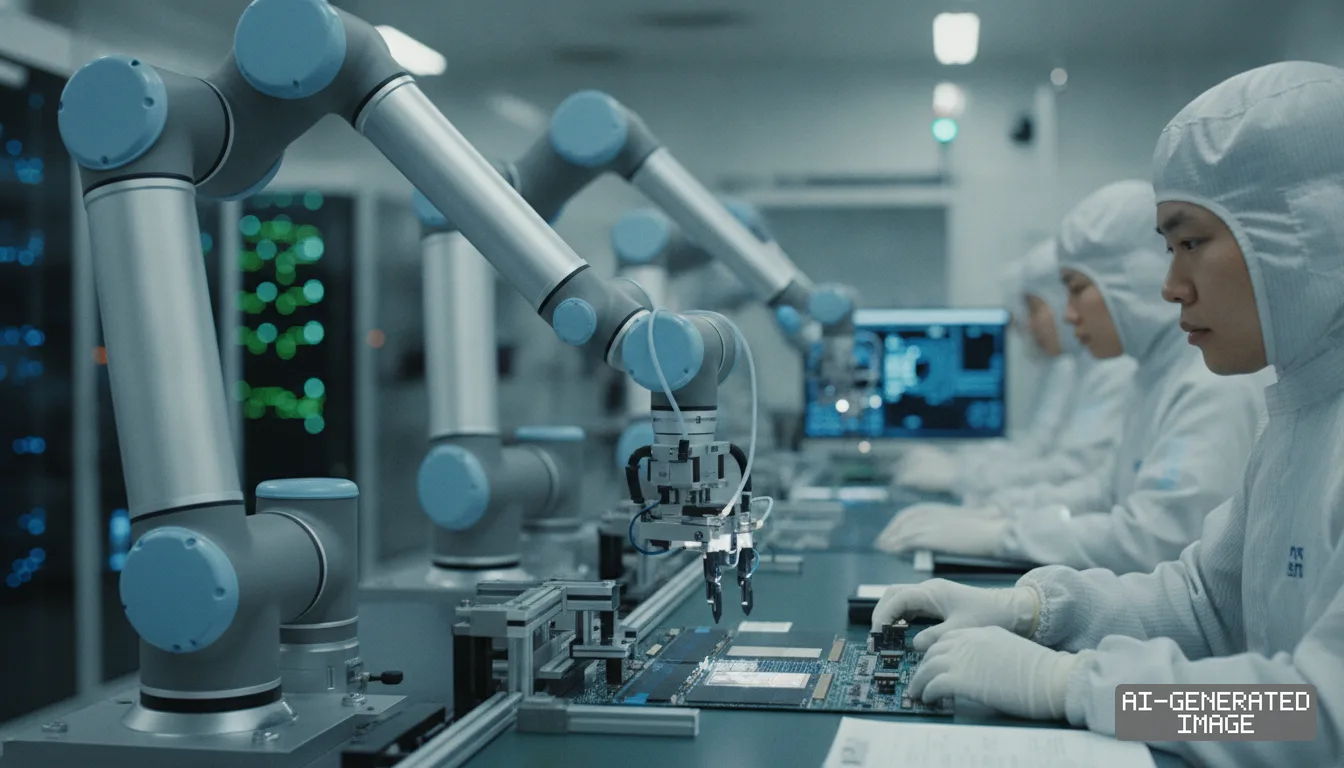
Dual-arm collaborative robots — machines featuring two synchronized articulated arms operating in shared human workspaces — solve that mechanical limitation. One arm secures a workpiece while the second arm inserts connectors or drives screws.
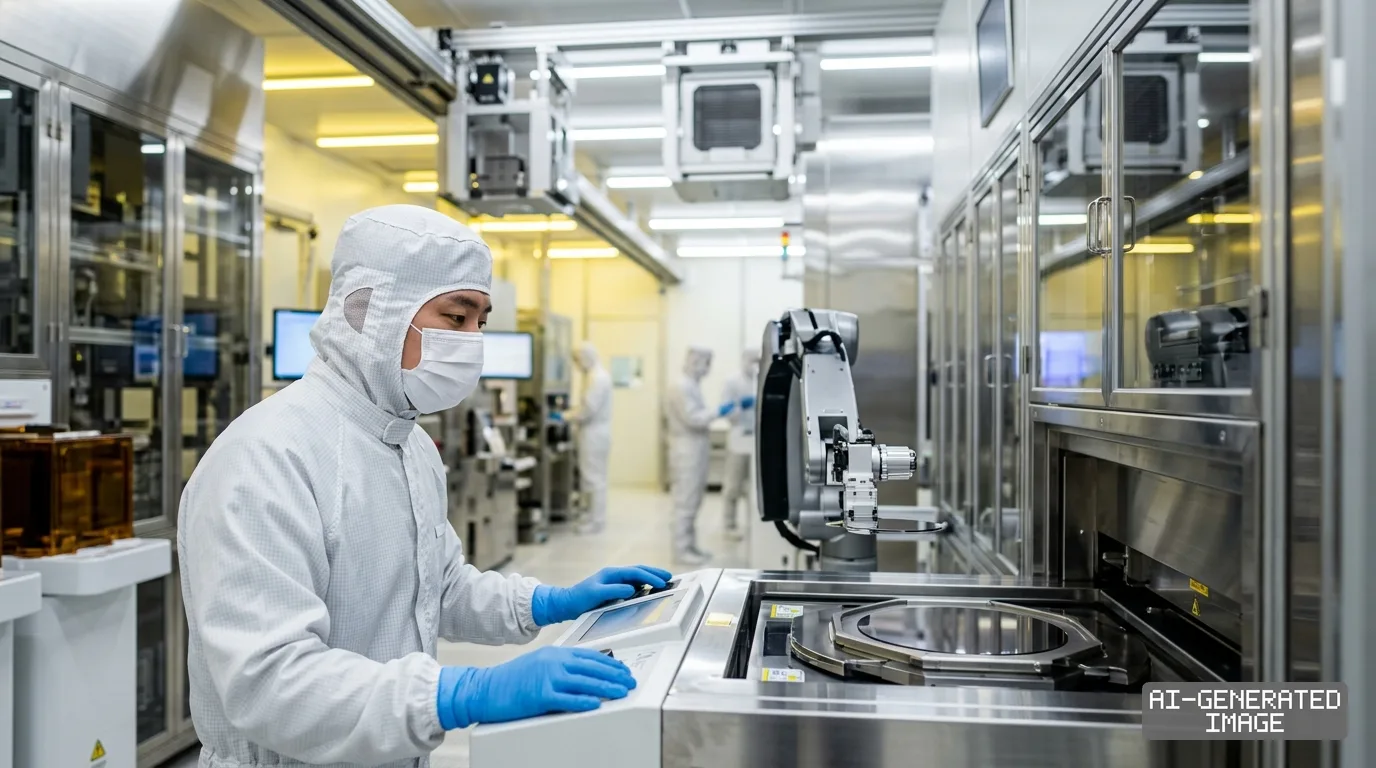
Cleanroom environments — manufacturing rooms filtered to limit airborne dust particles to specific microscopic thresholds — create acute cost pressures. Human operators shed microscopic skin flakes and fibers, generating particulate contamination that damages exposed silicon dies.
Every cleanroom operator requires positive-pressure protective suits, specialized air showers and strict decontamination routines. Those recurring procedures add thousands of dollars in annual labor overhead per workstation.
Floor space inside semiconductor cleanrooms also commands high construction and maintenance expenses. Traditional industrial robots require safety fencing and perimeter barriers, taking up floor footprints that advanced packaging facilities cannot spare.
Collaborative dual-arm units operate safely beside human workers without physical fences. Built-in force-torque sensors detect unexpected resistance and halt movement in milliseconds, allowing factories to place automation in tight cleanroom footprints.
Advanced packaging lines also handle fragile silicon substrates and fine pitch interconnects. Manual handling risks electrostatic discharge and micro-fractures, which depress production yields across expensive system-in-package modules.
Bimanual cobots limit these scrap losses by executing repeatable motion profiles with millimeter-level positional repeatability. Coordinated multi-axis control distributes mechanical stress evenly across delicate components during press-fit operations.
Suppliers of industrial automation are aligning product roadmaps around this cleanroom shift. Zurich-based ABB Group, which generates about $32 billion in annual revenue, deploys its dual-arm YuMi platform for small-parts electronics handling.
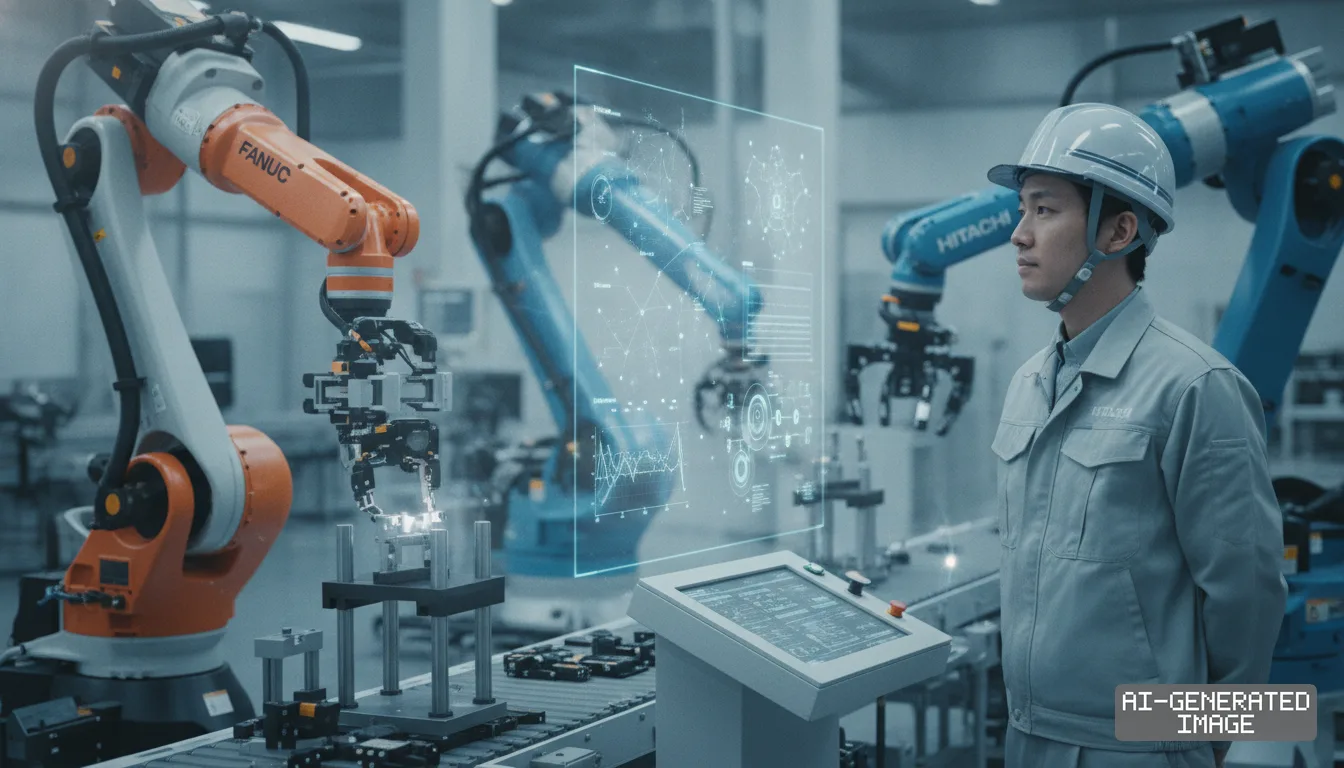
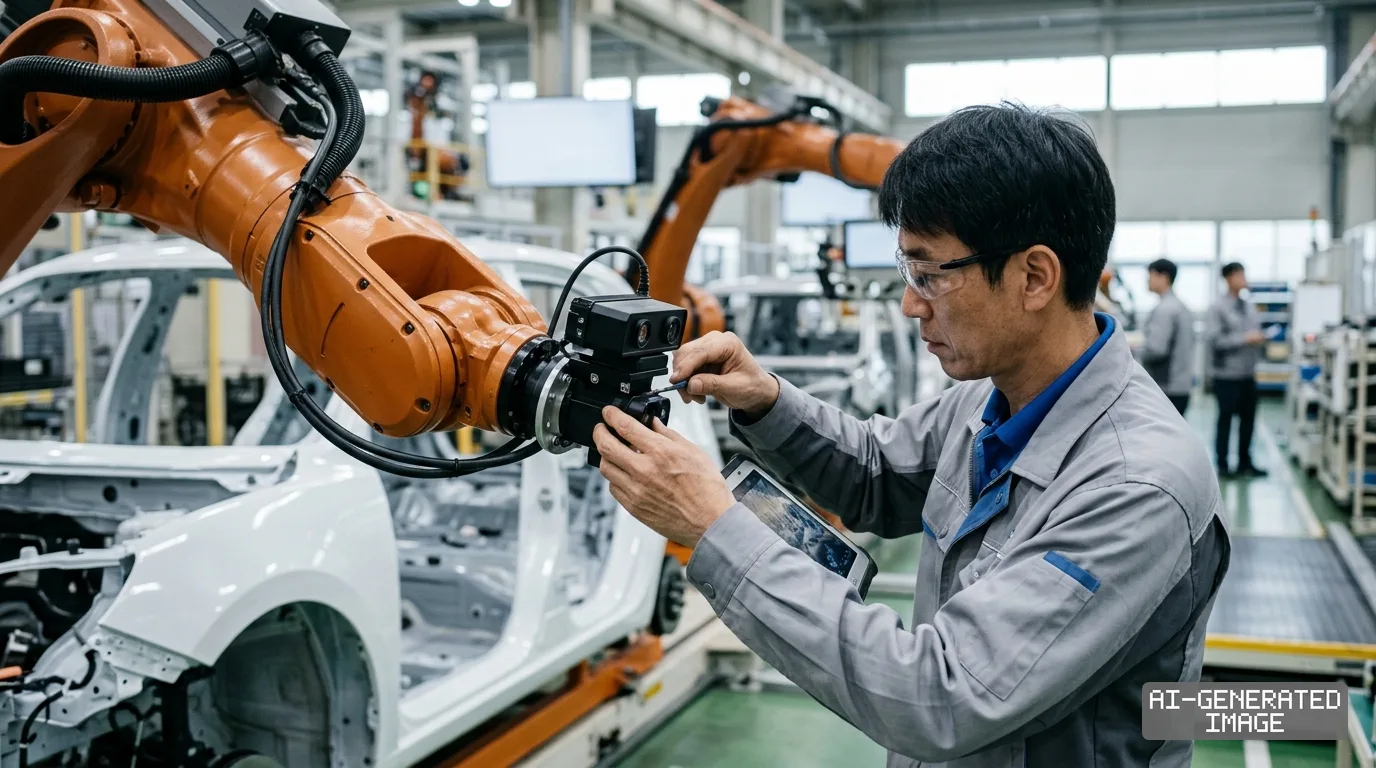
Japanese robotics vendors also hold heavy exposure to Asian manufacturing lines. Yaskawa Electric and Kawasaki Heavy Industries supply bimanual and collaborative systems engineered specifically for cleanroom electronic component assembly.
South Korean robotics firms are targeting cleanroom automation with mobile platforms. Rainbow Robotics developed the RB-Y1, a mobile dual-arm robot that pairs two seven-axis arms with a wheeled mobile base for manufacturing floors.
The RB-Y1 platform performs whole-body coordinated manipulation across 20 motion axes, allowing it to tend multiple workstations across a line. Rainbow Robotics is testing the hardware in electronics assembly environments.
Neuromeka has developed dual-arm configurations using artificial intelligence models trained on physical assembly data. These systems adapt grasping force dynamically when handling components with slight dimensional variations.
The IndexBox report noted that shared-workspace laboratory automation is the fastest-growing niche, expanding at an estimated 18% to 22% annual rate. Aftermarket servicing contracts are also growing at 15% to 20% annually.
Capital costs remain a significant hurdle for smaller component suppliers. Complete dual-arm work cells often cost more than double the price of conventional single-arm articulated units due to redundant joints and sensors.
Complex programming also slows field adoption. Synchronizing two arms to prevent collisions within their overlapping operational envelopes requires skilled software engineering or labor-intensive lead-through teaching.
Component bottlenecks create additional supply friction. Precision strain wave reducers and high-resolution torque sensors continue to experience extended manufacturing lead times across East Asian supply chains.
Regional packaging consortia and industrial robotics suppliers plan to complete cleanroom compliance reviews under ISO 14644-1 and ISO 10218-1 safety standards in March 2027.
The IndexBox report does not state total unit shipment volumes, and semiconductor packaging vendors have not published procurement contract values for specific dual-arm installations.
Standardization bodies in Japan, South Korea and China are scheduled to convene in November 2026 to review safety guidelines for mobile bimanual robots in electronics plants.
Impact map
How this development propagates across the region and out to global buyers.
| Event | Korea | China | Japan | Global impact |
|---|---|---|---|---|
| Dual-arm cobot cleanroom adoption | Rainbow Robotics validates RB-Y1 bimanual platform for semiconductor and electronics lines | Domestic electronics plants account for 25% to 30% of global dual-arm cobot purchases | Yaskawa Electric and Kawasaki Heavy supply cleanroom arms for backend packaging lines | Advanced packaging fabs reduce particle contamination overhead and floor space by eliminating fences |
In this story
- Companies
- ABB GroupRainbow RoboticsYaskawa ElectricKawasaki Heavy Industries
- Tickers
- 277810.KS6506.T7012.T
- Exposed
- Neuromeka
- Policy
- Economic Security
- Impact
- CapexSupply ChainCost Structure
Track every Economic Security development →
Related briefings
- Korean electronics component suppliers deploy AI dual-arm robots as factory labor pool shrinks Also on Neuromeka, Rainbow Robotics, Cost Structure
- Korea tightens export licensing rules on robotics actuator technology Also on Neuromeka
- Mitsubishi Heavy buys Shimonoseki site in $638M yard plan Also on Kawasaki Heavy Industries
- Japan Clears $635 Million in Subsidies to Modernize Shipyards by 2035 Also on Kawasaki Heavy Industries
Sources
Reporting
Confidence: medium — how we grade this
The documents behind this briefing are linked above. East Asia Brief produces its English text with AI assistance under human editorial review, and does not translate or republish other outlets' articles. See our methodology and AI policy. Spotted an error? Tell us.
The Morning Brief
What changed in Korean, Chinese and Japanese industry overnight — and what it means for your supply chain. One email, weekday mornings, US time. Free.
The Morning Brief is in preparation. Leave your address and we will write to you once — when the first issue is ready. Nothing before that.