DN Solutions pairs Addiguru AI vision with metal 3D printers
Live demonstrations at Formnext 2026 target inline defect detection to curb post-processing costs that consume 30% to 50% of component budgets.
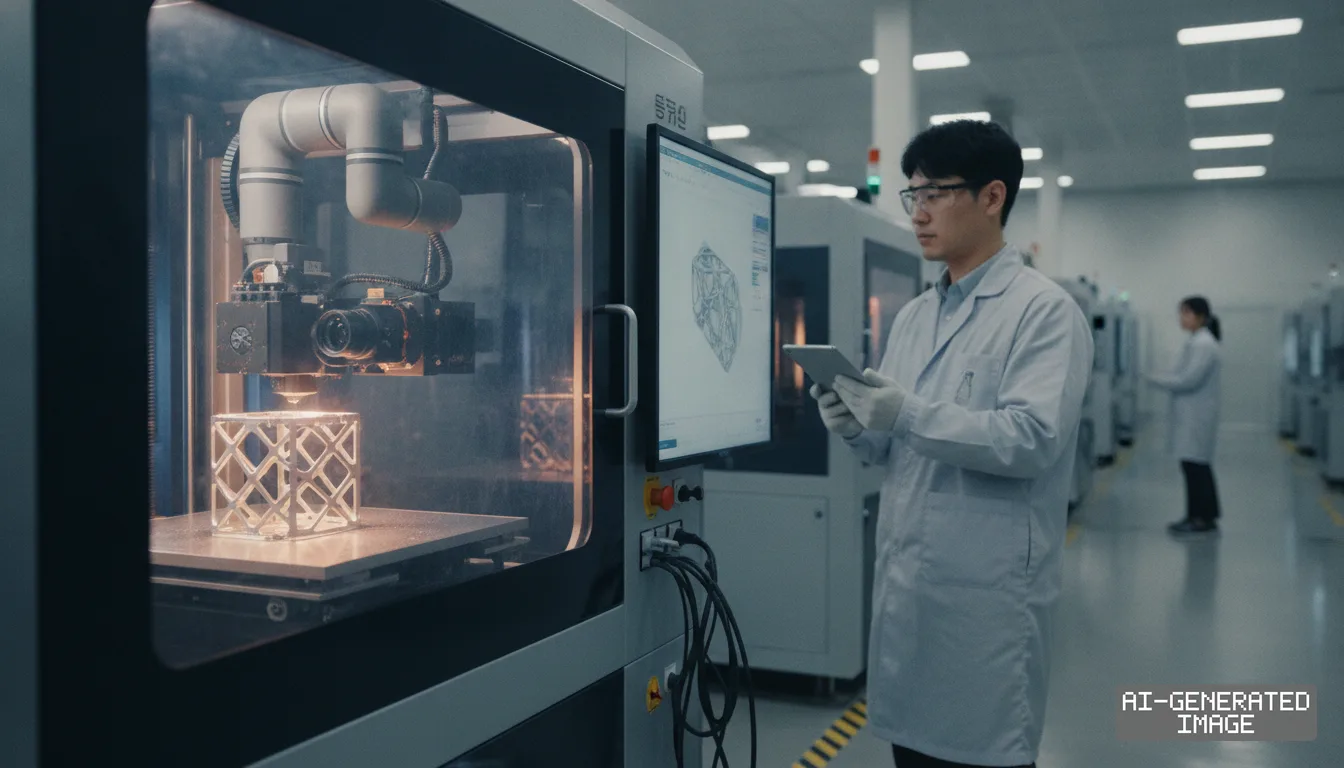
DN Solutions and Addiguru demonstrated automated defect detection for laser powder bed fusion systems on Nov. 18, 2026, linking computer vision algorithms directly to metal additive production.
The project targets finishing expenses that consume between 30% and 50% of total component production budgets, according to operational data published by the two companies at Formnext 2026 in Frankfurt.
Post-build processing in precision metal additive manufacturing requires heat treatment, five-axis milling on computer numerical control equipment and industrial computed tomography scanning.
When an internal structural void escapes detection inside the build chamber, downstream finishing runs on flawed stock. The entire post-processing budget is lost alongside the underlying raw material.
DN Solutions, South Korea's largest machine tool builder, is running the trials using layer build data generated by its DLX industrial metal additive equipment.
The DLX series uses laser beam powder bed fusion to melt metal powders into structural geometries. The flagship DLX 450 platform handles build volumes up to 450 by 450 by 470 millimeters.
The machine uses multi-laser optics and bidirectional powder recoating to process aerospace-grade alloys, including titanium, nickel-based superalloys and structural aluminum.
Addiguru, an industrial software developer based in New Orleans, Louisiana, supplies the artificial intelligence platform that inspects the powder bed surface during each recoating pass.
The software analyzes high-resolution optical images captured immediately after the powder spreader deposits feedstock across the build plate.
It monitors the surface for incomplete powder spreading, streaking, part distortion, debris, overheating zones and spatter distribution during laser exposure.
Reviewing layer images manually across a complex production build often requires dozens of engineering hours across thousands of individual slices, Addiguru said.
The automated platform classifies visual anomalies instantly, tracking layer irregularities as the part grows and issuing automated alerts when structural thresholds indicate a terminal build defect.
Machine operators can pause laser exposure or abort the build cycle before the printer consumes additional metal powder, shielding factory capacity from non-recoverable waste.
"A defect found during the build costs a reprint," Dr. Vino Suntharakumaran, Vice President of Additive Manufacturing at DN Solutions, said during the demonstration.
"Found after five-axis finishing and computed tomography, it costs the reprint plus every machine hour and inspection that went into the part," Suntharakumaran said.
DN Solutions has focused on combining additive builds with subtractive finishing into a continuous workflow branded as AM2CNC, which links additive printers to machining centers.
In typical production cells, parts built on DLX systems transfer directly to five-axis machines like the DVF 5000 for precision face milling, hole boring and surface finishing.
Without inline verification during the printing cycle, machining centers expend cycle time and spindle hours on components that non-destructive testing subsequently rejects.
Addiguru Chief Executive Officer Shuchi Khurana said inline analytics prevent advanced facilities from spending inspection capital on defective components.
"If we can identify a potential problem during the build, why wait until after machining and expensive inspection to find it?" Khurana said.
The partnership also addresses qualification bottlenecks in aerospace and defense supply chains, where structural integrity certification mandates comprehensive flaw documentation.
DN Solutions operates manufacturing and development sites across Asia, Europe and the Americas, including technical facilities in Changwon and an additive center in Gütersloh, Germany.
Integrating automated optical inspection with CNC workflows allows industrial users to log inspection certificates for individual build layers before subtractive tooling touches the billet.
Formnext 2026 runs through Nov. 20 in Frankfurt, Germany, where both companies are displaying the integrated monitoring pipeline to commercial manufacturing clients.
Following the close of the exhibition on Nov. 20, engineering teams from DN Solutions and Addiguru will begin testing additional sensor streams alongside powder bed camera images.
The joint engineering program will evaluate acoustic sensors, photodiode melt pool monitors and real-time machine telemetry to widen the automated anomaly detection baseline.
DN Solutions has not published commercial pricing schedules, nor has it confirmed whether Addiguru software will be bundled as standard factory equipment on DLX machines.
Impact map
How this development propagates across the region and out to global buyers.
| Event | Korea | China | Japan | Global impact |
|---|---|---|---|---|
| Metal AM defect monitoring integration | DN Solutions strengthens AM2CNC hybrid machining offerings against Japanese and European toolmakers | Domestic LPBF builders face pressure to incorporate real-time vision suites | Machining center leaders DMG Mori and Mazak face direct competition in hybrid cell workflows | Aerospace and defense part suppliers reduce post-build inspection scrap and CNC cycle waste |
In this story
- Companies
- DN Solutions
- Exposed
- Addiguru
- Policy
- Standards
- Impact
- Supply ChainCost Structure
Track every Standards development →
Related briefings
- DN Solutions Unveils AI Machining Cell at Robotworld 2026 Also on DN Solutions
- Jotun secures hull coating order for nine Knutsen LNG ships Also on Standards, Cost Structure
- LG Energy Solution pairs sodium batteries with SST for AI grids Also on Standards, Cost Structure
- Tank Clinic cuts tanker welding to 8 hours using Yaskawa robot Also on Standards, Cost Structure
Sources
Reporting
Confidence: medium — how we grade this
The documents behind this briefing are linked above. East Asia Brief produces its English text with AI assistance under human editorial review, and does not translate or republish other outlets' articles. See our methodology and AI policy. Spotted an error? Tell us.
The Morning Brief
What changed in Korean, Chinese and Japanese industry overnight — and what it means for your supply chain. One email, weekday mornings, US time. Free.
The Morning Brief is in preparation. Leave your address and we will write to you once — when the first issue is ready. Nothing before that.