Hitachi and Fanuc unite on physical AI to automate factories
The Japanese manufacturers will combine edge chips and robot arms at Ibaraki test sites ahead of an external commercial rollout across nine industrial sectors in fiscal 2027.
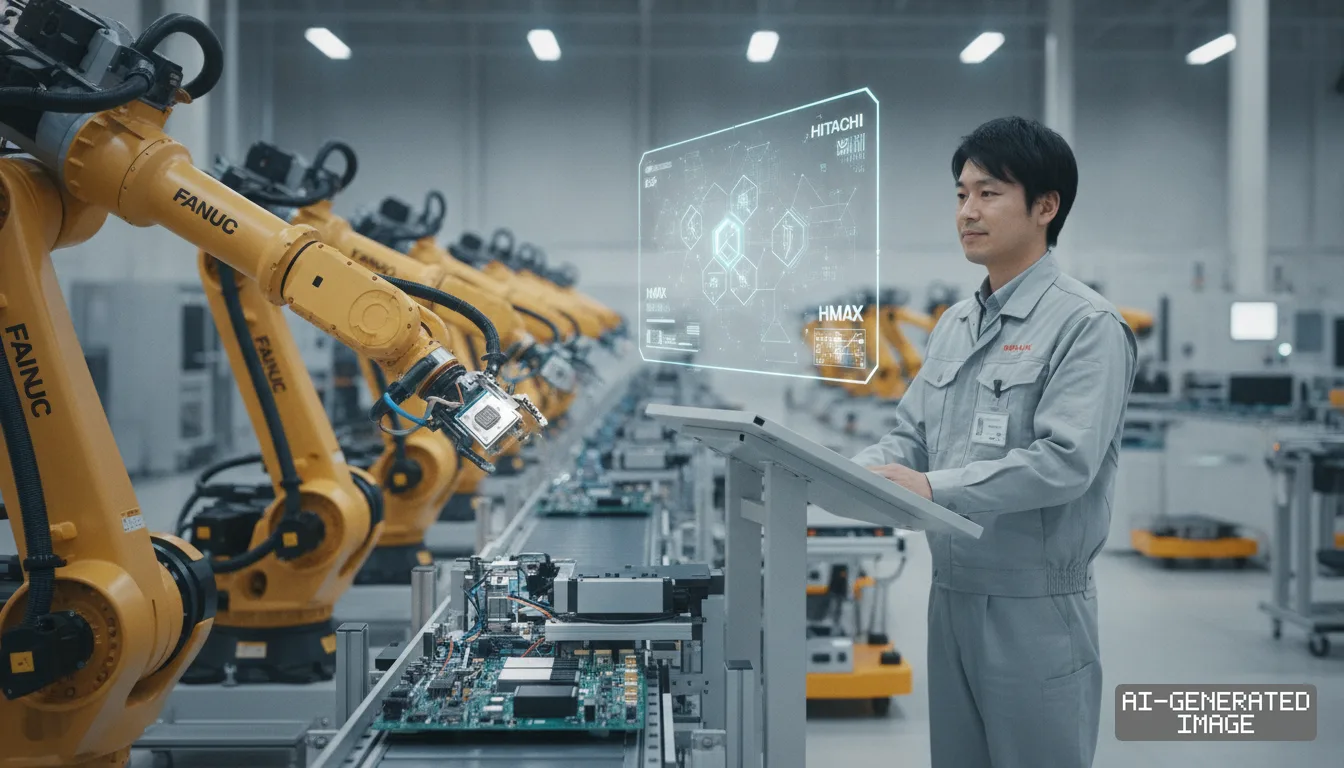
Hitachi and Fanuc finalized operational timetables on Oct. 13, 2026, to commercialize physical artificial intelligence across factory floors, advancing an industrial automation alliance signed on Sept. 30.
The initiative pairs Hitachi's HMAX Industry digital platform and proprietary edge microchips with Fanuc's industrial robot arms and computerized numerical controllers.
Fanuc maintains an installed base of more than 1 million industrial robots worldwide. Hitachi operates across social infrastructure and digital services with a global workforce of roughly 280,000 employees.
Hitachi President and Chief Executive Officer Toshiaki Tokunaga and Fanuc President and Chief Executive Officer Kenji Yamaguchi signed the agreement to address persistent shop-floor labor constraints, the companies said.
Physical artificial intelligence refers to software systems that perceive physical environments, execute spatial reasoning, and direct mechanical machinery to handle complex manipulation tasks without fixed manual programming.
Traditional industrial robotics requires extensive manual coding for specific product geometries. That engineering overhead creates high operating costs whenever production lines switch between different product batches or component variants.
The partners designated Hitachi's production facilities in Ibaraki Prefecture as Customer Zero for real-world testing. Engineers will gather operational sensor feeds directly from active machinery during working shifts.
On-site shop-floor training captures subtle mechanical friction, component inconsistencies, and ambient thermal expansion. Virtual digital twins and pure software simulation models cannot reliably reproduce those variables, the companies said.
Hitachi supplies the computational architecture through its HMAX Industry platform alongside custom edge semiconductors. The edge microchips execute machine-learning inference on local hardware without transferring proprietary telemetry off the factory floor.
Local data processing prevents network latency during high-speed mechanical motion. It also addresses data security requirements for global manufacturing clients that handle proprietary tooling specifications.
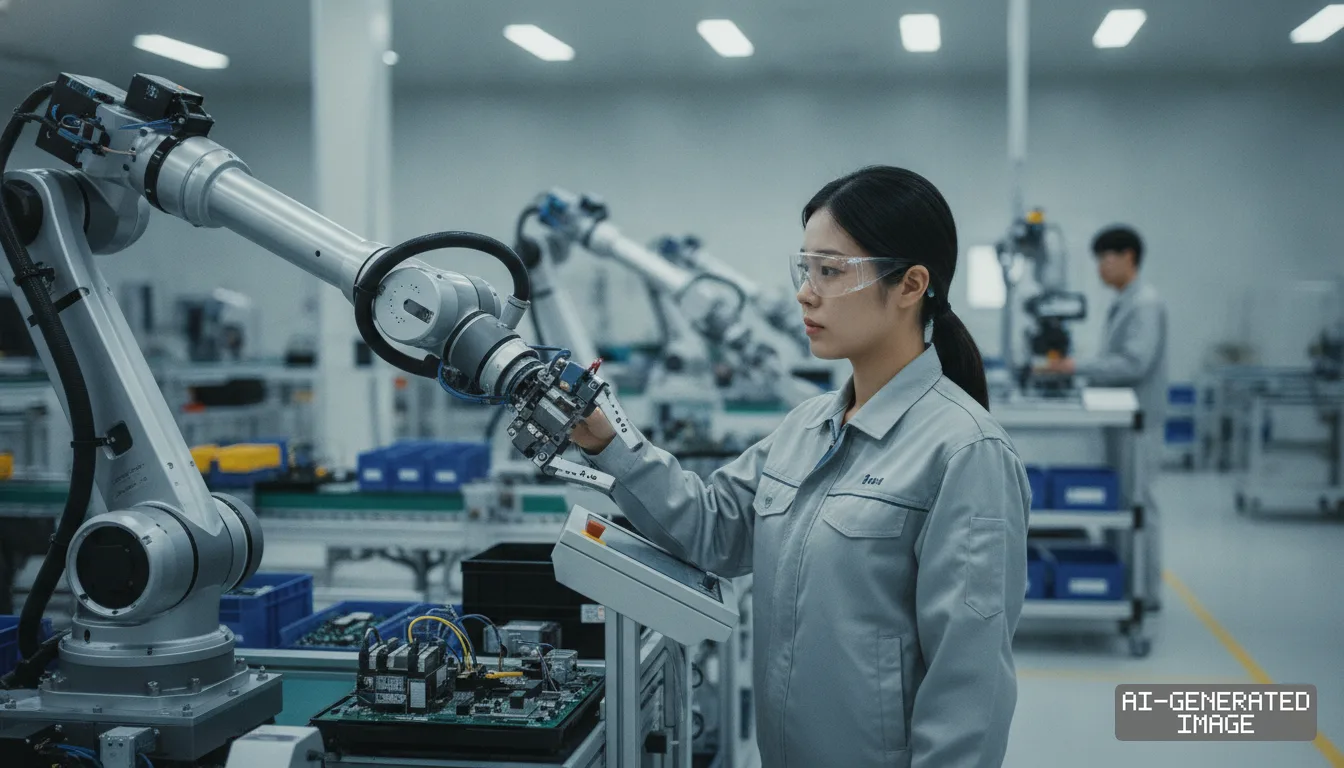
Fanuc integrates the software models into its programmable robotic arms and vision systems. The mechanical units adjust grip trajectories dynamically when sorting through unordered containers of irregular components.
Initial test programs focus on unstructured bin picking and rapid production line changeovers — known in Japanese manufacturing as dantorikae. These steps traditionally demand years of specialized technician experience.
The joint validation evaluates four operational performance benchmarks: visual recognition accuracy, motion trajectory efficiency, production takt time, and defect rates across high-mix assembly lines.
Both companies previously joined the Cosmos Coalition in July 2026. That open physical artificial intelligence initiative, organized by Nvidia, aims to establish interoperable foundational models for commercial robotics.
Western industrial buyers have historically relied on fragmented system integrators to bridge factory hardware with enterprise software suites. The Hitachi-Fanuc alliance seeks to provide an integrated alternative for international manufacturers.
Commercial rollout to external customers will begin in fiscal 2027. The joint sales initiative targets nine core industrial markets across North America, Europe, and Asia.
The target sectors comprise semiconductors, automotive assembly, pharmaceuticals, medical healthcare equipment, advanced materials, freight logistics, food processing, commercial shipbuilding, and agricultural machinery.
The companies did not disclose financial investment totals, joint venture equity shares, or specific revenue targets for the commercial alliance.
Engineers at the Ibaraki test plants continue baseline data collection across active assembly equipment ahead of multi-site validation scheduled for early 2027.
Impact map
How this development propagates across the region and out to global buyers.
| Event | Korea | China | Japan | Global impact |
|---|---|---|---|---|
| Hitachi and Fanuc physical AI commercialization | Hyundai and Samsung plants face integrated Japanese robotics competition in packaging | Local robot makers lose edge-chip integration advantage against Fanuc installed base | Hitachi and Fanuc anchor Ibaraki testbeds for fiscal 2027 export push | Industrial clients gain packaged physical AI across nine sectors from fiscal 2027 |
In this story
- Companies
- HitachiFANUC
- Tickers
- 6501.T6954.T
- Exposed
- Nvidia
- Policy
- Economic Security
- Impact
- Supply ChainCapexOrder Book
Track every Economic Security development →
Related briefings
- Hitachi and FANUC partner to deploy physical AI in factories Also on Hitachi, FANUC, Order Book
- Hitachi and FANUC Launch Physical AI Pact to Automate Plants Also on Hitachi, FANUC, Order Book
- Hitachi and Fanuc form physical AI alliance to run factories Also on Hitachi, FANUC, Order Book
- Kawasaki Heavy advances 2030 target for AI humanoid robots Also on Fanuc, Nvidia, Order Book
Sources
Reporting
Confidence: medium — how we grade this
The documents behind this briefing are linked above. East Asia Brief produces its English text with AI assistance under human editorial review, and does not translate or republish other outlets' articles. See our methodology and AI policy. Spotted an error? Tell us.
The Morning Brief
What changed in Korean, Chinese and Japanese industry overnight — and what it means for your supply chain. One email, weekday mornings, US time. Free.
The Morning Brief is in preparation. Leave your address and we will write to you once — when the first issue is ready. Nothing before that.